Kalshi 15-Minute Bitcoin Strategies: 4,904 Backtests
 Ryan Bajollari
Only 102 of 4,904 Kalshi 15-minute Bitcoin strategies made money in our April 2026 backtest. Compare results, fees, and execution assumptions.
Only 102 of the 4,904 strategies we tested made money in a 30-day simulation ending April 29, 2026. Panic-fade variants accounted for 93 of the top 100 results. All 432 mean-reversion variants lost money. These are historical backtest findings, not a ranking of strategies that work today.
New research update: Our 5,732-backtest review of Kalshi Bitcoin 15-minute bots covers the public research completed through September 24, including later panic-fade tests and new momentum, MACD, and entry-band comparisons. The April findings below remain tied to their original study window.
Study window: 30 days ending April 29, 2026, on Kalshi's Bitcoin 15-minute series (KXBTC15M). Editorial update: September 29, 2026, to add readable results tables; the September 24 edit clarified dates, execution assumptions, and limits of the comparison. No new backtests were run for this update.
Not investment advice. Educational content only. Results are from a backtest, not live trading. Full disclaimer at the end.
For the April study, we generated 4,904 distinct trading strategies and ran them through Turbine's backtest engine. Each strategy was evaluated across roughly 2,831 individual markets in the window: 13.9 million simulated strategy-market pairings and 41.8 million simulated trades.
This followed an earlier study with a window ending April 20, 2026, where "buy cheap, sell on bounce" strategies led the results. For the April 29 run, we changed both the data window and the execution assumptions:
- Added liquidity considerations.
- Updated fee handling.
- Used the next candle's open instead of the current one-minute candle.
Because both the window and the model changed, this is not a controlled comparison of market regimes. We cannot attribute the difference between the two leaderboards to changing market conditions alone.
Results at a glance
These figures describe the April 29 study window. ROI uses a fixed $10,000 notional and includes the execution assumptions described below.
| Measure | April 29 backtest result |
|---|---|
| Strategies evaluated | 4,904 |
| Profitable strategies | 102 |
| Strategies that did not make money | 4,802 |
| Median ROI | -14.53% |
| Best ROI | +18.32% |
| Worst ROI | -77.73% |
| Independent holdout test | Not included |
The Headline
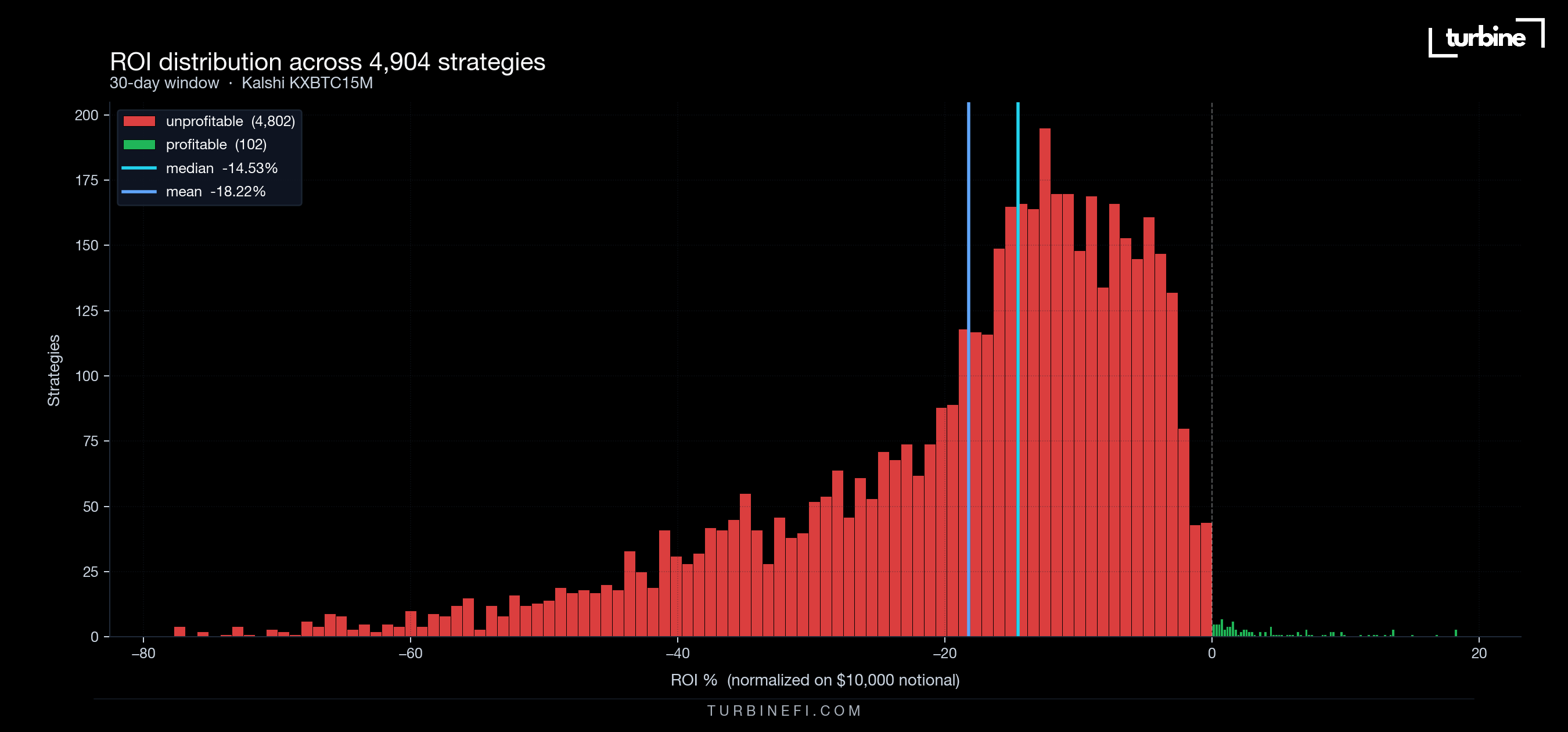
Out of 4,904 strategies, 102 made money. 4,802 did not. Median ROI was -14.53% on a $10,000 notional. The best strategy returned +18.32%. The worst returned -77.73%.
This is a one-sided distribution. There is no heavy right tail. There is one tight cluster of winners at the top, and a giant red wall everywhere else.
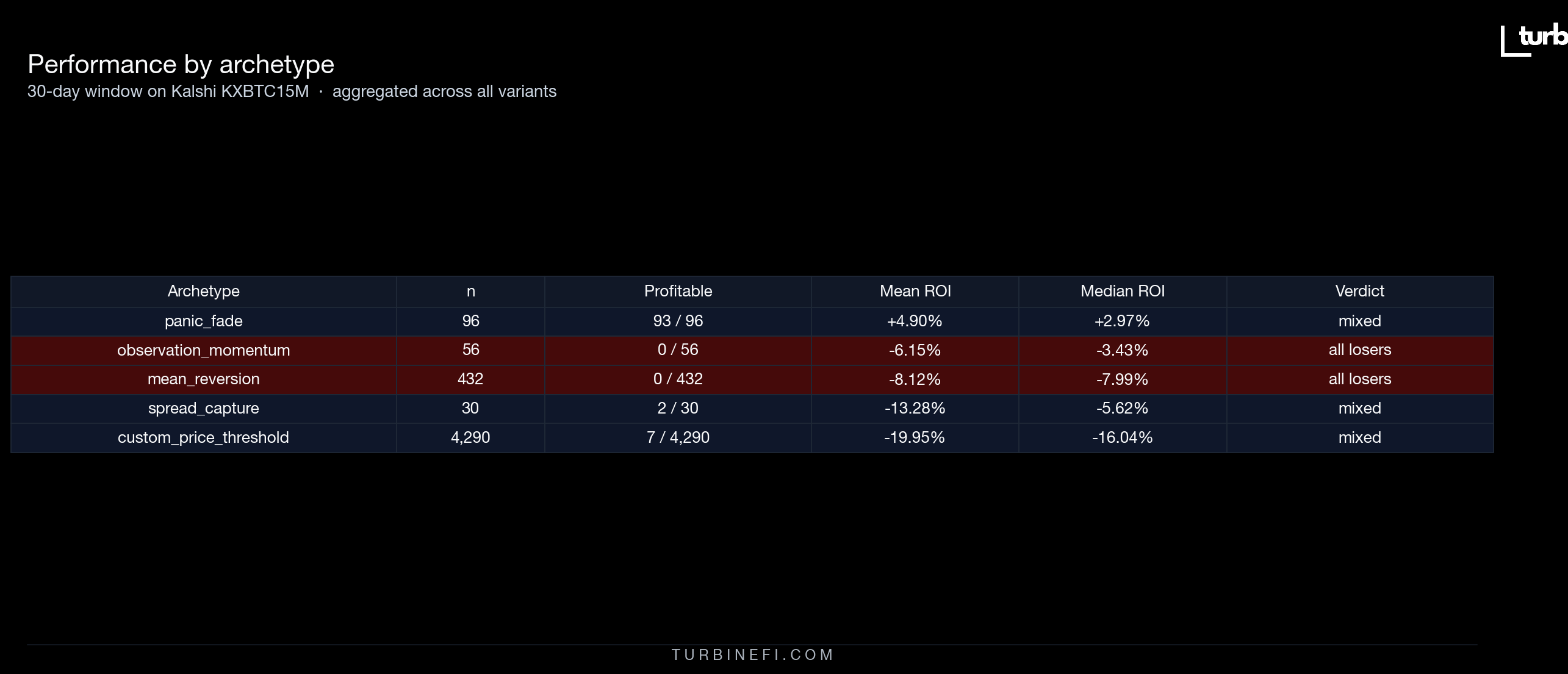
Mean reversion: 0 of 432 variants were profitable
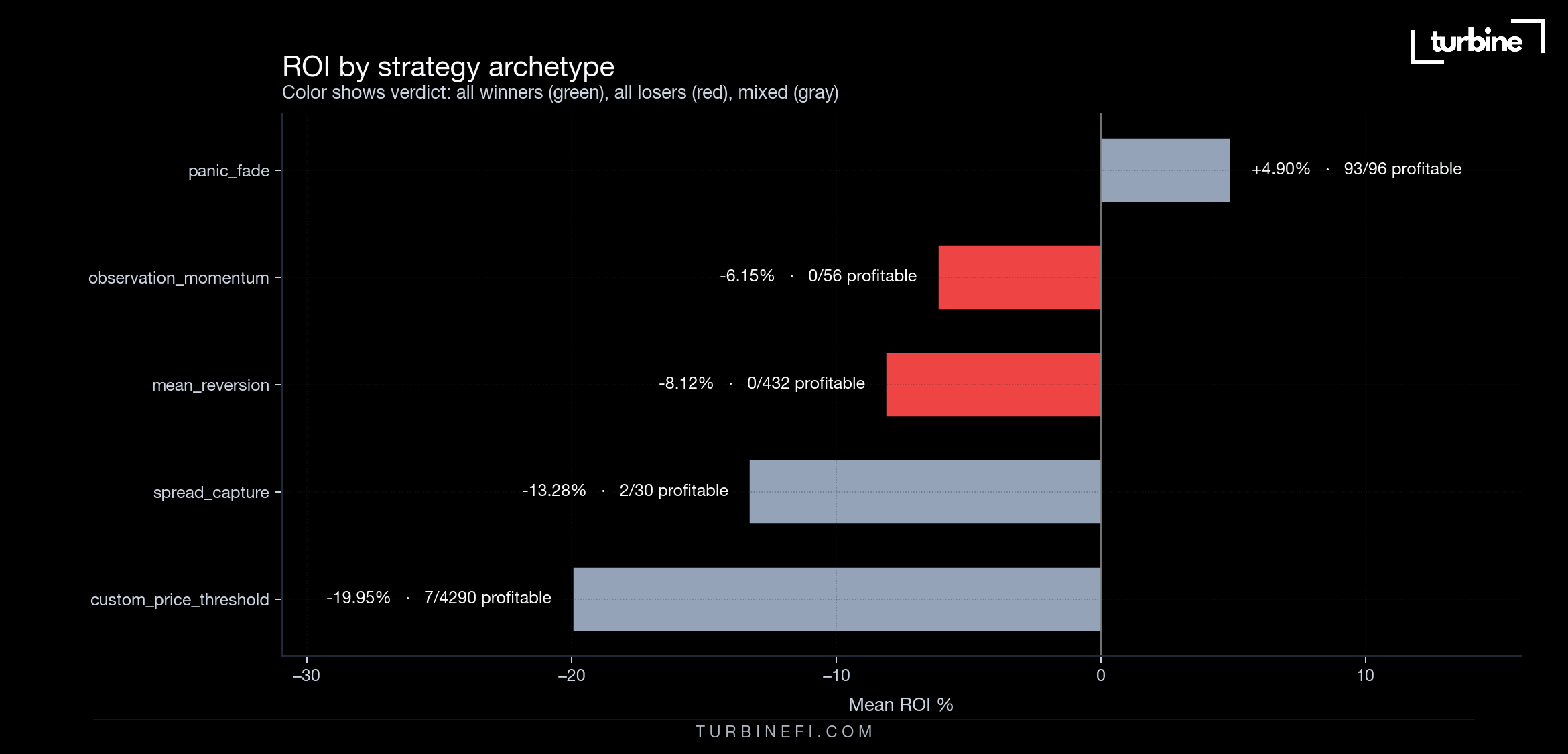
mean_reversion was 0 for 432. Not a single variant made money. We tested entry bands from 0.10 to 0.40 against exits at 0.50 to 0.90, with cooldowns up to 30 minutes. Mean ROI -8.12%. Best variant -1.29%. Worst -14.26%.
One possible explanation is the short time to settlement: an entry near the end of a contract leaves little time for a price recovery. This run does not isolate that explanation or establish that every mean-reversion strategy fails on 15-minute markets. It shows that these 432 parameter combinations lost money under this window and execution model.
Panic fade: 93 of 96 variants were profitable
panic_fade was 93 of 96 profitable. Mean ROI +4.90%. The 3 losers all came in at -0.12%. Best variant +18.32%, on panic_threshold=0.04 with fade_size=100.
Of the top 100 strategies in the run, 93 are panic_fade variants. The remaining 7 are custom price-threshold variants that cleared zero.
The panic-fade template takes the opposite side of a sharp price move. It was the strongest group in this sample, but three tested variants still lost money. Selecting winners from the same data used to test them does not establish an edge on new data or in live trading.
Strategy families compared
| Strategy family | Profitable / tested | Mean ROI | Best ROI | Worst ROI |
|---|---|---|---|---|
| Panic fade | 93 / 96 | +4.90% | +18.32% | -0.12% |
| Mean reversion | 0 / 432 | -8.12% | -1.29% | -14.26% |
| Custom price thresholds | 7 / 4,290 | -19.95% | Not summarized here | -77.73% |
These three families account for 4,818 of the 4,904 strategies and 100 of the 102 profitable results. Other tested families are not broken out in this table. A winning historical parameter sweep is not proof of an edge on unseen data.
The Top 10 Were All the Same Parameter
Look at the top of the leaderboard:
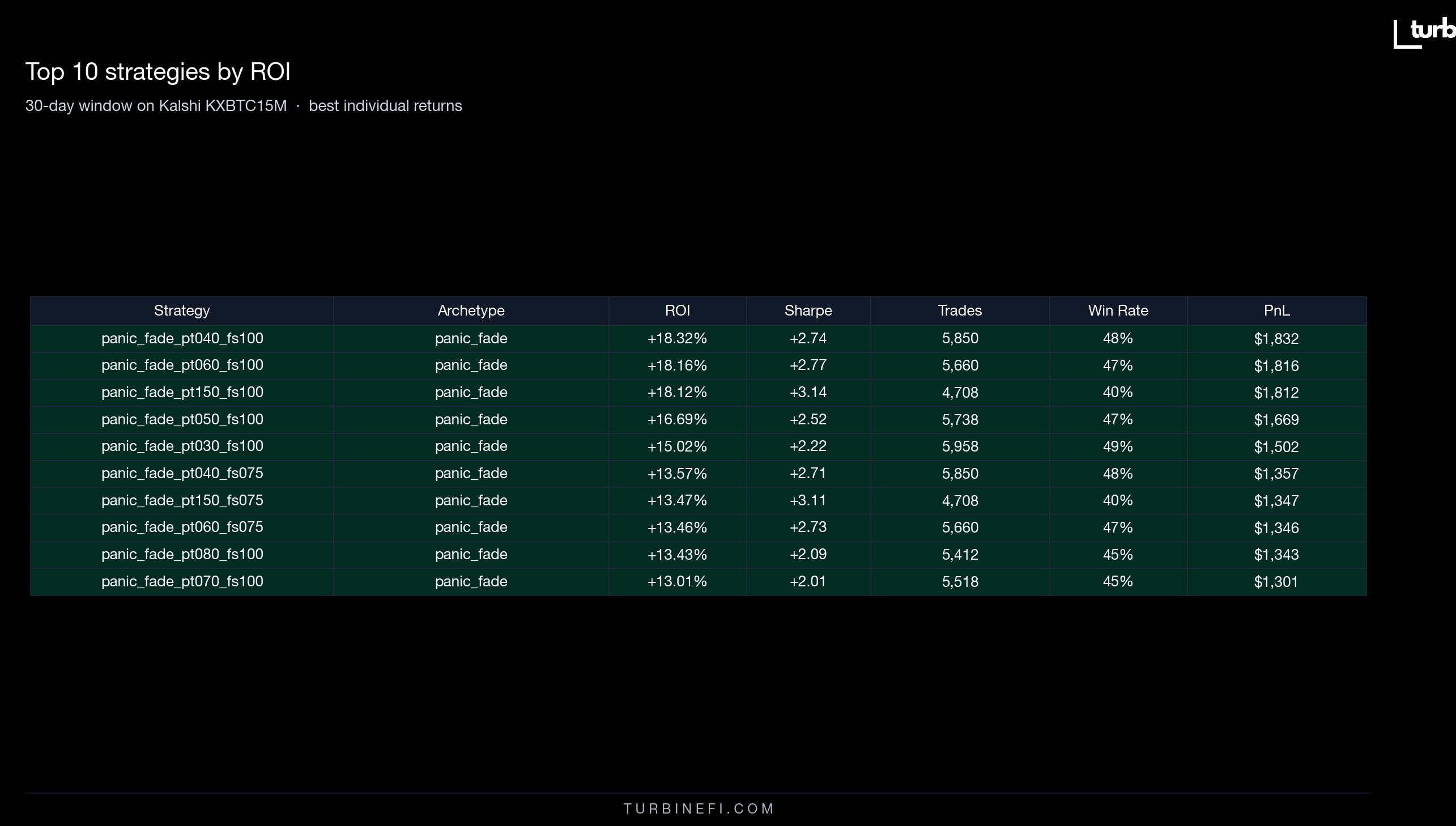
Every one is panic_fade. Every one used fade_size=100. The panic_threshold ranges from 0.03 to 0.15.
The larger tested sizes produced higher returns in this sample. Returns were normalized to a fixed $10,000 notional, so a higher return at a larger size does not by itself demonstrate better risk-adjusted performance. This leaderboard is not evidence that increasing position size improves a strategy's edge or that those sizes would fill in live trading.
Why the April 20 and April 29 results differ
The earlier research run on this series had custom price-threshold strategies (buy YES at price X, sell at price Y) at the top of the leaderboard. The single best strategy was buy at 0.50, sell at 0.70. It returned +56.6% on a 30-day window ending 2026-04-20, under the earlier execution assumptions.
This run, with a 30-day window ending 2026-04-29, the same archetype is 7 of 4,290. 0.16% hit rate. Mean ROI -19.95%. Worst variant -77.73%.
Nine days of data shifted into the window and nine shifted out. Liquidity, fee handling, and fill timing also changed. To separate the effect of the market window from those modeling changes, we would need to rerun both windows under identical assumptions. This study does not provide that comparison.
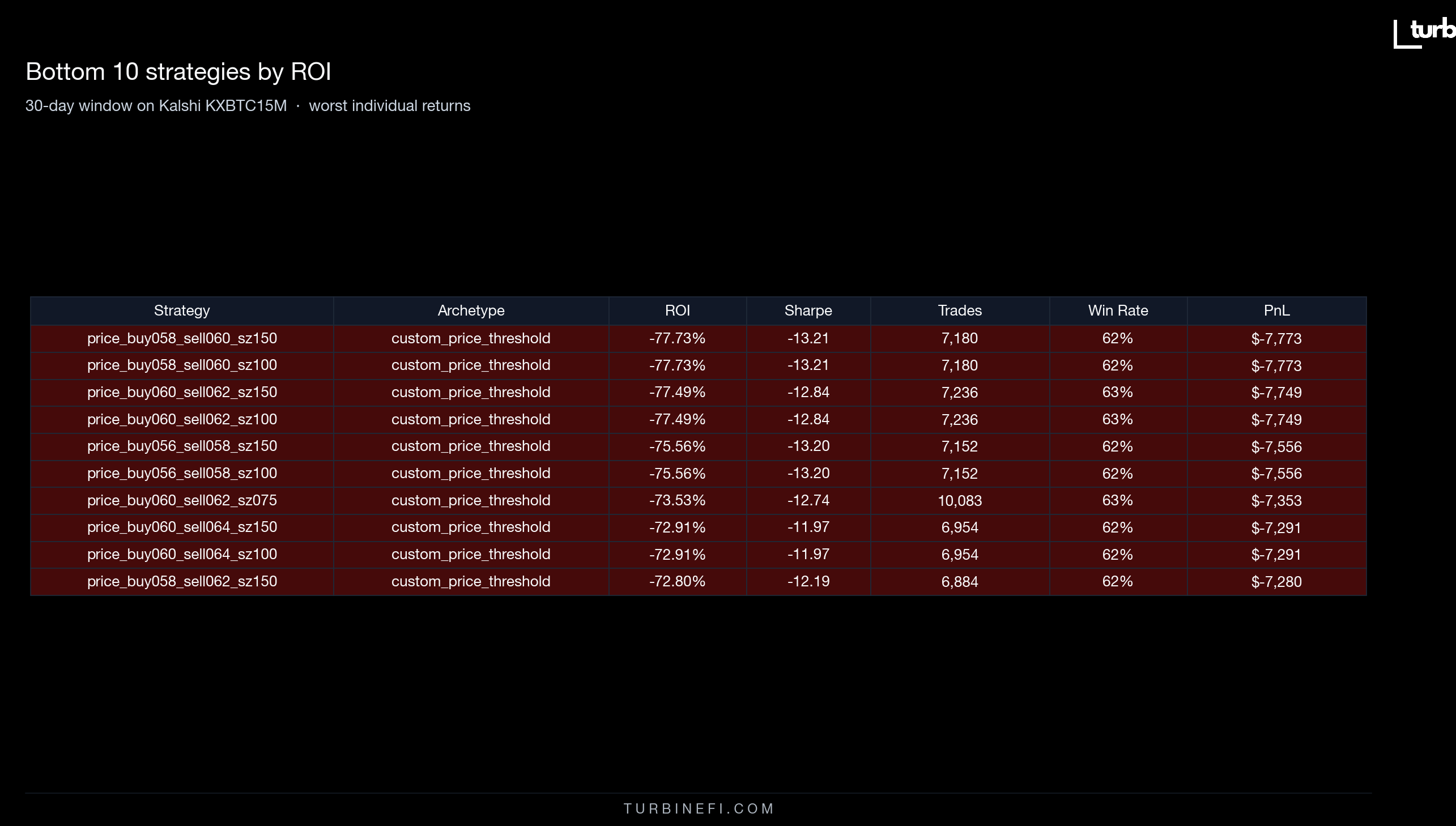
The bottom 10 strategies in this run are all tight-band price-threshold variants: buy at 0.58 and sell at 0.60, or buy at 0.60 and sell at 0.62. They had more than 7,000 trades each and 62–63% win rates, yet lost roughly 75–78% on the normalized notional. A high win rate was not enough to produce a positive net result. Narrow targets and high turnover make fees and execution assumptions especially important to inspect.
What this study tells you about a Kalshi Bitcoin strategy
- Most tested strategies lost money: 4,802 of 4,904 in this sample.
- Panic fade was the strongest group in the April 29 window. Its ranking needs testing on data that was not used to select the winners.
- All 432 tested mean-reversion variants lost money. That is a finding about this parameter sweep, not every possible mean-reversion strategy.
- Win rate alone hid large losses in the tight-band strategies. Net returns, drawdowns, fees, and fill assumptions belong in the same review.
- Changing the execution model can change the result. Compare strategies under consistent assumptions before drawing conclusions about market regimes.
How We Ran It
All 4,904 strategies were generated deterministically from a parameter sweep, submitted to the production Turbine backtest API, and pulled back as a flat results file. Total wall time: 58 minutes for 41.8 million trades, on a 4-worker batch runner. You can browse the strategies and the underlying execution model in the Turbine Studio strategies tab under crypto.
To test your own rules, open Turbine Studio and describe the market, entry, exit, and position limit in plain English. Review the generated strategy, run a backtest where historical data is supported, and inspect trades and drawdown alongside the return. Use a separate test window to check whether a result survives beyond the data used to choose it.
For the build-to-deployment workflow, see prediction market trading bots without coding.
Caveats
This study covers one 30-day window ending April 29, 2026, and one series (KXBTC15M). A different window, series, or execution model may produce a different leaderboard. The reported results do not include an independent holdout test of the winning strategies.
ROI is normalized on a $10,000 notional. Read the percentages as simulated P&L divided by $10,000, not as a guarantee of returns on a live account. Rankings reflect the tested parameters and execution assumptions, including differences in position size.
Backtests use historical orderbook snapshots. Live execution faces slippage, venue interruptions, and changing liquidity. The simulation cannot establish that orders would fill as modeled. Past performance, hypothetical or real, does not predict future performance.
Disclaimer
This post is for informational and educational purposes only. It is not investment advice, a recommendation to trade, or a solicitation to buy or sell any financial product, contract, or instrument. Turbine is not a registered investment adviser, broker-dealer, commodity trading advisor, or commodity pool operator.
The results described are from a backtest: a simulation of how strategies would have performed against historical orderbook data over a specific window on a single market series. Kalshi contracts are regulated by the U.S. Commodity Futures Trading Commission.
Hypothetical and simulated performance results have inherent limitations. They are prepared with the benefit of hindsight, do not involve real capital at risk, and cannot fully account for the impact of execution, liquidity, fees, or changes in market conditions. No representation is being made that any strategy will or is likely to achieve profits or losses similar to those shown.
Past performance, whether actual or hypothetical, is not indicative of future results. Trading prediction-market contracts involves substantial risk, including the possible loss of the entire amount invested.
Strategies described here were built and backtested by the author for research. Turbine does not recommend any of these strategies for use.
You are solely responsible for any decisions you make. Before trading any product, consider your financial situation and risk tolerance, and consult a qualified professional. Do not rely on anything in this post as the basis for a trading decision.