Is There a Bot That Can Backtest Strategies on Kalshi and Polymarket? (2026)
 Ryan Bajollari
Yes — backtesting bots for Kalshi and Polymarket exist. Here's what to look for in fill simulation, fee modeling, event normalization, and deployment.
Backtesting prediction market strategies requires historical data replay, fill simulation, and cross-platform event matching—capabilities that only a handful of specialized bots provide for Kalshi and Polymarket in 2026.
TL;DR
Yes, several tools backtest strategies on Kalshi and Polymarket. TurbineFi supports Kalshi replay broadly and Polymarket replay where historical L2 archive coverage is available; Polymarket US backtesting is not available yet.
TurbineFi backtests include historical replay, Kalshi fee modeling, spread-aware top-of-book fills, and L2 depth-aware fills where archive data is available. Reported metrics are simulated and should not be treated as live-performance forecasts.
Cross-platform arbitrage captured $40 million in profits on Polymarket alone between April 2024 and April 2025, with typical returns of 1.5% to 4.5% per trade [6].
Open-source alternatives exist—the OctagonAI kalshi-trading-bot-cli has 240 stars and supports strategy definition via natural language [3].
Real backtesting requires event normalization, fee and fill assumptions, data-window discipline, and survivorship-bias checks. TurbineFi exposes the execution assumptions it models, but it does not fully model live queue position, venue latency, or future liquidity.
Short answer: Yes. There are several open-source and commercial options that can backtest strategies across Kalshi and Polymarket, though they vary in maturity and ease of use [1][2]. The prediction market landscape grew 4x in 2025, hitting $63.5 billion in volume, and bots now dominate execution—14 of the top 20 most profitable Polymarket wallets are automated [6]. If you're building systematic strategies, the question isn't whether backtesting exists; it's which tool gives you the most realistic simulation before risking capital. TurbineFi addresses this gap with purpose-built backtesting infrastructure for Kalshi and supported Polymarket markets, including historical replay, fee-inclusive P&L calculation where fees are modeled, and a path from simulated review to live deployment. This guide breaks down what's available, how cross-platform backtesting actually works, and what to evaluate when choosing your stack.
What Does 'Backtest' Actually Mean for Prediction Markets?
In traditional finance, backtesting means replaying historical price data to see how a strategy would have performed. Prediction markets add complexity: binary outcomes, event-specific resolution, platform-specific fee structures, and cross-venue pricing fragmentation. A true backtest must simulate order execution using historical order book states, account for slippage and partial fills, and model venue-specific settlement rules.
TurbineFi backtests replay a 30-day window of Kalshi 1-minute OHLC candles, evaluating strategy rules once per minute. Signals from one candle can fill no earlier than the next tradable candle, and taker fills use top-of-book bid/ask prices with Kalshi-style fees modeled explicitly. Simulated P&L is net of fees, and backtests report Sharpe ratio, win rate (e.g., 85.9% over 74,789 trades), and max drawdown. This methodology avoids look-ahead bias, but the metrics remain simulated: live fills, queue position, latency, fees on unsupported venues, and future liquidity can all differ.
Most live-only bots skip historical replay entirely. The OctagonAI kalshi-trading-bot-cli, for example, focuses on real-time execution with 168 commits and active development as of April 2026 [3], but its primary mode is forward-looking signal generation rather than historical validation. Similarly, the ryanfrigo kalshi-ai-trading-bot (384 stars) includes paper trading with signal tracking but emphasizes live decision-making over rigorous backtest infrastructure [5]. For traders who want statistical confidence before deploying capital, this gap matters.
Can You Backtest Strategies on Kalshi?
Yes—Kalshi provides API access to historical market data, and TurbineFi is purpose-built to consume it. Kalshi processed $23.8 billion in trading volume in 2025, a 1,108% year-over-year increase, with free API access for every verified user [6]. The exchange publishes explicit fee schedules (typically 7% × p × (1−p) for takers), which TurbineFi models directly in backtest simulations. This level of transparency is critical: knowing your fee drag before live trading separates profitable strategies from those that look good on paper but fail in production.
TurbineFi backtests on Kalshi support BTC 15-minute markets (KXBTC15M), weather contracts, and other event series. A documented spread capture strategy generated +$289 in simulated P&L with a Sharpe ratio of 23.77 and win rate of 85.9% over 74,789 trades. These are hypothetical simulations: they are the result of running strategy rules against historical data with explicit, limited fill assumptions. The platform also includes a demo environment for paper trading before capital deployment, addressing the research-to-deployment gap that forces most traders to choose between backtesting in isolation or going live blind.
Historical Data Depth and Granularity
Kalshi's API provides access to OHLC candles at 1-minute resolution, which TurbineFi uses for one-minute replay. The default 30-day window can help strategies warm up indicators and evaluate recent behavior, but it is not a substitute for out-of-sample validation. For longer-term event contracts (election markets, economic data releases), backtesting requires event-level historical snapshots rather than continuous price feeds—a capability TurbineFi is expanding to cover macro and political markets in addition to crypto and weather.
Can You Backtest Strategies on Polymarket?
Polymarket backtesting is less mature than Kalshi, but TurbineFi can replay supported markets where PMXT historical L2 archive coverage is available; otherwise it fails closed instead of pretending a backtest exists. Polymarket operates on Polygon with on-chain settlement, meaning historical order book states and trade data are publicly accessible via blockchain explorers and the CLOB API. However, Polymarket lacks the first-party data infrastructure Kalshi provides, so backtesting typically requires scraping historical snapshots or using third-party archives.
The realfishsam prediction-market-arbitrage-bot demonstrates one approach: it uses pmxt (a unified API wrapper for prediction markets) to fetch real-time pricing from both Kalshi and Polymarket, identify cross-platform spreads, and execute rotational arbitrage [6]. While the bot is optimized for live trading, the same data-fetching logic could be adapted for historical replay if Polymarket CLOB snapshots are archived. Arbitrage traders using this approach captured spreads ranging from 1.5% to 4.5% per trade on high-volume events, with profits compounding weekly rather than waiting for event expiration.
TurbineFi supports Polymarket replay for covered markets, but cross-platform arbitrage backtesting is not part of Arbitrage v1. Arbitrage users should still model fees, leg risk, failed fills, latency, and settlement differences explicitly before deploying live capital.
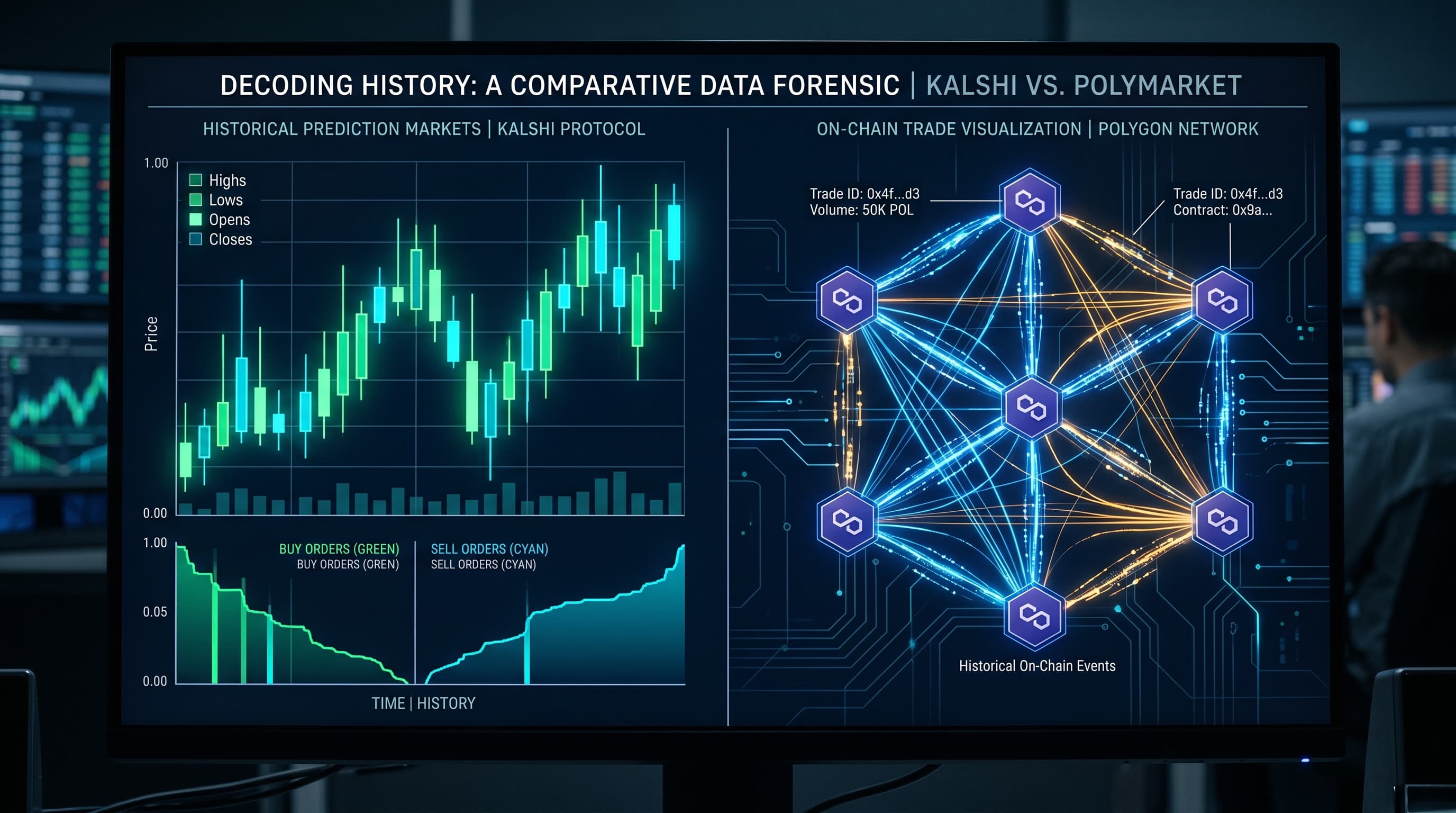
Cross-Platform Backtesting: Kalshi vs. Polymarket Feature Comparison
| Feature | TurbineFi | Open-Source Bots | Custom-Built Solutions |
|---|---|---|---|
| Kalshi Backtesting | ✅ Native 1-min OHLC replay, 30-day windows, fee modeling | ⚠️ Paper trading only (ryanfrigo bot [5]) | ✅ Possible with API + data pipeline |
| Polymarket Backtesting | ✅ Supported where PMXT L2 archive coverage exists; no Polymarket US backtests yet | ❌ Live execution focus | ✅ Requires CLOB snapshot archive |
| Cross-Platform Arbitrage | ⚠️ Live deployment workflow with explicit fee inputs; Arbitrage v1 does not run backtests | ✅ pmxt wrapper (realfishsam [6]) | ⚠️ High engineering overhead |
| Historical Data Access | ✅ Integrated Kalshi API and PMXT archives where covered | ⚠️ Manual API calls required | ✅ Full control, high maintenance |
| Slippage & Fill Modeling | ✅ Top-of-book bid/ask plus depth-aware fills where L2 exists; no queue-position or latency model | ❌ Typically mark-price only | ✅ Configurable (if built) |
| Deployment Path | ✅ Backtest review → optional demo/small live deployment workflow | ⚠️ Separate tools for each stage | ✅ Custom workflow |
TurbineFi's approach unifies backtesting, paper trading, and live execution in a single platform. A user can describe a strategy in plain English, backtest it against supported historical data, inspect the assumptions, and then choose whether to deploy live without rewriting the strategy from scratch. Open-source alternatives like the OctagonAI CLI [3] require manual integration of separate backtesting scripts, live trading modules, and risk controls, which adds 75–150 hours of development time for a basic bot [6].
What to Evaluate in a Prediction Market Backtesting Bot
1. Event Normalization Across Venues
Kalshi and Polymarket structure identical events differently: contract naming, strike prices, expiration timestamps, and resolution sources vary. A bot that backtests cross-platform strategies must map equivalent events, align UTC timestamps, and handle resolution discrepancies (e.g., Kalshi using CFTC-approved sources vs. Polymarket using UMA oracles). TurbineFi handles some venue-specific normalization for supported workflows; custom cross-venue systems still require careful event taxonomy mapping and maintenance as platforms evolve.
2. Order Book Reconstruction and Fill Simulation
Realistic backtesting simulates fills using historical order book depth, not just mark prices. TurbineFi models taker fills at top-of-book bid/ask with Kalshi fees, and can use depth-aware fills where L2 archive data is available. Queue position, venue latency, and future liquidity are not fully modeled. This transparency is critical—overfitting to mark-price backtests creates strategies that fail under real market microstructure. Bots that ignore slippage and liquidity constraints produce inflated backtest returns that vanish in live trading.
3. Fee Modeling and Cost Transparency
Kalshi charges explicit per-contract fees (7% × p × (1−p)), while Polymarket embeds costs in the bid-ask spread plus minimal Polygon gas fees. A backtest that ignores fees will show 2–5% higher returns than reality. TurbineFi includes Kalshi-style fees in simulated Kalshi trades, so reported P&L is net of modeled fees; live execution can still differ because of fills, latency, liquidity, and venue-specific costs. Open-source bots typically omit fee modeling or require manual configuration, which leads to costly surprises when strategies go live.
4. Out-of-Sample Validation and Overfitting Controls
Backtests trained on the same data they're tested against produce overfitted strategies that fail on unseen markets. Rigorous validation splits historical data into training and testing windows, or uses walk-forward analysis where the strategy is re-optimized periodically. TurbineFi's standard Studio flow is a single recent-window backtest, typically 30 days. True out-of-sample or walk-forward validation requires rerunning on separate windows or doing additional analysis outside the default UI. Custom bots require implementing these controls manually—a step most traders skip, leading to strategy decay within weeks of deployment.
How TurbineFi Simplifies Cross-Platform Backtesting
TurbineFi supports Studio backtesting on Kalshi and supported Polymarket markets, then lets users inspect the result before live deployment. Instead of building separate data pipelines, backtesting scripts, and execution engines, users describe strategies in natural language and TurbineFi generates the full stack: backtest simulation with fee-inclusive P&L where fees are modeled, assumption review, and live bot deployment.
A documented example shows how TurbineFi users running 15-minute crypto strategies focus on direction-agnostic volatility forecasting rather than trying to predict BTC price direction [6]. By backtesting implied-volatility-style rules against historical Kalshi data, users can inspect whether a thesis appeared to work across repeated short-dated contracts. The Studio overview explains the public build, backtest, and run workflow without requiring traders to operate low-level execution infrastructure.
For traders evaluating whether to build custom backtesting infrastructure or use TurbineFi, the trade-off is clear: building from scratch takes 75–150 hours of API integration, order management, risk controls, and deployment infrastructure. TurbineFi can compress the path from strategy description to an inspectable bot and live deployment workflow to minutes, assuming credentials and market access are ready.
Conclusion
Yes—bots that backtest strategies across Kalshi and Polymarket exist, but most require significant engineering effort to build or lack the depth needed for rigorous validation. TurbineFi stands out by offering native Kalshi backtesting, supported Polymarket replay, fee-inclusive P&L simulation where fees are modeled, and an inspectable path from backtest review to live execution. With prediction market volume hitting $63.5 billion in 2025 and bots capturing $40 million in arbitrage profits, systematic traders need infrastructure that validates strategies before risking capital. Open-source tools like the OctagonAI CLI [3] and ryanfrigo bot [5] provide foundations for custom builds, but TurbineFi eliminates the 75–150 hour development overhead while delivering reproducible simulated metrics that users can compare against live performance over time. Whether you're testing volatility strategies on 15-minute BTC contracts or cross-platform arbitrage on election markets, the right backtesting bot turns prediction market trading from a pure hunch into a testable, auditable workflow.
Ready to backtest your first prediction market strategy? Start with TurbineFi's trial and treat the result as evidence to review, not proof of future profits.