How to Backtest Prediction Market Strategies Before Risking Real Money
 Ryan Bajollari
84% of prediction market traders lose money. Backtesting can change that. Learn where to get historical data, avoid common pitfalls, and validate strategies on Kalshi.
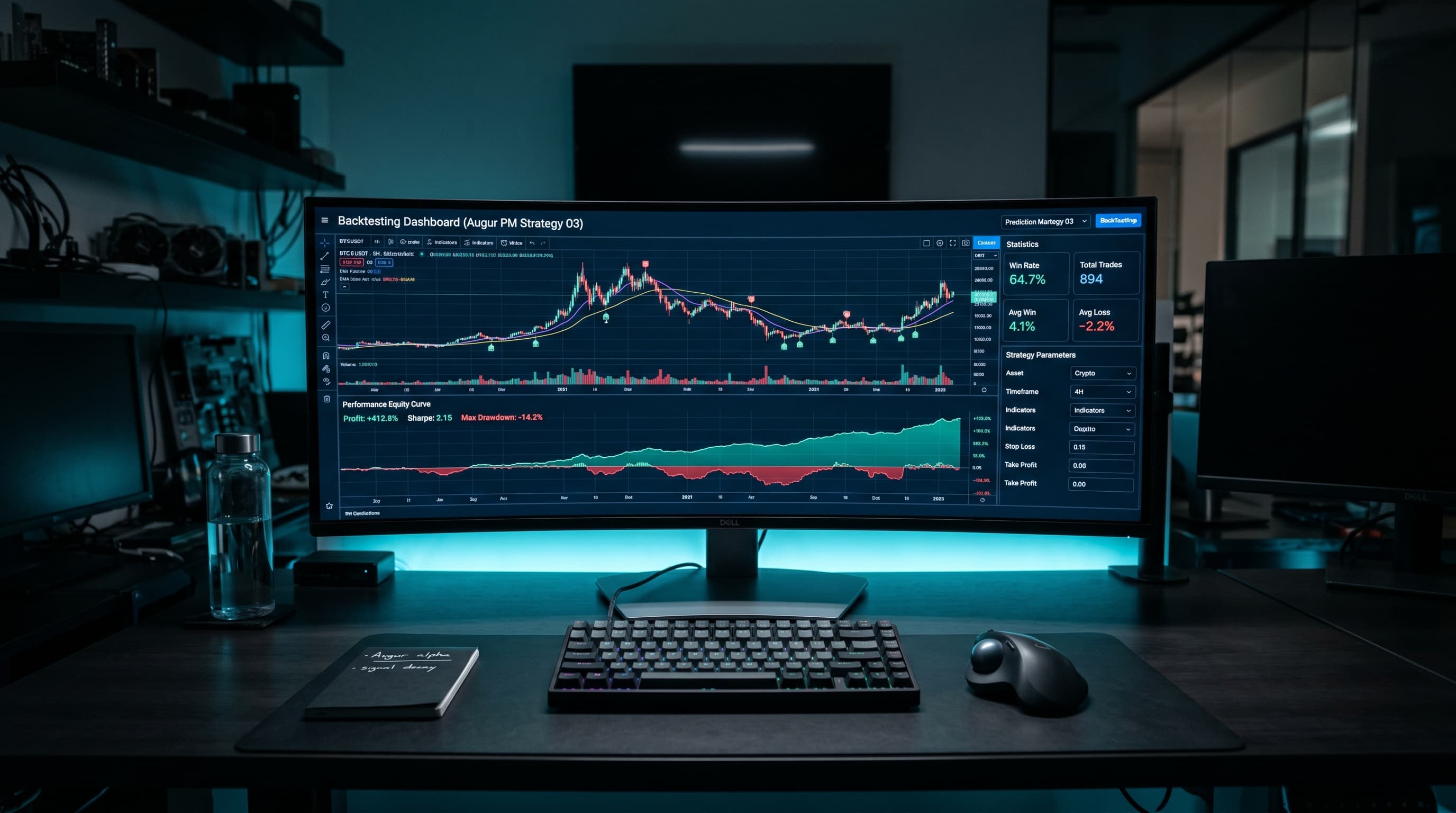
Here's a stat that should make you pause: 84.1% of Polymarket traders have not turned a profit (CryptoNews / Sergeenkov, 2026). A separate blockchain analysis found that fewer than 0.04% of addresses captured over 70% of all realized profits — roughly $3.7 billion collectively (Yahoo Finance / DeFi Oasis, 2025).
Most traders jump in with a "strategy" that's actually just a hunch. They lose money. They blame the market. What they never did was test whether their approach actually works on historical data before putting real capital behind it.
That's what backtesting is for. And in prediction markets, almost nobody does it — because until recently, nobody had the tools or the data. That's changed.
For concrete examples, browse Turbine's library of backtested prediction-market strategies — a curated, ranked set, each page showing the full methodology, the strategy's rules, and its simulated PnL, Sharpe, win rate, and drawdown.
Key Takeaways
- 84.1% of prediction market traders lose money, but the top 0.04% capture 70%+ of profits — the difference is systematic strategy (CryptoNews, 2026)
- Live trading typically delivers 60-70% of backtested performance after slippage, fees, and liquidity constraints
- Kalshi's API provides historical trades and candlestick data, while true historical depth replay usually requires captured snapshots or third-party archives
- Turbine Studio includes built-in backtesting so you can validate strategies and deploy them as live bots without writing code
Why Do 84% of Prediction Market Traders Lose Money?
Academic research from HEC Montreal and the University of Toronto analyzed prediction market outcomes and found that the top 1% of users capture 84% of all gains, while the top 0.1% capture roughly 60% (Akey, Gregoire, Harvie, Martineau / SSRN, 2026). This isn't a fair fight — it's a small group of systematic traders extracting value from everyone else.
Why? The winning traders have three things the losers don't:
Data-driven strategies. They don't trade on gut instinct. They have a quantifiable thesis — "buy weather YES contracts when NOAA probability exceeds market price by 8%+" — and they test it before risking capital.
Position sizing discipline. They use Kelly criterion or fractional Kelly to size each trade based on edge confidence. They don't bet half their bankroll on one contract because it "feels right."
Execution speed. Many are automated. 14 of the top 20 most profitable wallets on Polymarket are bots (Finance Magnates, 2026). But before those bots went live, someone tested the logic against historical data.
Backtesting is the foundation of all three. You can't size positions correctly without knowing your win rate. You can't automate a strategy you haven't validated. And you definitely shouldn't risk real money on a thesis you haven't stress-tested.
If you're new to prediction markets and want the fundamentals first, start with our beginner's guide to prediction markets.
What Is Backtesting and Why Does It Work Differently for Prediction Markets?
Backtesting is running your trading strategy against historical data to see how it would have performed. In stock markets, this is standard practice. In prediction markets, almost nobody does it — which is exactly why it's such an advantage if you do.
But prediction market backtesting isn't the same as stock backtesting. There are three critical differences:
Binary Payoffs
Stock backtests model continuous price movement. Prediction market contracts resolve to exactly $0 or $1. Your backtest needs to simulate binary outcomes, not price curves. A strategy that's profitable 55% of the time at an average entry of $0.45 is wildly different from one that's profitable 55% of the time at $0.85.
Event Expiration
Every prediction market contract has an expiration. Liquidity evaporates as expiry approaches, spreads widen, and your ability to exit changes dramatically. Your backtest needs to model this liquidity curve, not assume constant liquidity.
Regime Changes
Prediction markets are event-driven. An election market behaves completely differently before vs. after a debate. A weather market shifts when NOAA updates its models. Your backtest needs to account for these regime changes or it'll overfit to conditions that won't repeat.
Key insight: The Bocconi Students Investment Club backtested prediction market strategies on Polymarket crypto contracts and achieved a 58.5% hit ratio using geometric Brownian motion models. But they found that orders above three figures moved market spreads significantly (BSIC, 2025). Liquidity constraints are the #1 reason backtests overstate real performance in prediction markets.
Where Do You Get Historical Prediction Market Data?
Kalshi's API provides historical trade data and candlestick data at 1-minute, 1-hour, and 1-day intervals (Kalshi API Docs, 2026). This is the primary built-in data source for Kalshi-focused backtesting; true historical depth replay usually requires captured snapshots or a third-party archive.
Here's the full landscape:
Kalshi API (Free)
The official API gives you historical trades, OHLCV candlesticks at multiple timeframes, and live orderbook access. It's rate-limited but free for all verified users. Kalshi also rolled out fractional trading in March 2026, which changes position sizing dynamics.
PMXT Archive (Free)
The PMXT community archive provides hourly orderbook snapshots for both Polymarket and Kalshi in Parquet format (archive.pmxt.dev). Great for cross-platform backtesting and arbitrage strategy validation.
PolyBackTest (Free to $35/mo)
A dedicated prediction market backtesting platform with AI-powered strategy generation. The free tier has limited features, Pro runs $19.90/mo for the data API, and the AI Plan at $35/mo includes roughly 100 backtests per month (PolyBackTest, 2026). Currently limited to Polymarket BTC/ETH/SOL crypto contracts.
Turbine Studio (Built-In)
Turbine Studio includes integrated backtesting as part of the bot-building workflow. Describe your strategy, backtest it against Kalshi historical data, review the results, and deploy as a live bot — all without leaving the platform. No separate data pipeline needed. No coding required. This is the fastest path from idea to validated, running strategy.
From our experience: Most traders spend weeks setting up backtesting infrastructure — pulling data, cleaning it, writing simulation logic, handling edge cases. By the time they start actually testing strategies, they've burned their motivation. Turbine Studio's built-in backtester exists because we saw this pattern killing promising traders before they even placed their first trade.
For more on the tools available to prediction market traders, check our guide on 5 strategies you can automate today.
What Are the Common Backtesting Pitfalls in Prediction Markets?
Live trading typically delivers just 60-70% of backtested performance after accounting for real-world factors (LuxAlgo, 2025). Backtest Sharpe ratios above 3.0 often turn negative in live trading (PickMyTrade, 2025). Here's why — and how to avoid each pitfall.
Overfitting (The Silent Killer)
You test 200 parameter combinations and pick the one that performed best on historical data. Congratulations — you've probably found noise, not signal. In-sample Sharpe ratio correlates with out-of-sample performance at below 0.05. That's essentially random.
Fix: Use walk-forward analysis. Split your data into in-sample (training) and out-of-sample (validation) windows. Only trust strategies that perform on data they weren't trained on.
Liquidity Illusion
Your backtest assumes you can buy 500 contracts at $0.48. In reality, the orderbook has 50 contracts at $0.48, then 100 at $0.49, then 200 at $0.50. Your actual average fill price is $0.49 — and that 1 cent kills your edge.
Fix: Model realistic slippage. Realistic slippage trims simulated returns by 0.5-3% per year (LuxAlgo, 2025). Use historical depth snapshots when you have them; otherwise use a conservative top-of-book model and label the limitation clearly.
Survivorship Bias
Survivorship bias inflates backtest returns by 4-6% annually in traditional markets (LuxAlgo, 2025). In prediction markets, this manifests as only testing strategies on contracts that had healthy volume — ignoring the illiquid ones where your bot would have gotten stuck.
Fix: Include low-liquidity markets in your test universe. If your strategy only works on the top 10% most liquid contracts, you need to know that before going live.
Ignoring Event-Driven Regime Shifts
A strategy that works brilliantly during football season may crater during the offseason. Political market strategies that print money during election years may lose consistently in off-cycle years.
Fix: Test across multiple time periods and event types. If your strategy only works in one regime, you don't have a strategy — you have a coincidence.
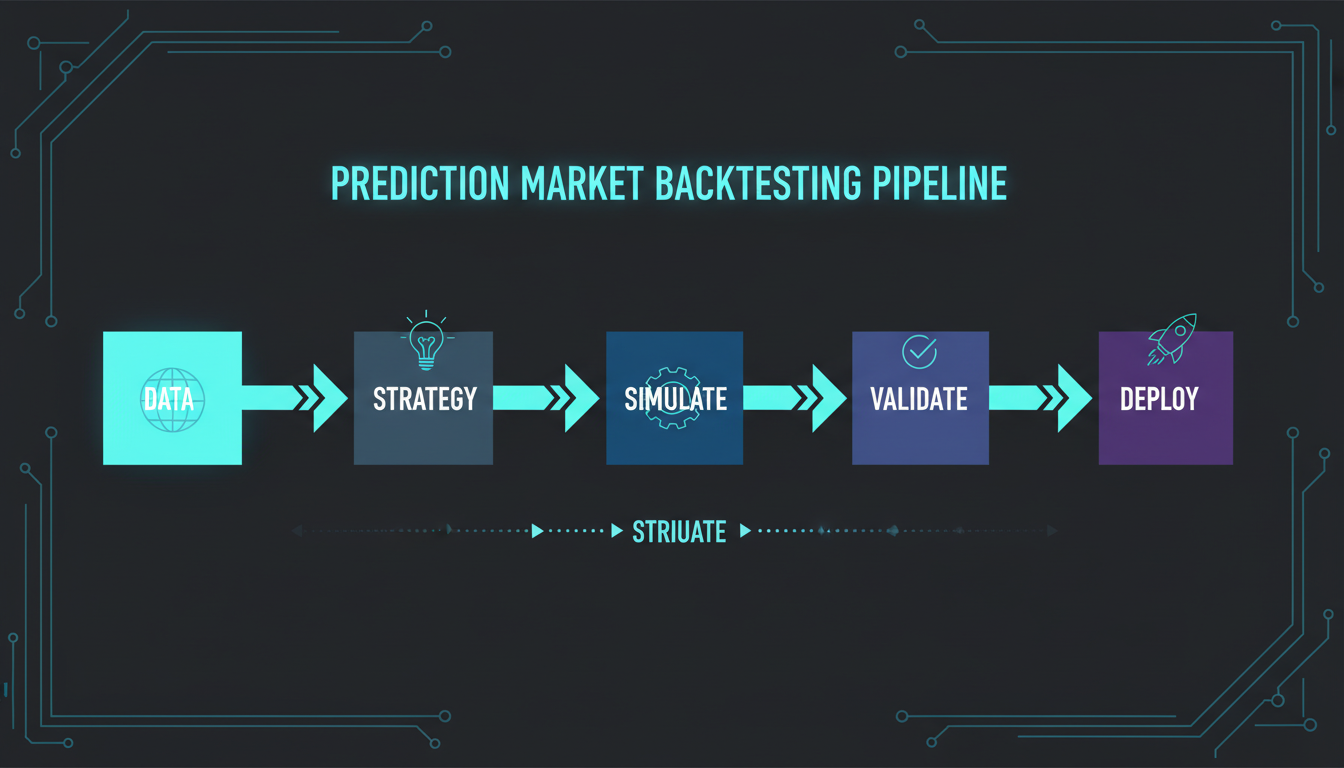
How Do You Actually Run a Prediction Market Backtest?
The prediction market backtesting landscape has matured significantly in 2026. Monthly market volume grew from under $100 million in early 2024 to over $16.8 billion by February 2026 (TradeTheOutcome, 2026), which means there's now enough historical data to run meaningful backtests. Here's the step-by-step process.
Step 1: Define Your Strategy in Testable Terms
"Buy underpriced contracts" isn't testable. "Buy YES on Kalshi weather contracts when market price is 10+ cents below NOAA GFS ensemble probability, exit at expiry" is testable. Write down your entry rules, exit rules, and position sizing formula before you touch any data.
Step 2: Pull Historical Data
Use Kalshi's API for candlestick and trade data. For orderbook depth, use PMXT archive snapshots. Define your test period — at least 6 months of data for weather strategies, at least one full election cycle for political strategies.
Step 3: Split Train vs Test
Use the first 60-70% of your data as the training set and the remaining 30-40% as the out-of-sample test. Never optimize parameters on the test set. If you catch yourself going back to tweak something after seeing test results, you've compromised the split.
Step 4: Simulate Fills Realistically
Don't assume market orders fill at the quoted price. Model slippage based on historical orderbook depth when available, or at least bid/ask execution when depth replay is unavailable. Apply Kalshi's current fee schedule rather than assuming zero fees.
Step 5: Measure the Right Metrics
Win rate alone is meaningless. Track: Sharpe ratio, maximum drawdown, profit factor, average win vs average loss, longest losing streak, and time in drawdown. A strategy that wins 80% of the time but loses 5x per loss what it gains per win is a disaster.
Step 6: Go Live (Small)
Once your strategy passes out-of-sample validation, deploy it with 5-10% of your intended capital. Run it live for 2-4 weeks alongside your backtest to confirm that live performance tracks within 60-70% of backtested results. Only scale after validation.
Or — skip Steps 2-5: Turbine Studio handles data sourcing, simulation, and metrics out of the box. Describe your strategy logic, run the built-in backtest against Kalshi historical data, review the performance dashboard, and deploy as a live bot. One platform, no pipeline assembly required.
For a deeper look at what strategies are worth testing, see our guide to how to make money on prediction markets. And if you want to understand how the top performers are automating their execution, read our prediction market arbitrage deep-dive.
Frequently Asked Questions
How much historical data do you need to backtest a prediction market strategy?
At minimum, 6 months of data for high-frequency strategies (weather, daily crypto) and one full event cycle for lower-frequency strategies (elections, season-long sports). Kalshi's API provides data back to 2021, and the industry generated $63.5 billion in volume in 2025 alone (TradeTheOutcome, 2026), so there's no shortage of data.
What's the minimum win rate for a profitable prediction market strategy?
It depends on your average entry price. At an average entry of $0.50, you need above 50% to break even. At $0.30, you only need above 30%. The Kelly criterion helps you calculate optimal position sizing given your actual edge. Research shows misjudging edge even slightly degrades portfolio growth significantly (Meister / arXiv, 2024).
Can I backtest prediction market strategies for free?
Yes. Kalshi's API is free for all verified users and provides historical trades and candlestick data. The PMXT community archive offers free Parquet files with hourly orderbook data. Turbine Studio's backtester is available as part of the platform. PolyBackTest offers a limited free tier as well (PolyBackTest, 2026).
Why do backtested strategies fail in live trading?
Live performance is typically 60-70% of backtested results (LuxAlgo, 2025). The main culprits: slippage (orderbook depth means your fills are worse than assumed), overfitting (optimizing to historical noise), survivorship bias (only testing on liquid markets), and regime changes (strategies that worked in one event type failing in another).
What's the difference between backtesting prediction markets vs stocks?
Three critical differences: prediction markets have binary payoffs ($0 or $1, not continuous prices), event-driven expirations (liquidity evaporates near expiry), and regime-dependent behavior (election markets behave differently than weather markets). Stock backtesting frameworks don't model any of these correctly. Use prediction-market-specific tools.
Stop Guessing. Start Testing.
84% of traders lose money in prediction markets. The other 16% — and especially the top 0.04% — aren't lucky. They're systematic. They test before they trade. They size positions based on measured edge. They automate execution to remove emotion.
- Get data: Kalshi API (free), PMXT archive (free), or Turbine Studio (built-in)
- Avoid the pitfalls: Model slippage, split train/test, correct for survivorship bias
- Expect degradation: Plan for 60-70% of backtested performance in live trading
- Start small: Validate with 5-10% capital before scaling
- Automate what works: A validated strategy running as a bot captures edge humans can't
The tools exist. The data exists. The only question is whether you'll test your strategy before risking real money — or become one of the 84%.
Backtest and deploy your strategy on Turbine Studio
This post is for informational purposes only and does not constitute financial advice. Prediction market trading involves risk of loss, including total loss of invested capital. Past performance — including backtested performance — does not indicate future results.