How to Keep Your Prediction Market Bot and Funds Secure (2026)
 Ryan Bajollari
Hackers stole $713M from crypto wallets in 2025. Here's how to secure your prediction market bot's API keys, wallet approvals, and funds.
Hackers drained $713 million from personal crypto wallets in 2025 across roughly 80,000 victims (Chainalysis, 2026). That's the attack class that hits solo traders hardest.
A prediction market bot widens your attack surface. It holds API keys. It signs token approvals. It runs unattended for hours. Every one of those is a door someone can walk through.
This is a how-to for locking that down. We'll cover API key scoping, Polymarket wallet hygiene on Polygon, the scams aimed at bot operators, and the question that decides everything: who can actually move your funds.
If you're still choosing a platform, read the companion piece — Best Prediction Market Bot Platform in 2026 — which compares platforms on security. This post secures the stack you already run.
Key Takeaways
- Private key compromise caused 43.8% of all crypto stolen in 2024 — key hygiene is the highest-leverage thing you can do (Chainalysis, 2025).
- Scope API keys to trade-only, disable withdrawals, and rotate them. Over 28 million secrets leaked to public GitHub in 2025 alone.
- On Polymarket, set bounded token approvals and revoke stale ones. Wallet drainers still hit 106,000 victims in 2025.
- Ask who can move your funds. Custodial bot platforms that hold your keys are a single point of failure.
The Stakes Are Rising Faster Than the Defenses
Prediction markets aren't niche anymore. Combined monthly volume on Kalshi and Polymarket jumped from under $5 billion in September 2025 to roughly $24 billion by April 2026 (Pew Research, 2026). The money is arriving fast.
More money means bigger targets. When you automate trading, you're not just risking a bad fill. You're standing up infrastructure that holds credentials and signs transactions on your behalf.
The defensive playbook hasn't kept pace. Most "secure your trading bot" guides still cite 2022 numbers and talk only about seed phrases. Bot operators have a different threat model. Let's build for that.
1. Lock Down Your API Keys
API keys are the credential most bot operators handle carelessly. They're also the one attackers love most. Stolen credentials were the initial access vector in 22% of all breaches, and 88% of basic web-application attacks involved stolen credentials (Verizon 2025 DBIR, 2025).
The leak problem is enormous. GitGuardian detected 28.65 million new hardcoded secrets pushed to public GitHub in 2025, up 34% year over year (GitGuardian, 2026). Worse, about 64% of secrets it flagged as valid years earlier were still live when retested. Leaked keys don't expire on their own.
[UNIQUE INSIGHT] Most crypto-security advice is about wallet seed phrases. For a Kalshi bot, your API key is the seed phrase. It's the credential that authorizes trades, and on a custodial exchange it's the main thing standing between your account and a stranger.
Here's the discipline that matters:
- Scope to trade-only. Disable withdrawals. If your exchange lets you create a key without withdrawal permission, do it. A trade-only key can lose you money through bad trades — it can't drain your balance to an attacker's address.
- Never commit keys to git. Use environment variables or a secrets manager. Add
.envto.gitignorebefore your first commit, not after. - Keep keys out of Docker images. Baking a key into an image layer means it ships with every copy of that image. Pass secrets at runtime.
- Rotate on a schedule. Rotate quarterly, and immediately if a laptop is lost, a contractor leaves, or anything feels off.
- One key per bot. Separate keys per strategy or machine mean you can revoke one without taking everything down.
[ORIGINAL DATA] When we audit new Turbine Studio users migrating from DIY setups, the most common finding is a single all-permissions API key hardcoded into a script that's been pushed to a public or "private-but-shared" repo. It takes two minutes to fix and closes the biggest hole most operators have.
2. Practice Wallet Hygiene on Polymarket
Polymarket runs on Polygon, and it's non-custodial. You hold the keys and you sign the approvals. That's good for control — and it means the approval layer is now your responsibility. (New to it? Start with how to build a Polymarket trading bot without coding.)
Token approvals are the quiet killer. To trade, you grant a smart contract permission to move your USDC. Grant an unlimited approval to the wrong contract and you've handed over your balance. Wallet drainers and approval phishing stole $494 million from roughly 332,000 victims in 2024 (Scam Sniffer, 2024).
Losses dropped sharply in 2025, to $83.85 million across 106,106 victims (Scam Sniffer, 2025). That's progress, but 106,000 people still got drained. The ecosystem shifted to smaller, higher-frequency hits. It didn't go away.
Your Polygon hygiene checklist:
- Set bounded approvals, not unlimited. Approve only what a strategy needs, not an infinite allowance. Many wallet interfaces let you cap the amount.
- Revoke stale approvals. Use a reputable allowance-revoking tool to audit and clear permissions you no longer use. Do it monthly.
- Use a dedicated bot wallet. Fund it with trading capital only. Keep your long-term holdings in a separate wallet your bot never touches.
- Keep cold storage cold. Private key compromise drove 43.8% of all crypto stolen in 2024 (Chainalysis, 2025). A hardware wallet for funds your bot doesn't actively trade removes that key from any internet-connected machine.
- Verify every contract address. Approval phishing works by getting you to sign a transaction to a malicious contract. Confirm addresses against official sources before signing.
Law enforcement now treats this as a category. Chainalysis-supported Operation Spincaster processed over 7,000 leads tied to roughly $162 million in approval-phishing losses (Chainalysis, 2025). The signature is always the same: a signed approval the victim didn't fully understand.
3. Answer the Custody Question: Who Can Move Your Funds?
This is the question that reframes everything else. For any tool you use, ask one thing: who can move my money without my signature?
The answer differs by platform, and the threat models don't transfer. (For how the two leading venues compare on automation, see Kalshi vs Polymarket automation.)
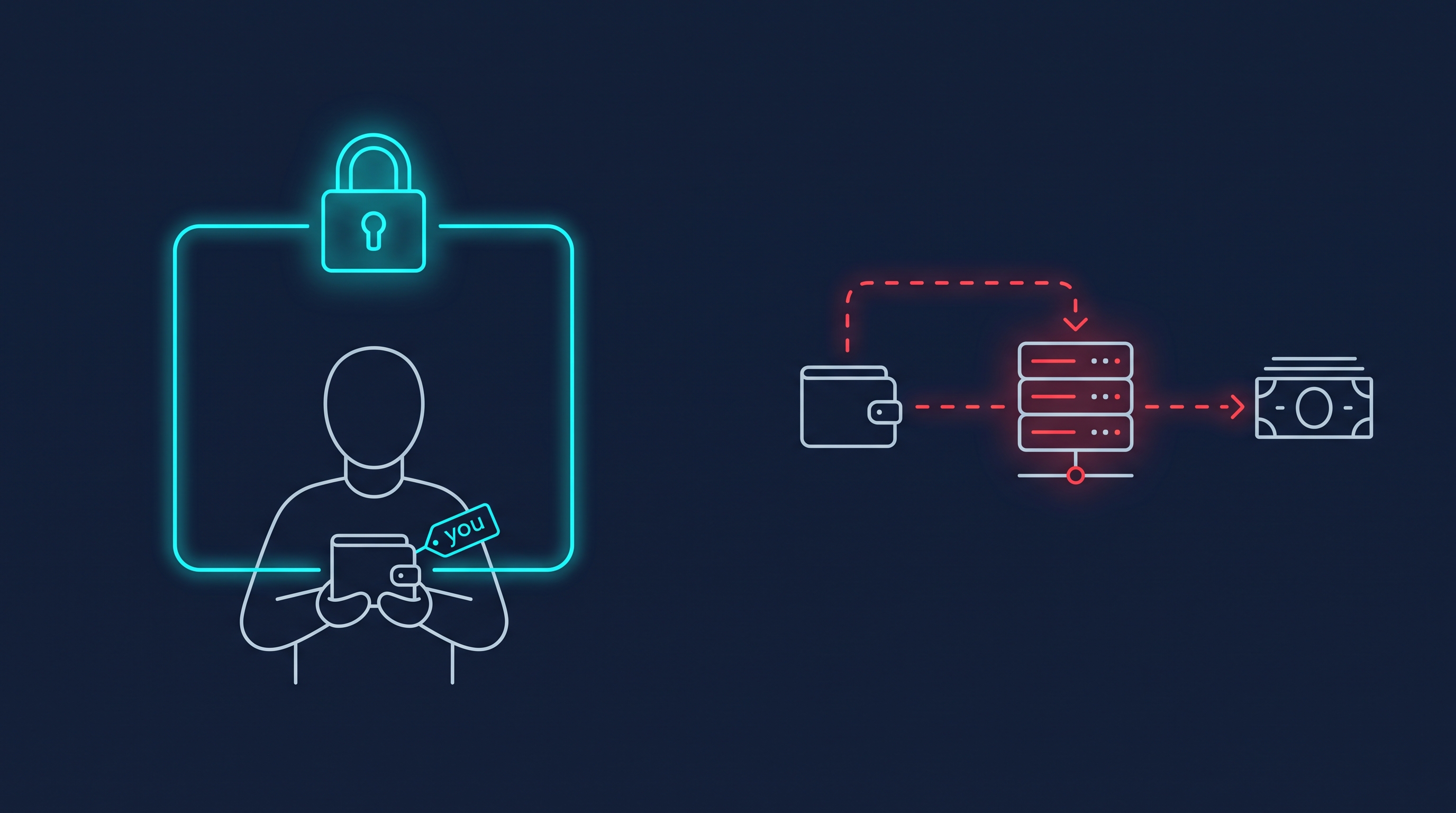
Kalshi is custodial and CFTC-regulated. Kalshi holds your funds. You don't manage private keys — you manage API keys. So your levers are key scoping, withdrawal permissions, and account access controls. Your risk is credential theft, not seed-phrase loss.
Polymarket is non-custodial. You hold the keys and signed approvals on Polygon. Nobody can move your funds without your signature — which also means nobody can recover them for you. Your risk is approval phishing and key compromise, covered above.
Custodial bot platforms are the wildcard. Some hosted bot services generate private keys on their servers or ask for withdrawal-enabled API keys. That makes the platform operator a party who can move your funds. Even honest operators are a target: the single largest theft of 2025 was the $1.5 billion Bybit breach (Chainalysis, 2026). When a platform holds the keys, its breach is your breach.
Citation capsule: In 2024, private key compromise accounted for 43.8% of all crypto value stolen, the single largest vector (Chainalysis 2025 Crypto Crime Report). Any setup where a third party holds or generates your keys inherits that risk on your behalf. The fewer parties who can sign for your funds, the smaller your attack surface.
This is why Turbine is built around key control. You connect your own credentials, keep custody where the platform's design puts it, and inspect what a strategy will do before it trades. We're not a party that can move your funds out from under you. That's a deliberate design choice, not a feature toggle.
4. Avoid the Scams Aimed at Bot Operators
The trading-bot niche attracts predators because the victims have capital and want automated returns. The numbers are staggering. Investment scams were the #1 fraud loss category at $5.7 billion in 2024 (FTC, 2025), and reported investment-scam losses climbed to $7.9 billion in 2025 (FTC, 2026).
The FBI tells the same story. Americans lost $9.3 billion to digital-asset fraud in 2024, including $5.8 billion to crypto investment fraud — the category the bureau describes as "pig butchering" (FBI IC3, 2024).
For bot operators specifically, watch for these:
- Fake bot tools. "Download our free arbitrage bot." It runs, shows fake profits, and quietly exfiltrates your keys. Only run software you can read or that comes from a platform with a verifiable track record.
- Signal sellers. Someone sells "guaranteed" signals, then asks for your API key to "auto-execute." Never hand a stranger a key. That's not automation — that's account access.
- Custodial deposit traps. A "bot platform" asks you to deposit funds into their wallet to start trading. Deposits are easy. Withdrawals mysteriously aren't.
- Fake recovery services. After a loss, "recovery experts" appear offering to get your money back for a fee. They're a second scam targeting the same victim.
The common thread: anything asking for your keys, your seed phrase, or a custodial deposit deserves maximum suspicion. Legitimate tools minimize what they ask you to trust them with.
The Practical Security Checklist
Print this. Run through it before you deploy.
API keys
- Key scoped to trade-only, withdrawals disabled
- Key stored in env vars or a secrets manager, never in code
-
.envand key files listed in.gitignore - No secrets baked into Docker images
- Rotation reminder set (quarterly + on any incident)
- One key per bot or machine
Wallet (Polymarket / Polygon)
- Dedicated bot wallet, funded with trading capital only
- Bounded token approvals, not unlimited
- Stale approvals revoked (monthly audit)
- Long-term funds in separate cold storage
- Every contract address verified before signing
Custody & platform
- You know exactly who can move your funds
- No third party holds withdrawal-enabled keys
- Strategy is inspectable before it trades
- No custodial deposits to unverified "bot platforms"
Scam defense
- Bot software is readable or from a verified source
- No API keys or seed phrases shared with signal sellers
- Recovery-service offers ignored
Build on a Control-First Foundation
You can do everything above on a homemade stack. It's just a lot of moving parts to get right, every time, forever. The point of a serious platform is to make the secure path the default path.
Turbine Studio is built for that: connect your own credentials, backtest a strategy on historical data, inspect exactly what it will do, then deploy with control over access. New here? Getting Started with Turbine Studio walks through the first deployment. We're not the hidden counterparty to your funds. For a deeper comparison of how platforms handle custody and security, see Best Prediction Market Bot Platform in 2026.
Frequently Asked Questions
Should I disable withdrawals on my trading bot's API key?
Yes, whenever the exchange supports it. A trade-only key can lose money through bad trades, but it can't send your balance to an attacker. Stolen credentials were the initial vector in 22% of breaches in 2025 (Verizon DBIR), so scoping the key is your cheapest, highest-leverage defense.
Is a custodial bot platform safe if it's popular?
Popularity isn't safety. The $1.5 billion Bybit breach in 2025 hit a major, established platform (Chainalysis, 2026). When a platform holds your keys, its breach becomes your loss. Prefer setups where no third party can move your funds without your signature.
What's the single most important wallet setting for a Polymarket bot?
Bounded token approvals. Never grant an unlimited allowance to a contract. Approval phishing and wallet drainers still hit 106,106 victims in 2025 (Scam Sniffer), and the attack always relies on an over-broad approval the victim signed without reading.
How often should I rotate API keys?
Quarterly as a baseline, and immediately after any incident — a lost laptop, a departed contractor, or a key that may have touched a public repo. GitGuardian found 64% of leaked secrets stay valid for years (GitGuardian, 2026), so rotation is what limits the damage from a leak you didn't catch.
Do I need a hardware wallet for prediction market trading?
For funds your bot actively trades, a dedicated hot wallet is practical. For everything else, cold storage helps: private key compromise caused 43.8% of crypto theft in 2024 (Chainalysis, 2025), and a hardware wallet keeps that key off any internet-connected machine.
The Bottom Line
Securing a prediction market bot isn't complicated, but it's unforgiving. The same automation that earns while you sleep can leak while you sleep.
- Scope and rotate API keys. Trade-only, no withdrawals, never in code.
- Guard the approval layer. Bounded approvals, monthly revokes, dedicated bot wallet.
- Know who can move your funds. Minimize the parties who can sign for your money.
- Treat every key request as a red flag. Real tools don't need your seed phrase.
Get these four right and you've closed the doors that account for the overwhelming majority of losses. Then you can let the bot do what it's for.
This post is for informational purposes only and does not constitute financial, legal, tax, or security advice. Prediction market trading involves risk of loss. Security practices should be evaluated against your own setup and, where appropriate, with qualified professionals.