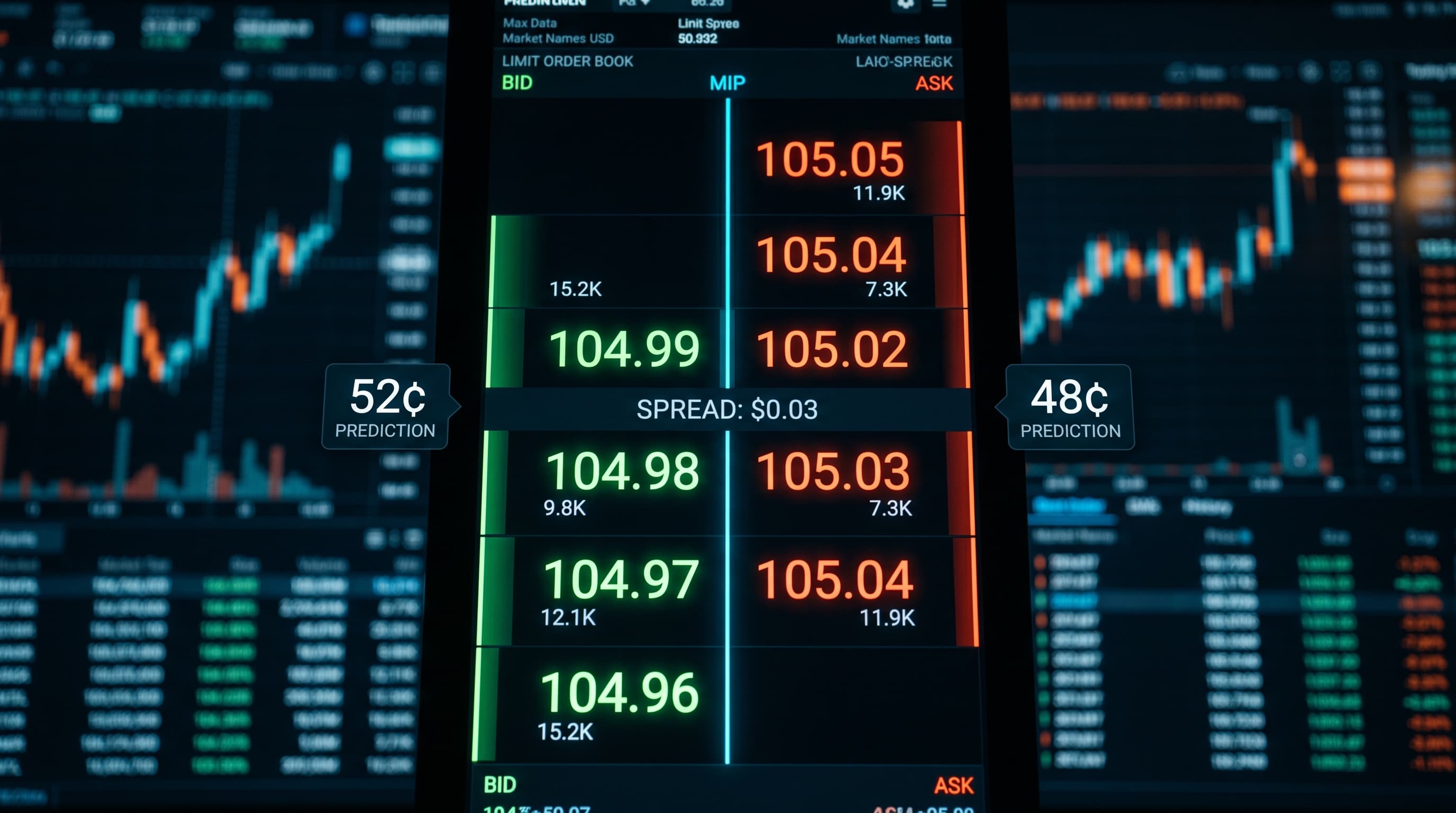
Sports Prediction Markets: A Trader's Guide to Kalshi and Polymarket Sports Contracts
 Ryan Bajollari
Sports contracts drive 89% of Kalshi's revenue. Learn what's available, how they differ from sportsbooks, and what real trader returns look like in 2026.
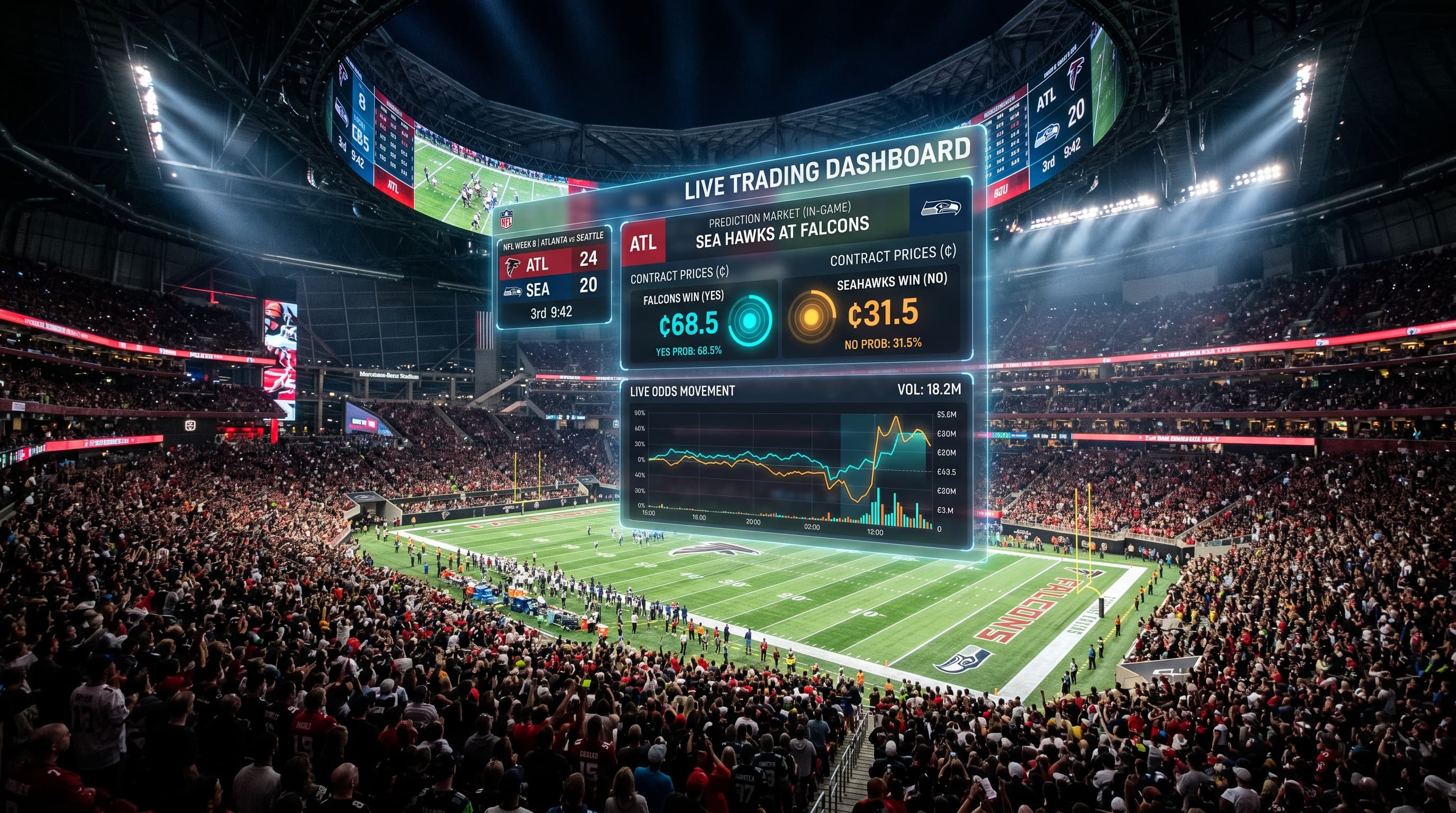
Sports prediction markets generated over $6 billion in trading volume during Super Bowl weekend alone, with a single-day record above $1 billion on game day (Next.io / Covers.com, 2026). This isn't sports betting. It's something different — and if you're still placing bets through DraftKings or FanDuel, you're paying for it.
Prediction markets now account for 62% to 89% of Kalshi's trading volume, depending on the season (The Block, 2025). The global market hit $63.5 billion in 2025, up 4x from $15.8 billion the year before (CertiK / Yahoo Finance, 2026). And Major League Baseball just signed a $300 million exclusive deal with Polymarket, making it the league's official prediction market exchange (Fortune, 2026).
Whether you're a sports bettor looking at cheaper alternatives or a prediction market trader who hasn't touched sports contracts yet, here's what you need to know.
Key Takeaways
- Sports drive 62-89% of prediction market volume, with Super Bowl weekend alone generating $6B+ in trades (Covers.com, 2026)
- Kalshi offers game outcomes, point spreads, player props, and parlays with transparent exchange-style fees vs. sportsbook vig of 5-10%
- Retail traders lose more on prediction markets (median -8% ROI) than sportsbooks (-5%), but high-volume traders ($500K+) earn +2.6% median ROI
- Prediction markets skew younger (24% under 25 on Kalshi vs. 7% on DraftKings) and are growing faster than any other trading category
What Sports Contracts Can You Actually Trade?
Kalshi launched as the first CFTC-regulated exchange to offer player props and parlay-style "build your combo" prediction markets (SBC Americas, 2025). The contract menu now rivals what you'd find on any major sportsbook, but the mechanics are fundamentally different.
Here's what's available on Kalshi right now:
Game Outcome Contracts
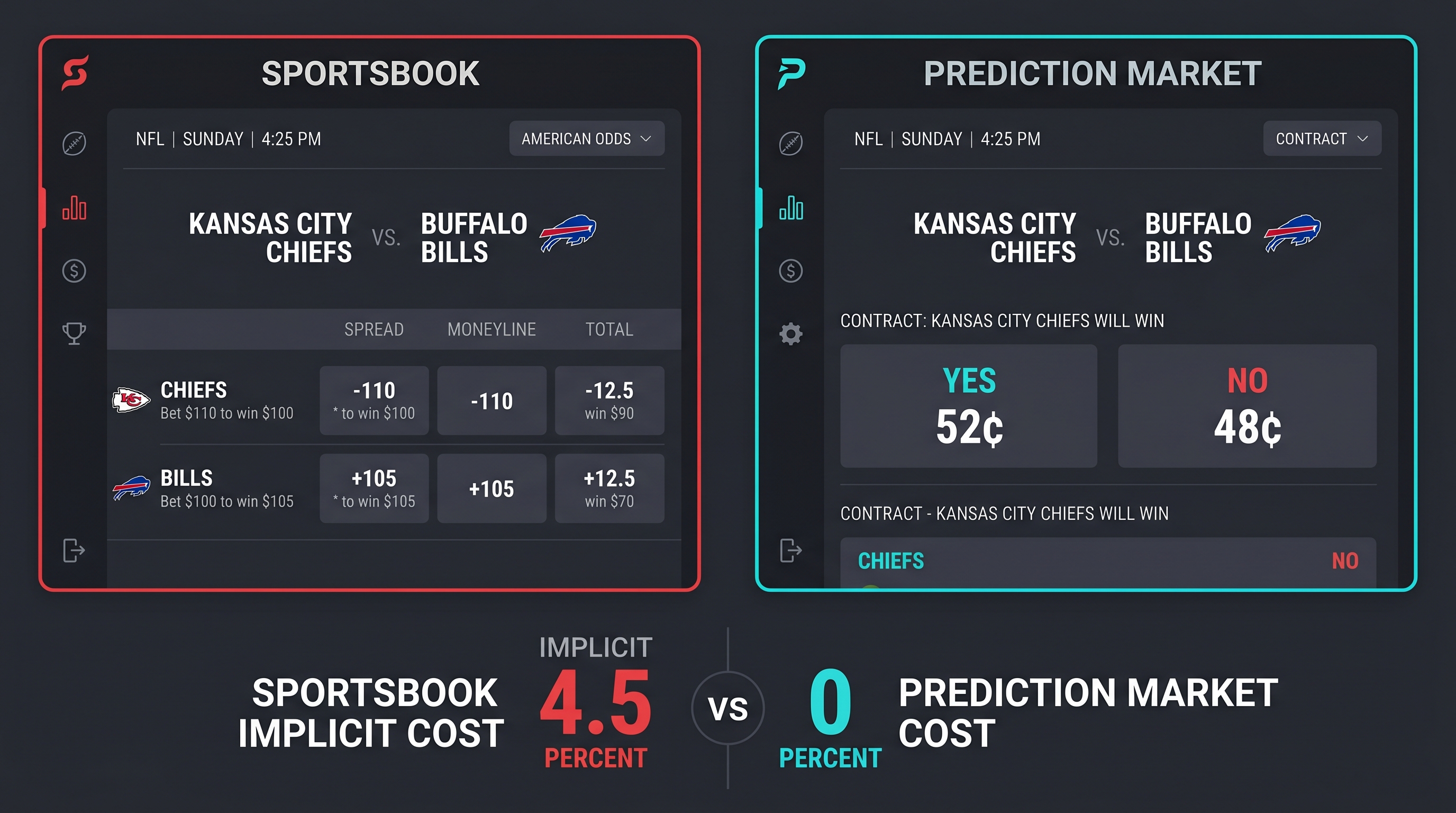
Will the Chiefs beat the Bills on Sunday? Buy YES at $0.52 or NO at $0.48. If you're right, you get $1.00. Your profit is the difference between what you paid and the $1.00 payout.
Point Spreads and Totals
Same concept as sportsbook spreads, but structured as binary contracts. "Will the Lakers win by 7+ points?" trades at whatever the market prices it. No -110 juice. No vig.
Player Props
"Will Jalen Brunson score 30+ points tonight?" This is where Kalshi's contract selection gets interesting. Player props generate huge volume because they're opinion-heavy markets where casual traders and sharp analysts diverge the most.
Parlay Builder
Kalshi introduced prebuilt parlays and custom "build your combo" markets. Stack multiple contracts into a single position. The payouts compound, but so does the risk — just like traditional parlays.
Season Futures
"Will the Yankees win the World Series?" These contracts trade continuously from preseason through the playoffs, with prices shifting based on team performance, injuries, and market sentiment.
During the week ending January 4, 2026, Kalshi's sports volume broke down to college football at 32%, NFL at 24%, and NBA at 22% of total wagers (Gambling Insider, 2026). Meanwhile, Polymarket hosts over 3,128 active sports markets with $1.3 billion in total sports trading volume, where individual NBA marquee games generate $500K to $2M each (Laika Labs, 2026).
If you're coming from a beginner's understanding of prediction markets, sports contracts are the fastest way to start trading with intuition you already have.
How Do Sports Prediction Markets Differ from Sportsbooks?
Retail prediction market traders have a median ROI of -8% since mid-2025, which is actually worse than sportsbook bettors at -5% (CoinDesk / Citizens, 2026). But here's the twist — high-volume traders with $500K+ in volume achieve a median ROI of +2.6%, while even the highest-volume sportsbook users remain unprofitable at roughly -0.6%.
What does that mean? Prediction markets reward skill and system more than sportsbooks do. The floor is lower, but the ceiling is dramatically higher.
The Structural Differences
Pricing model. Sportsbooks set odds and bake in a margin (the "vig" or "juice") — typically 5-10%. On a -110 line, you're paying $110 to win $100. Prediction markets are peer-to-peer exchanges. You buy at whatever price the market sets. There's no house edge because there's no house.
Fees. Kalshi publishes explicit exchange-style trading fees. Compare that transparent cost to the 5-10% implicit vig on many sportsbook wagers.
Liquidity. You can exit a position before the event ends. Bought a Super Bowl contract at $0.40 and the price moved to $0.65 at halftime? Sell it. You can't do that at a sportsbook. They take your bet and you wait for the final whistle.
Tax treatment. Prediction markets settle as Section 1256 contracts — 60% long-term capital gains, 40% short-term, regardless of holding period. Sportsbook winnings are taxed as ordinary income at your full marginal rate. For a profitable trader, this difference is enormous.
Key insight: The -8% median retail ROI on prediction markets vs. -5% on sportsbooks isn't because prediction markets are worse. It's because prediction markets attract more casual speculators making impulsive trades. The sportsbook model hides your losses behind one-shot bets. Prediction markets expose them because you're trading continuously. This transparency is actually an advantage if you're systematic about it.
For a detailed comparison of which platform to choose, see our Polymarket vs Kalshi breakdown.
Who's Trading Sports Prediction Markets?
Twenty-four percent of Kalshi users are under 25, with a median age of 31. Compare that to DraftKings and FanDuel, where only 7% of users are under 25 and the median age is 35 (CNBC, 2026). Women now make up 26% of prediction market users, up from 13% just ten months ago (WSJ / Gambling Insider, 2026).
This isn't your dad's sportsbook. Prediction markets are pulling in a younger, more diverse, more tech-savvy crowd — people who think about sports in terms of probability and edge rather than gut instinct and loyalty.
From our experience: The sports traders who do best on Turbine Studio aren't necessarily the biggest sports fans. They're the ones who treat sports contracts like financial instruments — tracking line movements, comparing prices across platforms, and automating execution. Domain knowledge helps, but systematic thinking matters more.
And the automation angle is real. 14 of the top 20 most profitable wallets on Polymarket's leaderboard are bots (Finance Magnates, 2026). Sports markets aren't immune to this. If you want to understand how automated trading dominates prediction markets, check our deep dive on prediction market arbitrage bots.
Why Did MLB Sign a $300M Deal with Polymarket?
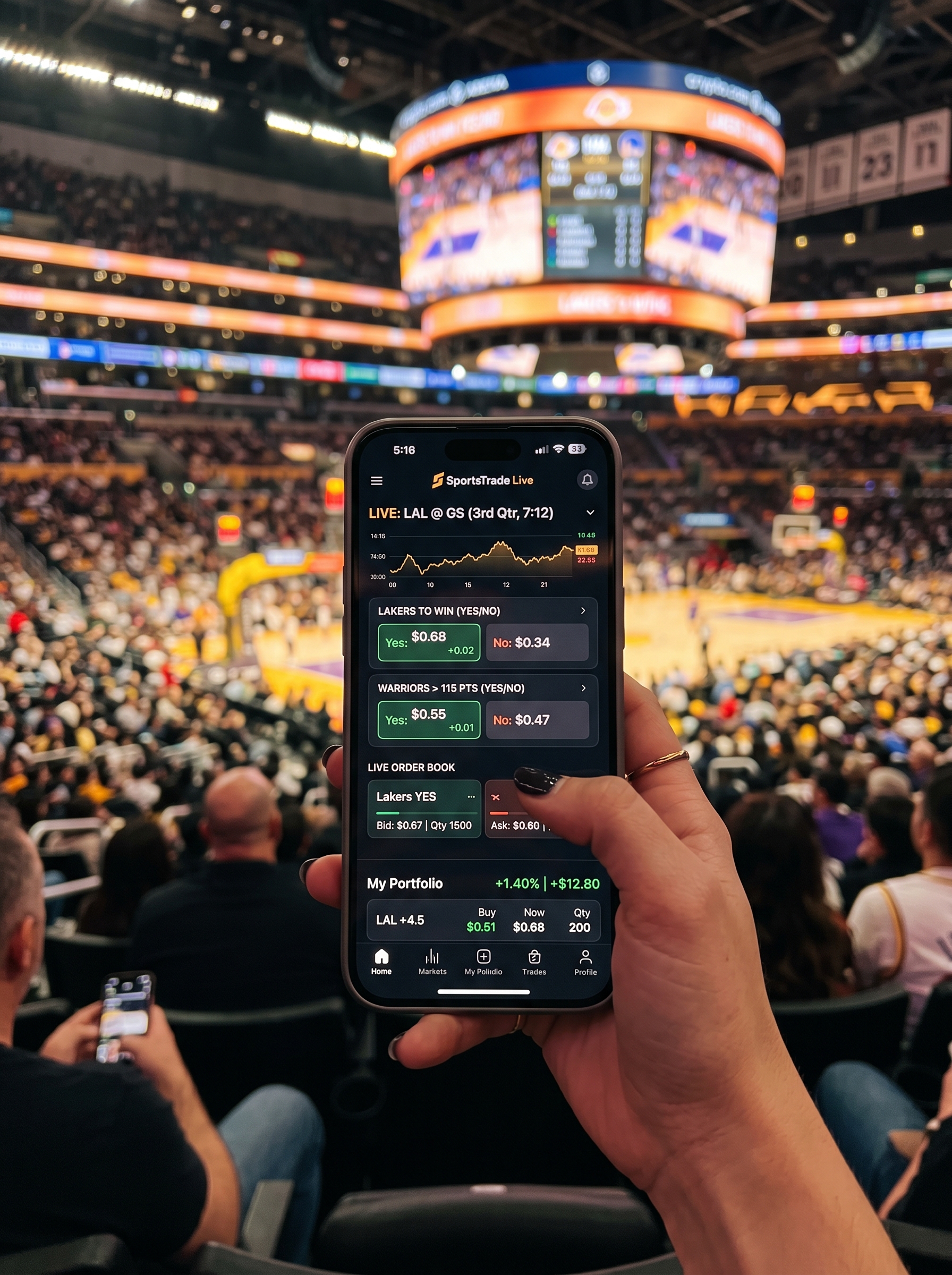
Major League Baseball named Polymarket its exclusive "Official Prediction Market Exchange" in a multi-year deal estimated at $300 million. The partnership includes a memorandum of understanding with the CFTC to establish an integrity framework (Fortune, 2026). MLS and NHL have also entered prediction market partnerships (Front Office Sports, 2026).
This is the legitimacy signal that matters. When professional sports leagues — the same organizations that fought fantasy sports and daily fantasy for years — actively partner with prediction market platforms, it means the category has crossed from "interesting experiment" to "mainstream financial product."
Why are leagues doing this? Engagement. Prediction markets turn every pitch, every possession, every play into a tradeable moment. That's deeper engagement than passive viewing, and it doesn't carry the same regulatory baggage as traditional sports gambling.
Our finding: Bernstein projects prediction market volumes will hit $1 trillion by 2030, with revenue growing from roughly $500 million in 2025 to $10.8 billion — a 2,000%+ increase. But sports' share is expected to decline from 62% to 31% of volume as institutional non-sports trading grows (Bernstein / Yahoo Finance, 2026). The smart move is to build sports trading systems now while the market is still relatively inefficient.
What's the Regulatory Picture for Sports Prediction Markets?
Eleven states have issued cease-and-desist orders against prediction market operators, claiming over $600 million in lost state sports betting tax revenue (MultiState, 2026). The courts are split: federal courts in Nevada and New Jersey sided with Kalshi (citing federal preemption under the Commodity Exchange Act), Maryland ruled against, and Tennessee granted Kalshi a preliminary injunction in February 2026 (Holland & Knight, 2026).
Here's what this means for traders: Kalshi is a CFTC-designated contract market. Federal law currently preempts state gambling regulations for CFTC-regulated exchanges. The legal challenges are real, but Kalshi's $22 billion valuation and $1 billion Series E (led by Paradigm, with Sequoia, a16z, and ARK Invest) suggest the smart money thinks federal preemption will hold (TechCrunch, 2025).
This is likely headed to the Supreme Court. In the meantime, Kalshi controls 89% of the US prediction market as of April 2026 (CoinDesk, 2026). The platform isn't going anywhere.
How Do You Start Trading Sports Prediction Markets?
Kalshi processed $23.8 billion in volume in 2025 — a 1,108% year-over-year increase — with 97 million trades across 1.2 million active traders (Sacra, 2026). Getting started takes about 5 minutes.
Manual Trading
- Create a Kalshi account. Verify your identity (required — it's CFTC regulated).
- Deposit funds. Bank transfer, debit card, or crypto.
- Browse sports markets. Filter by sport, league, or contract type.
- Place your first trade. Start small — $10-$50. Buy YES if you think it'll happen, NO if you don't.
- Track and learn. Watch how prices move before, during, and after games. You'll notice patterns fast.
Automated Trading
Manual is fine for learning. But if you want to trade at scale — monitoring dozens of games, comparing odds across platforms, executing instantly on pricing gaps — you need automation.
The hard way vs. easy way decision applies here too. You can code a bot from scratch using Kalshi's free API (REST, WebSocket, FIX connectivity). Or you can describe your strategy in plain English on Turbine Studio and have it running on Kalshi in minutes.
Sports contracts are perfect for automation because they're high-volume, time-sensitive, and generate pricing inefficiencies that bots can exploit faster than any human. Want to know what strategies actually work? Check our guide on how to make money on prediction markets.
Start building your sports trading strategy on Turbine Studio
Frequently Asked Questions
Are sports prediction markets legal in the United States?
Kalshi operates as a CFTC-designated contract market (DCM), making sports prediction contracts federally regulated. Federal courts in Nevada, New Jersey, and Tennessee have sided with Kalshi against state challenges. Eleven states have issued cease-and-desist orders, but CFTC preemption currently prevails (MultiState, 2026).
How are prediction market profits taxed differently than sports betting?
Prediction markets settle as Section 1256 contracts — taxed at 60% long-term capital gains rate and 40% short-term, regardless of holding period. Traditional sportsbook winnings are taxed as ordinary income at your full marginal rate. For a trader in the 32% bracket, this difference can save thousands annually.
Can I use bots to trade sports prediction markets?
Yes. Kalshi provides free API access (REST, WebSocket, FIX connectivity) to all verified users. 14 of 20 top-earning Polymarket wallets are automated bots (Finance Magnates, 2026). Automated trading is not only permitted — it's where most of the profit is generated.
How much money do I need to start trading sports prediction markets?
Kalshi has no minimum deposit. You can place trades starting at $1 per contract. Most new traders start with $100-$500 to learn market mechanics before scaling. High-volume traders ($500K+) achieve median ROI of +2.6% vs. retail's -8% (CoinDesk, 2026).
What sports generate the most prediction market volume?
NFL and college football lead during fall and winter (56% combined), NBA runs strong year-round at roughly 22%, and baseball is growing rapidly following the MLB-Polymarket $300M partnership deal (Gambling Insider, 2026).
The Sports Prediction Market Is Just Getting Started
The numbers tell the story. $63.5 billion in 2025 volume. $6 billion on Super Bowl weekend. MLB, MLS, and NHL signing platform partnerships. Bernstein projecting $1 trillion by 2030. Sports prediction markets aren't a niche anymore — they're becoming the default way a younger generation engages with sports outcomes.
- Sports contracts now cover everything sportsbooks offer: game outcomes, spreads, player props, parlays, and futures
- Zero fees on Kalshi vs. 5-10% vig on sportsbooks — the math favors prediction markets
- Better tax treatment (60/40 Section 1256) vs. ordinary income on sportsbook winnings
- Tradeable positions — sell before the game ends, unlike sportsbooks where your bet is locked
- Automation-friendly — API access enables systematic strategies that sportsbooks actively block
Whether you're trading manually or building automated strategies, the sports prediction market is where the opportunity is in 2026.
Build your first sports trading bot on Turbine Studio
This post is for informational purposes only and does not constitute financial or legal advice. Prediction market trading involves risk of loss, including total loss of invested capital. Past performance does not indicate future results. Tax information is general — consult a tax professional for your specific situation.