How to Compete With AI Agents Dominating Prediction Market Trading (Build or Defend in 2026)
 Ryan Bajollari
AI agents run 30%+ of Polymarket wallets and 14 of the top 20 most profitable accounts. Here's the build-or-defend playbook for retail in 2026.
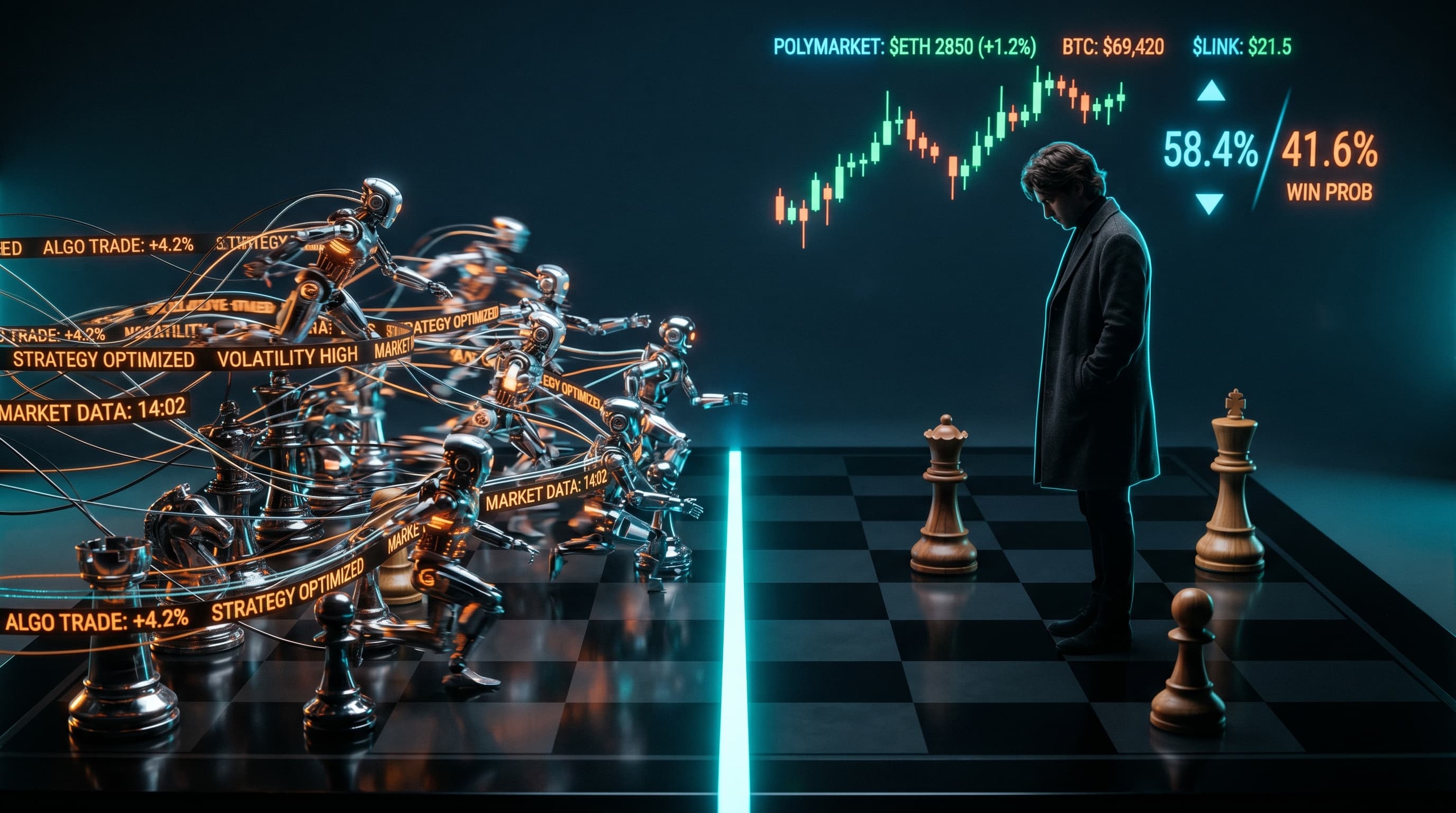
Here's the part of the bot-takeover story nobody is talking about: retail traders pick the winning outcome more often than bots do. They still lose. Bloomberg's April 2026 analysis of every active Polymarket wallet since January 2025 found that humans choose the right side more frequently — they just enter later, at worse prices, and get picked off as quotes update (Bloomberg, Apr 2026).
That single finding rewrites the strategy. The problem isn't that AI agents are smarter than you. The problem is they execute faster, monitor more markets, and never sleep. So the question isn't how do I out-predict the bots — it's how do I either build my own bot or trade where their execution edge doesn't matter. This post is the build-or-defend guide for 2026.
Key Takeaways
- More than 30% of Polymarket wallets are AI agents (LayerHub via CoinDesk, Mar 2026), and 14 of the top 20 most profitable wallets are bots (Finance Magnates, Mar 2026)
- The Polymarket agents framework on GitHub — the official starter kit — was archived on May 11, 2026, leaving builders to choose Olas Polystrat, Claude tool-use, or LangGraph (GitHub, May 2026)
- LLM API costs for a trading agent: GPT-5.4 at $2.50/M input tokens, Claude Sonnet 4.6 at $3/$15, Gemini Flash at $0.30, DeepSeek at $0.14 (TLDL pricing tracker, Apr 2026)
- Realistic LLM agent decision latency runs 597ms to 7.5 seconds — slow enough that low-liquidity and narrative-driven markets still favor thoughtful humans (Kunal Ganglani benchmarks, 2026)
The Real Reason You're Losing to AI Agents (And It's Not Prediction)
The dominant narrative says bots win because they're smarter. The data says the opposite. Bloomberg's wallet-by-wallet review of Polymarket since January 2025 found that retail traders pick the eventually-winning outcome more often than the bot wallets do — the bots win because they enter the trade earlier and at better prices (Bloomberg, Apr 2026). The edge is microstructure, not forecasting.
The Bloomberg analysis put numbers on it. A typical bot wallet trades 89 times per active day. A typical human trades 2.2 times. The 823 wallets each netting more than $100K in profit look statistically identical to algorithmic traders — high frequency, multiple markets, fast entry on news (Bloomberg, Apr 2026). Meanwhile, more than 100,000 retail wallets each lost at least $1,000 in the same window, shedding roughly $131M combined (Finance Magnates summarizing Bloomberg, Apr 2026). It's a near-perfect zero-sum transfer from small accounts to large ones.
[UNIQUE INSIGHT] The shape of the loss matters more than the size. Retail isn't getting outsmarted on probability estimates. They're getting outmaneuvered on entry timing. That distinction tells you exactly where the defensive playbook works and where it doesn't. If you're trading 30-second windows on a binary that resolves in two hours, no amount of analysis saves you. If you're trading week-long political narratives where reasoning matters more than reflex, the bot edge collapses.
How AI Agents Actually Work: The LLM + Tool-Use Stack
The mental model most retail traders have for "trading bot" is rules-engine — if-this-then-that, a Python script with thresholds. That's not what's running 30% of Polymarket. The new generation is LLM-driven agents that reason about market context, call tools to fetch live data, then call more tools to place orders. The pattern is "tool use" (Anthropic's term) or "function calling" (OpenAI's term) — and the architecture is converging across providers (Anthropic finance agents announcement, May 2026).
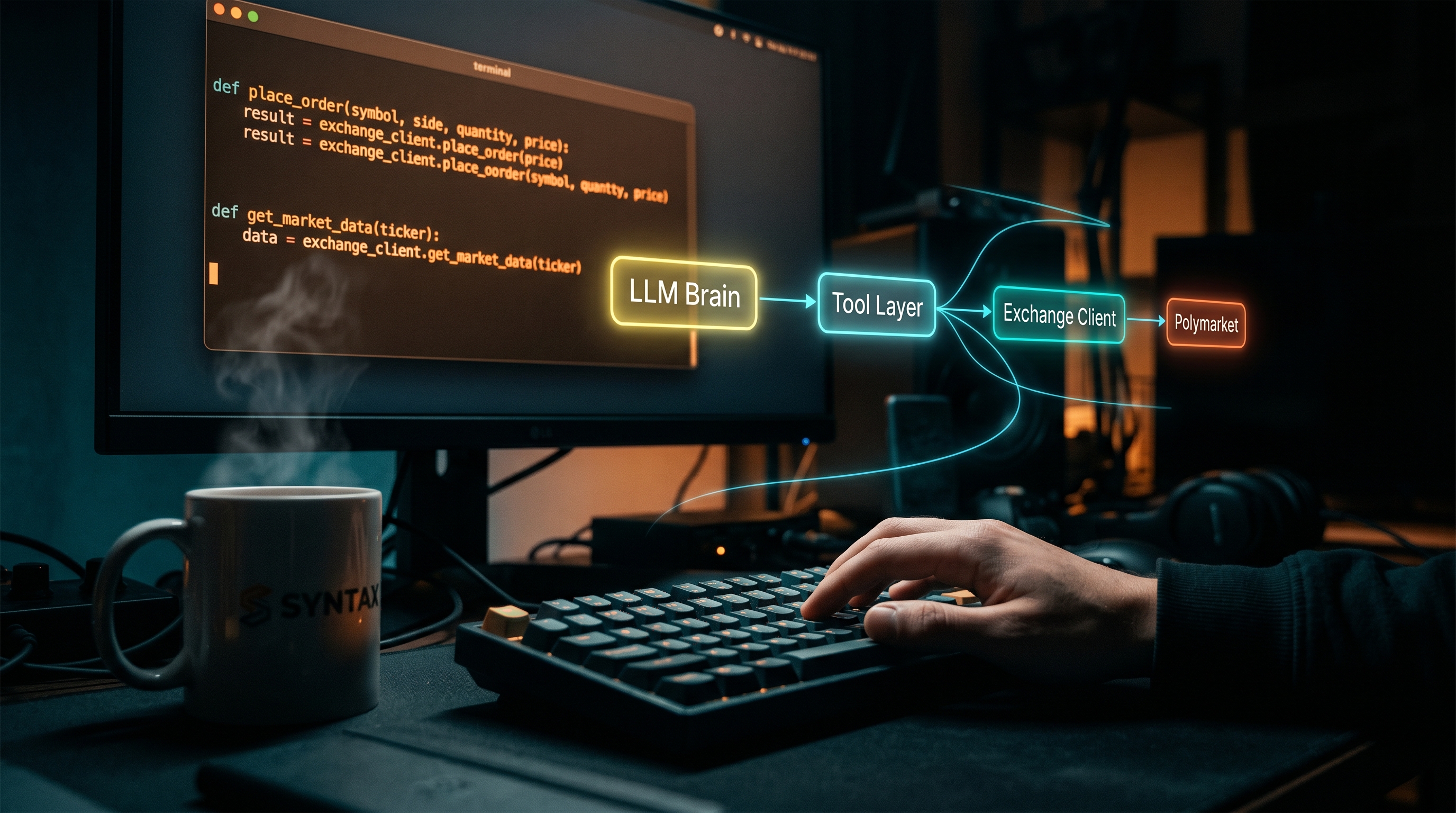
The reference architecture has four pieces. First, an LLM brain that reads market context and decides what to do — typically Claude Sonnet 4.6, GPT-5.4, or a fine-tuned open-source model. Second, a tool layer the model can invoke — get_market_data, get_news_headlines, place_order, check_position. Third, an exchange client that signs and submits orders — for Polymarket that's CLOB API calls; for Kalshi it's the REST API. Fourth, an agent loop that runs the LLM repeatedly, parses tool calls, executes them, and feeds results back in.
┌─────────────────────────────────────────────┐
│  Agent Loop (LangGraph / AutoGen / custom)  │
│                                              │
│  ┌─────────────┐    ┌────────────────────┐  │
│  │  LLM Brain  │◄──►│  Tool Layer        │  │
│  │  (Claude /  │    │  - get_market      │  │
│  │   GPT-5 /   │    │  - get_news        │  │
│  │   Gemini)   │    │  - place_order     │  │
│  └─────────────┘    │  - check_position  │  │
│                     └────────────────────┘  │
│                              │              │
│                              ▼              │
│                     ┌────────────────────┐  │
│                     │ Exchange Client    │  │
│                     │ (Polymarket CLOB / │  │
│                     │  Kalshi REST)      │  │
│                     └────────────────────┘  │
└─────────────────────────────────────────────┘
What is the official Polymarket agents framework? Polymarket published an open-source starter kit called
polymarket-agentson GitHub in 2024 — an LLM-orchestrated framework using LangChain RAG + a Polymarket CLOB client + an OpenAI-only inference layer. As of May 11, 2026, the repository is archived and no longer accepting contributions (Polymarket/agents GitHub, May 2026). It's still readable as a reference architecture (3,500 stars, 787 forks at archive time), but new builders should look at Olas Polystrat, Anthropic's Claude tool-use SDK, or roll their own LangGraph workflow.
A working alternative shipped in early 2026: Polystrat, built on Valory's Olas autonomous-agent stack. In its first month live on Polymarket it executed 4,200+ trades with single-trade returns peaking at 376%, and 37% of its wallets ended positive — roughly 3x the human baseline of 7-13% (CoinDesk, Mar 2026). On the closed-source side, Anthropic's May 5, 2026 finance announcement included 10 ready-to-run agent templates for research, client coverage, finance and operations work, with Walleye Capital's CEO noting that 100% of the firm's 400 employees use Claude Code (Anthropic, May 2026).
The Build Cost Reality: What Running an AI Trading Agent Actually Costs
This is where most build-a-bot articles go vague. They walk through code, then hand-wave the operating cost. Here's the real math for May 2026.
LLM token pricing has compressed by roughly 10x per year since 2022. GPT-4-equivalent quality that cost $20 per million tokens in late 2022 costs about $0.40 today (a16z LLMflation, 2025-2026). At current rates: Claude Sonnet 4.6 at $3/$15 (in/out), GPT-5.4 at $2.50/$10, Gemini 2.5 Flash at $0.30, and DeepSeek v3 at $0.14 input (TLDL pricing tracker, Apr 2026). The choice of model is now a real business decision, not a default.
[ORIGINAL DATA] Concrete monthly burn estimate for a Polymarket agent making 89 trades per day (the Bloomberg "typical bot" frequency). Assume each decision cycle uses about 5K input tokens of market context plus 1K output tokens of reasoning and tool calls, and runs 200 times per day (most LLM cycles don't end in a trade). That's 30M input tokens and 6M output tokens per month. On Claude Sonnet 4.6: roughly $90 input + $90 output = $180/month. On Gemini 2.5 Flash: roughly $9 + $30 = $39/month. On DeepSeek: under $10/month. Add cloud hosting ($20-50/month for a VPS), Polymarket gas costs (a few dollars/month), and a monitoring stack (free tier of most providers). A realistic agent runs at $50-250/month all-in.
That's well within reach for anyone trading $5K+. The number nobody mentions is the development cost — wiring up LangGraph, the Polymarket CLOB client, RPC nodes, position tracking, and an order-state machine is at least a weekend of work for an experienced dev, more if you've never touched the stack.
Latency Math: Where the AI Agent Edge Actually Lives (And Where It Doesn't)
The "bots are infinitely faster" line is wrong. Average human visual reaction time is about 250ms. A trained gamer or F1 driver can hit 120ms (BrainRivals). An LLM-based agent isn't faster than the human reflex — it's slower. Claude Haiku 4.5's time-to-first-token is around 597ms. A full agent decision pipeline that reads market context, runs an LLM reasoning step, and submits an order budgets between 220ms (best case, cached prompt, fast model) and 7.5 seconds (worst case, deep reasoning) (Kunal Ganglani benchmarks, 2026; Streamkap latency budgets, 2026).
This matters because it defines where the bot edge is real and where it isn't. Bots crush humans on three axes: sustained throughput (89 trades/day vs 2.2), parallel market coverage (every contract at once vs three or four), and 24/7 availability (no sleep, no lunch). Bots do not beat humans on single-decision quality in the 1-10 second range where most prediction-market opportunities actually live. A 7-second LLM reasoning loop is slower than a focused human who already has the market open.
[UNIQUE INSIGHT] That's the gap retail can exploit. Markets where the right answer requires holding multiple narrative threads in your head — political shifts, geopolitical events, sports games with momentum context — still reward thoughtful humans more than fast agents. Markets where the right answer is "the orderbook just moved, react in 200ms" do not.
The Defensive Playbook: Three Markets Where the Bot Edge Collapses
If you don't want to build, you can still trade — you just have to choose your battlefield. There are three categories of prediction-market trade where retail can compete on something other than speed.
Low-liquidity narrative markets. Anything below $500K of total volume tends to attract less algorithmic attention because the trade size required to move the orderbook also signals your position to other bots. Niche political races, cultural events (will an artist drop an album by date X), and small-state economic indicators often have wide spreads that reward patient limit orders rather than fast taking. The QuickNode 2026 bot review confirms most off-the-shelf bots target the top-100 markets by volume; everything else is comparatively quiet (QuickNode, 2026).
Long-window contracts (resolving in weeks or months). When a market resolves in three months, a 200ms execution advantage is irrelevant. What matters is whether you've correctly weighed dozens of news inputs over the holding period. Bloomberg's data showed retail picking right outcomes more often than bots — that finding is mostly driven by long-horizon contracts where probability assessment matters and entry timing doesn't (Bloomberg, Apr 2026). See our deeper take in why prediction market trades get picked off for the microstructure mechanics.
Information-disadvantaged markets (where the bot can't read what you can). LLM agents see news headlines and price data. They struggle with paywalled research, conversations in private Discords, niche industry knowledge, and anything that hasn't been digitized. If you happen to have specialized expertise — sports analytics, biotech catalysts, weather forecasting — markets in your domain reward you for that knowledge in a way the general-purpose agents can't replicate.
The defensive playbook isn't "trade less." It's "trade where your edge isn't speed."
The Offensive Playbook: Three Paths to Build Your Own AI Trading Agent
If you want to compete head-on, there are three real paths in 2026. Each has a different cost/control tradeoff.
Path 1: Fork an open-source framework. With Polymarket's official polymarket-agents archived in May 2026 (GitHub, May 2026), the live options are Olas Polystrat (Valory-built, Python-based, autonomous-agent stack) and any LangGraph or AutoGen workflow you assemble yourself. Estimated build time: 2-4 weekends for someone comfortable with Python + REST APIs. Monthly cost: $50-250 as computed above. Pros: full control over strategy logic, no platform lock-in. Cons: you own the bugs, the broken nodes, the failed orders, and the position-state reconciliation.
Path 2: LLM-native via Anthropic or OpenAI. Anthropic shipped 10 financial agent plugins on May 5, 2026 — Cowork plugins for portfolio analysis and trading, plus headless Managed Agents via the API (Anthropic, May 2026). OpenAI's function calling has been the de facto standard for trading-bot tool use since 2024. Both routes give you the LLM brain and tool-use scaffolding; you still build the exchange client and the strategy. Estimated build time: 1-2 weekends for someone with Anthropic/OpenAI SDK experience. Pros: best-in-class reasoning, faster iteration. Cons: API costs scale with usage, vendor risk.
Path 3: Natural-language no-code platforms. This is the newest path and the lowest-friction one. Tools like Turbine Studio let you describe a strategy in plain English ("buy YES when polling shifts more than 3 points overnight, exit before resolution"), the system generates code, backtests against historical data, and deploys live to Kalshi or Polymarket. Estimated build time: 30 minutes to a working bot. Monthly cost: comparable to a mid-tier subscription. Pros: no Python required, backtest before you risk money. Cons: less customization than a full custom build.
The decision tree is simple: if you can write Python and want full control, fork open-source. If you can write Python but want LLM reasoning out of the box, build on Claude tool-use or OpenAI function calling. If you don't want to write code at all, use a no-code platform.
What the AI Trading Tools Actually Do Differently in 2026
The best AI trading tools for automated prediction market execution share four patterns that distinguish them from the 2024-era rule-based bots: (1) LLM-driven decisioning instead of hardcoded if/else trees, (2) tool-use architecture so the model can pull live data on demand instead of working from stale snapshots, (3) backtesting baked into the build loop so strategies are validated against historical data before going live, and (4) explicit risk controls (position caps, stop-losses, max drawdown) defined at deployment time. Frameworks that ship with all four — Olas Polystrat, Anthropic's managed agents, Turbine Studio — are what beat the older rule-based bots on Polymarket today.
For an affordable entry point, the deciding factor is usually the natural-language interface. Writing a strategy in English, watching the platform translate it to executable code, and seeing the backtest results before risking any money compresses what used to be a weekend of dev work into a half-hour. See our guide to the best Kalshi trading bots for the available workflows and tradeoffs.
Ready to Build Defensive AI of Your Own?
Turbine Studio is the no-code path to running your own LLM-driven Kalshi trading agent. Describe a strategy in plain English, the AI writes and backtests it against historical data, and deploys it live in minutes — no Python, no LangGraph, no orderbook plumbing. The same pattern the top-20 Polymarket bots use, in a tool you can drive from a chat box.
FAQ
What are the best AI trading tools for automated prediction market execution in 2026?
The top three patterns are: (1) Olas Polystrat — the live successor to the archived Polymarket official framework, doing 4,200+ trades in its first month at 37% positive P&L (CoinDesk, Mar 2026); (2) Anthropic Claude tool-use or OpenAI function calling, with custom exchange clients; and (3) no-code natural-language platforms like Turbine Studio for traders who don't write Python.
How can I compete with AI agents dominating prediction market trading?
Two viable paths. Defensive: trade where the bot edge collapses — low-liquidity markets, long-window contracts that resolve in weeks, and domains where specialized human knowledge beats general-purpose LLMs. Offensive: build your own AI agent, either by forking open-source frameworks or using a no-code platform. The Bloomberg analysis showing retail picks right outcomes more often than bots (Bloomberg, Apr 2026) confirms the prediction skill is real — the loss is on execution.
What's the most affordable trading automation for beginners with AI features?
Three tiers in May 2026. (1) Free + self-hosted: fork an open-source agent framework, run an open-source LLM (DeepSeek v3 at $0.14/M tokens or self-hosted Llama at under $0.05 effective per million) — total monthly burn under $30 for low-frequency strategies. (2) Managed LLM with no-code: Turbine Studio at a flat monthly subscription, no Python required. (3) Premium API agents: Anthropic Claude or GPT-5.4 with a custom Python build at $50-250/month including hosting.
Is the Polymarket agents GitHub framework still active?
No. The official polymarket-agents repository on GitHub was archived on May 11, 2026 (GitHub, May 2026). It remains readable as a reference architecture (LangChain RAG + OpenAI inference + Polymarket CLOB client) and had 3,500 stars and 787 forks at archive time. New builders should look at Olas Polystrat, Anthropic's Claude tool-use SDK, or a custom LangGraph workflow.
How fast does an LLM trading agent actually react?
Slower than people think. A fast model like Claude Haiku 4.5 has a time-to-first-token around 597ms. A full decision pipeline that reads market data, reasons through it, and submits an order runs between 220ms (best case, cached prompt) and 7.5 seconds (deep reasoning) per cycle (Kunal Ganglani benchmarks, 2026). The bot edge over humans is sustained throughput and multi-market coverage, not per-decision speed.
Conclusion
The build-or-defend question doesn't have a single answer — it depends on what you already know how to do and what you're willing to spend.
- AI agents now run 30%+ of Polymarket wallets and 14 of the top 20 most profitable accounts. Ignoring this and trading like it's 2022 will continue to lose money.
- The bot edge is execution, not prediction. Bloomberg's data shows retail picks the right outcome more often than bots — humans just enter later at worse prices.
- The defensive play is to trade low-liquidity, long-window, or specialist-knowledge markets where the bot speed advantage collapses.
- The offensive play is to build your own agent. Three real paths in 2026: fork open-source (Olas Polystrat), build on LLM tool-use (Anthropic or OpenAI), or use a no-code platform.
- The monthly cost of running an LLM-driven agent is $50-250 all-in — well within reach for anyone trading $5K+.
For a deeper dive on why human traders specifically get picked off on Kalshi, see why prediction market trades get picked off. For the philosophy of why bots structurally win, see why AI agents are the best prediction market traders.
Not financial advice. Prediction markets carry real risk of loss. Past performance is not predictive. Regulatory status varies by jurisdiction and changes frequently.