Why You're Losing Money to Bots and Insiders on Kalshi (And How to Fight Back)
 Ryan Bajollari
Bots trade 89 times a day vs 2.2 for humans. 0.1% of Polymarket accounts captured 67% of profits. Here's why retail loses on prediction markets, and what to do.
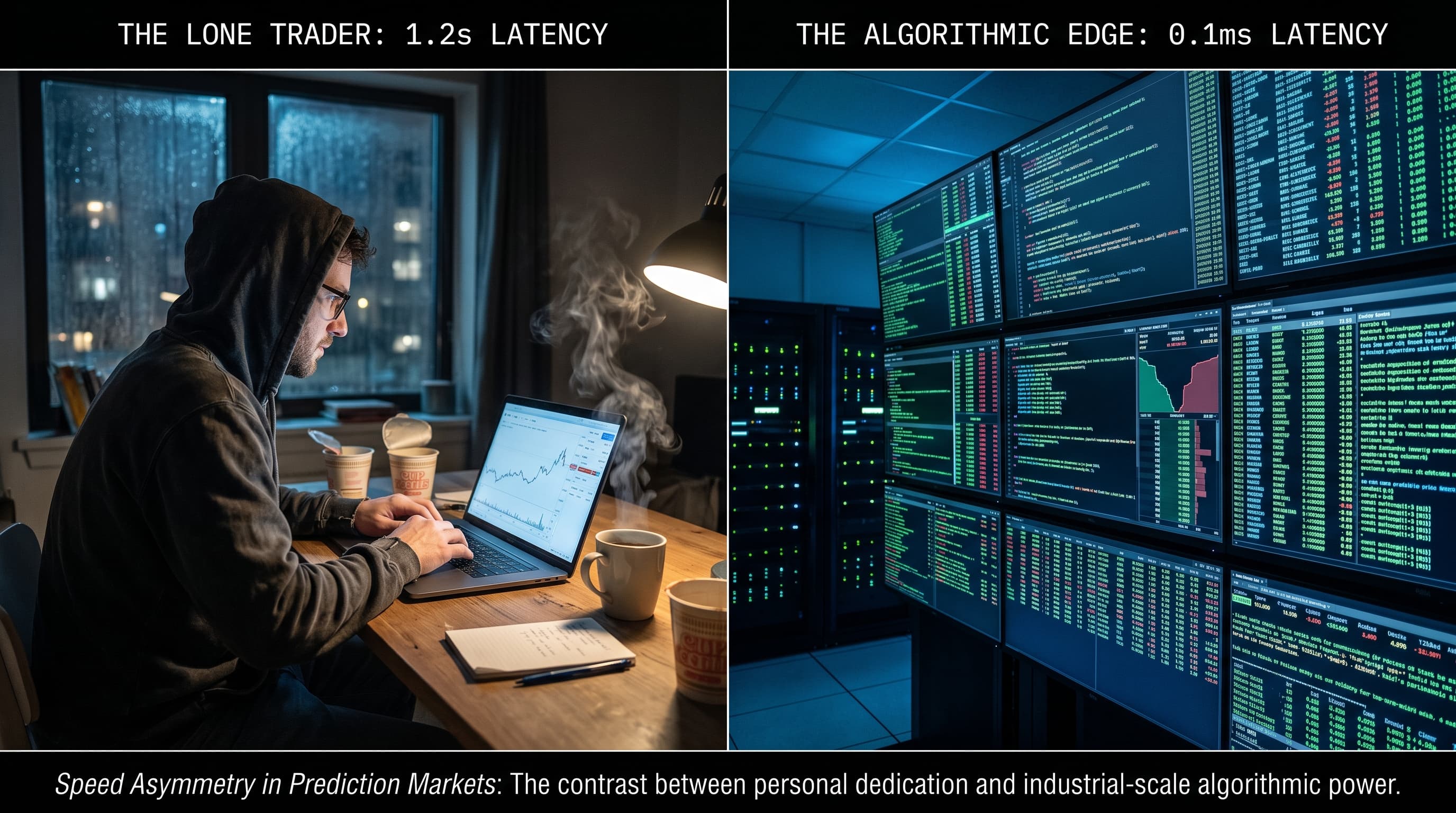
A typical prediction-market bot trades 89 times per active day. The typical human trades 2.2 times (Bloomberg, Apr 2026). Fourteen of the top 20 most profitable Polymarket wallets are bots (Finance Magnates, 2026). And 0.1% of all Polymarket accounts — fewer than 2,000 traders — captured 67% of every profit dollar paid out last year, roughly $500 million (WSJ via Crypto Times, May 2026).
If your Kalshi or Polymarket trades keep getting picked off seconds after you place them, this isn't bad luck. It's structural. A Stanford Law study of 41.6 million Kalshi trades published in April 2026 found measurable adverse selection in single-name contracts — informed traders systematically pick the slow side of the orderbook before quotes update (Stanford Law, Apr 2026). Here's what's happening, who's on the other side of your trade, and the four-step defense playbook that actually works.
Key Takeaways
- Bots execute 89 trades per active day vs 2.2 for human traders, and 14 of the top 20 most profitable Polymarket wallets are bots (Bloomberg, Apr 2026)
- 0.1% of Polymarket accounts (< 2,000 traders) captured 67% of all profits — about $500M (WSJ, May 2026)
- Stanford Law's 41.6M-trade Kalshi study found informed adverse selection is twice as severe in single-name contracts as in broad-based markets (Stanford Law, Apr 2026)
- Campaign staffers told NPR they make "thousands" betting on their own races with pre-release polling — Kalshi has already suspended traders for it (NPR, May 2026)
The Numbers: Who's Actually Making Money on Prediction Markets?
The retail-vs-whale gap on prediction markets is wider than on regulated sportsbooks. A March 2026 Citizens JMP analysis of trader-cohort data from Juice Reel found the median prediction-market user lost 8% over an eight-month window — compared to 5% on sportsbooks (CoinDesk, Mar 2026). When you slice by account size, the gap turns into a chasm.
Traders staking less than $100 per market posted a median return of -26.8%. Traders staking more than $500K posted +2.6%. The smallest accounts lose ten times faster than the biggest accounts make money (CoinDesk, Mar 2026).
Bloomberg's April 2026 analysis of every Polymarket wallet active since January 2025 made the same point with bigger numbers. Strip out the high-volume traders and the rest of the user base collectively lost $131 million. The 823 wallets each staking over $100K netted +$131 million (Bloomberg, Apr 2026). It's a near-perfect zero-sum transfer from small accounts to large ones.
This isn't about smarter analysis. It's about being on the right side of a structural microstructure problem.
Why Retail Loses: The Adverse Selection Problem
In April 2026, Stanford Law professor Robert Bartlett released the first peer-reviewed academic study of adverse selection on Kalshi, covering 41.6 million trades. The headline finding: informed traders systematically pick off slow quotes, and market makers compensate by widening spreads — particularly in single-name contracts (Stanford Law, Apr 2026).
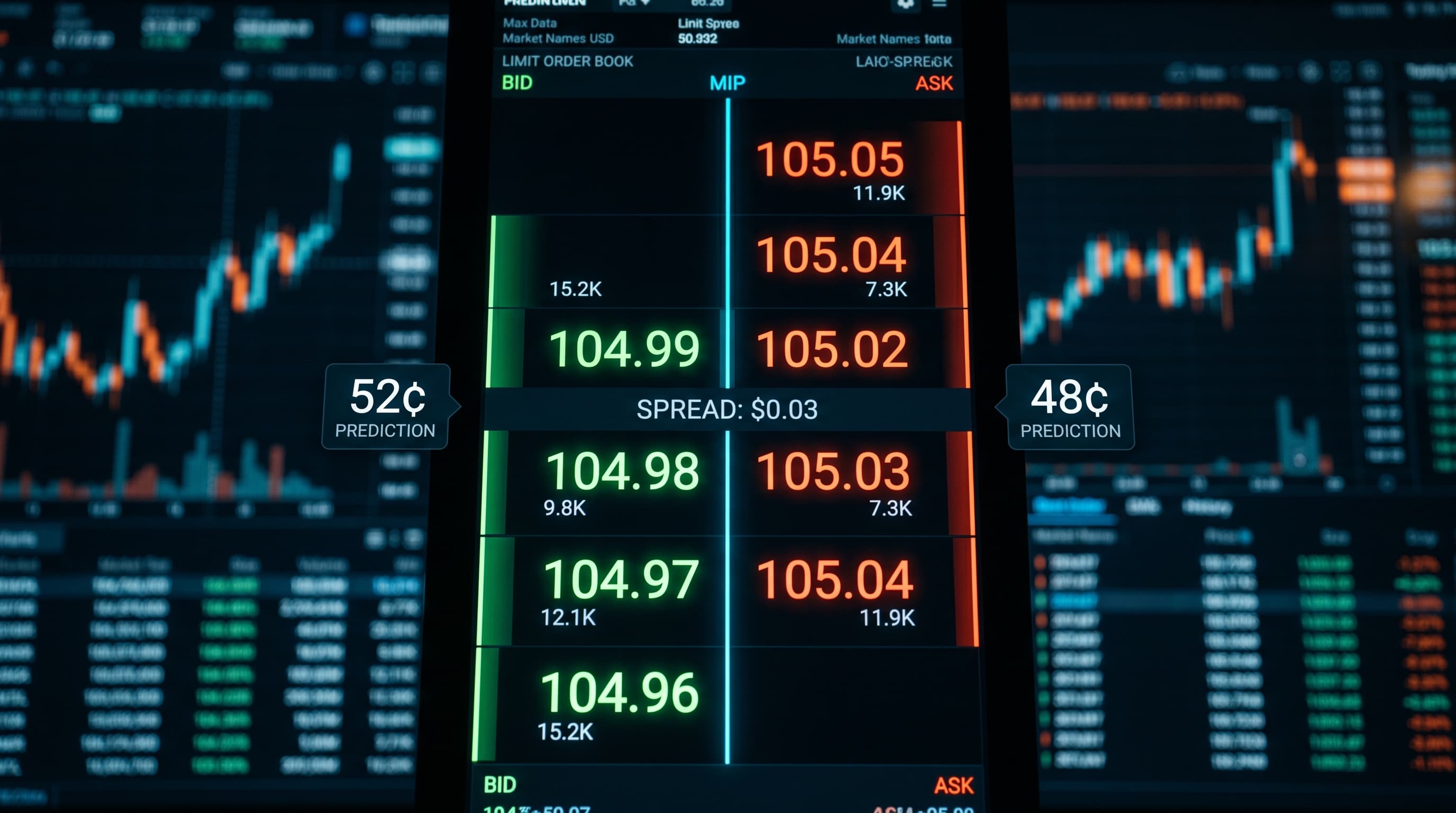
The mechanic is simple. Market makers post a bid and an ask. A trader with private information — a news headline that hasn't propagated, a polling result not yet public, a sports lineup change — hits the stale side of the book before the maker can cancel. The maker takes a small loss on that fill but can't avoid posting; without quotes, there's no spread to earn. So they raise the spread for everyone else.
The Bartlett finding in plain English: Market makers on Kalshi earn roughly twice as much per contract in single-name markets (e.g., "Will Candidate X win in District Y?") than in broad-based markets (e.g., "Will the Fed cut rates in June?"). Why? Single-name markets attract more informed flow — staff, insiders, people with edge — so makers price wider to survive. As a retail trader, you pay that wider spread every time you cross it (Stanford Law / SSRN, Bartlett, Apr 2026).
Until April 2026, that dynamic was a hypothesis traders complained about on Reddit. Now it's documented in 41.6 million trades. If you trade single-name Kalshi markets manually, you're paying the adverse selection tax in every fill.
For the deeper mechanics on why faster traders systematically beat slower ones, see our breakdown of prediction market arbitrage bots and AI agents in prediction markets.
Who's On the Other Side of Your Trade?
Kalshi's liquidity isn't coming from a single Citadel-style firm. It's a layered structure that retail traders rarely see:
- Designated Market Maker: Susquehanna International Group became Kalshi's first dedicated institutional market maker in 2024, with reduced fees and higher position limits in exchange for two-sided quoting obligations (Business Wire, 2024).
- Strategic stakeholders: Jump Trading took equity stakes in both Kalshi and Polymarket in February 2026 in exchange for liquidity-provision services (Bloomberg, Feb 2026).
- The long tail: Only 5% of bid matches on Kalshi come from major institutional market makers. The remaining 95% come from 2,000+ smaller market makers and individuals — many of them running their own bots (eFinancialCareers, 2026).
On Polymarket the imbalance is starker. LayerHub data analyzed by Finance Magnates found AI agents now represent over 30% of wallet activity on Polymarket. Bots dominate the leaderboard: 14 of the top 20 most profitable wallets in 2025 were automated (Finance Magnates, 2026).
The structural picture: When you place a manual order on Kalshi or Polymarket, you're not competing with other humans. You're competing with Susquehanna's quoting algorithms, Jump's flow models, 2,000 individual bots, and at least 30% of all wallet activity being automated. Manual trading against that field is a strategy decision with predictable results.
The Insider Trading Problem (Yes, It's Real)
The bot problem is structural. The insider problem is sometimes literally illegal.
NPR's May 2026 investigation found campaign staffers betting on their own races using pre-release polling data — internal polls hours or days before they go public. One source told reporters they make "thousands" per cycle. Kalshi has already suspended and fined three users, with penalties ranging from $539 to $6,200 (NPR, May 2026).
The single most famous example is the French trader known as "Théo," who netted roughly $85 million on Polymarket betting Trump would win the 2024 election. The trades were spread across 11 anonymous accounts; Chainalysis revised the initial $48 million estimate upward in 2025 after additional wallets were linked (Bloomberg, Nov 2024 / 2025).
You don't need to assume insider trading is happening in every market. You do need to assume that in any politically- or sports-correlated market, someone with non-public information is probably present — and they're moving faster than you can.
The Speed Gap: Why Manual Trading Fails
Even setting aside informed flow, the raw speed gap is unwinnable manually. Polymarket's 5-minute Bitcoin contracts do up to $60 million in daily volume with persistent bid-ask spreads of 2–5 cents — consistent with the Glosten-Milgrom adverse selection model. On breaking news, prices move 40–50 percentage points within seconds (Yahoo Finance / Bloomberg, 2026).
A single bot extracted $271,500 from Polymarket in 30 days in early 2026 by exploiting multi-second UI and price-feed latency. Polymarket responded with dynamic fees specifically to curb the strategy (Finance Magnates, Mar 2026). The fact that the platform had to design defenses tells you the speed gap is real and exploitable.
Polymarket's structural inefficiencies aren't just theoretical, either. An August 2025 arXiv paper analyzed pricing errors in over 7,000 Polymarket markets and estimated arbitrageurs extracted approximately $40 million between April 2024 and April 2025 from structural pricing mispricings alone (arXiv 2508.03474, Aug 2025). That's $40M of edge that retail manual traders effectively donated to bots.
How to Defend Yourself (4-Step Playbook)
You can't out-speed Susquehanna. You can structurally reduce how often you get picked off:
1. Avoid single-name markets when possible. Bartlett's Stanford study found adverse selection is roughly twice as severe in single-name contracts as in broad-based ones. If you're trading "Will Senator X retire?" you're paying the informed-flow tax. Broad-based macro contracts ("Will the Fed cut in June?") attract less informed flow and tighter effective spreads.
2. Use limit orders, never market orders. Market orders cross the spread and absorb the full adverse selection premium. Limit orders make the spread work for you. The downside: you don't always fill. That's a feature, not a bug — most of the unfilled orders would have been the ones picked off by faster traders.
3. Watch the clock around news events. Polymarket's 5-minute BTC markets see 40–50pp moves on news within seconds. If you're trading manually and news breaks, you're already behind. Either close positions before scheduled events or skip those windows entirely.
4. Run an always-on bot, not a manual workflow. This is the structural answer. The same automation that's eating you alive becomes a defensive layer if you're using it. A bot that watches the orderbook 24/7 doesn't fall asleep, doesn't miss the news pulse, doesn't get tilted by a bad streak.
For a full breakdown of how to build that defensive layer, see our guides to how to build a Kalshi trading bot and the five strategy archetypes that automate well.
What This Looks Like in Turbine Studio
[PERSONAL EXPERIENCE] We built Turbine Studio around this exact problem. The pitch isn't "we'll make you a quant" — it's "let's give you the same defensive tooling the bots use."
You describe a strategy in plain English. Turbine compiles it into inspectable logic, fee-aware backtests it against historical Kalshi data, and deploys it with strict risk limits. The bot watches the book 24/7 so you don't have to. If a market starts moving in ways the strategy didn't expect, the deploy gate stops new entries before losses compound.
You don't out-speed Susquehanna with Turbine either. You just stop hand-feeding edge to faster traders by trading manually against a 30%-automated counterparty pool. See Turbine Studio plans.
Frequently Asked Questions
Are prediction market bots illegal?
No. Both Kalshi and Polymarket explicitly support API-based automated trading. Kalshi publishes API docs and a designated market-maker program. Polymarket runs on Polygon with an open smart-contract surface. The legal gray area is around insider trading (using non-public information), which is enforced on Kalshi but harder to police on Polymarket's pseudonymous structure (NPR, May 2026).
How do I know if my trade got picked off?
The classic signature: you place a limit order, it fills almost instantly, and the price then moves against you within seconds. A market-maker fill that turns into immediate adverse movement is the textbook adverse-selection pattern. Bartlett's Stanford study formalized this in 41.6M Kalshi trades (Stanford Law, Apr 2026).
Should I just stop trading Kalshi?
Not necessarily, but you should match your method to the field. Manual trading in single-name markets against an at-least-30%-bot counterparty pool has predictable outcomes. Either trade broad-based markets manually (lower informed flow), or use a bot for single-name markets where the speed gap matters most.
Are sports markets less affected?
Mixed. Sports markets have less direct insider information than political races (fewer "campaign staffers with internal polls"), but they have more lineup-news and injury-news arbitrage opportunities, which bots exploit on a different timescale. See our sports prediction markets guide for the full breakdown.
What's the minimum account size to compete?
Citizens JMP's data suggests the meaningful breakpoint is roughly $10K — below that, the median user loses money even before accounting for bots. Above $100K, you have enough capital to absorb adverse-selection costs and still profit on edge. Below $10K, the right move is to automate first, scale second.
The Bottom Line
You're not losing because your analysis is wrong. You're losing because you're playing a different game than the people winning:
- 89 vs 2.2 — bots out-trade you 40-to-1 (Bloomberg)
- 0.1% take 67% — profit concentration is extreme (WSJ)
- 2x spread tax in single-name Kalshi markets (Stanford Law)
- 30%+ bot share of Polymarket wallet activity (Finance Magnates)
The good news: the same automation eating retail is available to retail. Defensive bots don't need to be faster than Susquehanna — they just need to be faster than the manual trader who would have placed that order without one. Start with Turbine or any always-on tool you trust. Just stop trading by hand against a field that doesn't sleep.
This article is for educational purposes only. Prediction market trading involves substantial risk of loss. Past performance does not guarantee future results. Always check current platform rules and applicable regulations in your jurisdiction before trading.