How to Trade Kalshi 15-Minute Crypto Contracts and Perpetual Futures
 Ryan Bajollari
Kalshi launched crypto perpetual futures April 27. Here's how 15-minute crypto contracts work, why bots dominate them, and how they compare to Binance and CME.
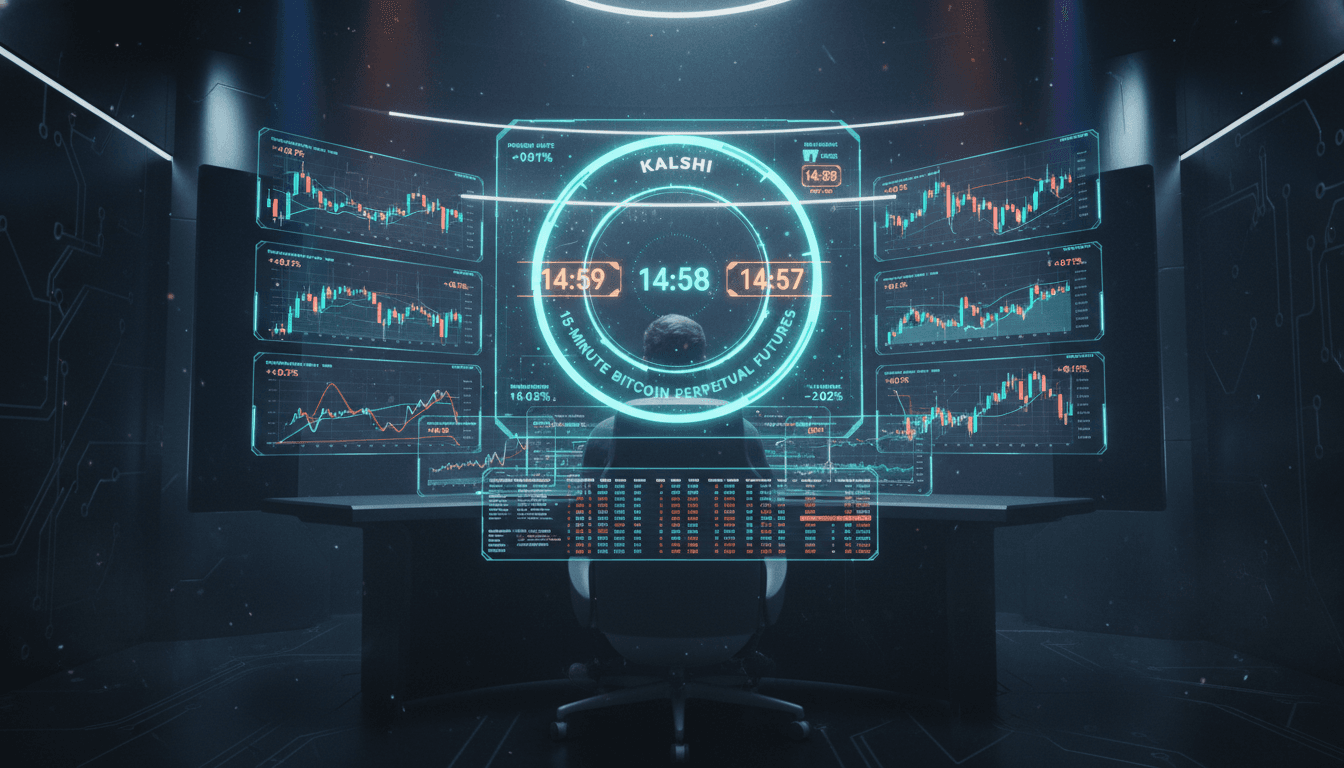
On April 27, 2026, Kalshi launched crypto perpetual futures under the codename "Timeless" — three days ago as of writing (Bitcoin Magazine, Apr 2026). Polymarket beat them to market by a week with their own perpetuals offering up to 10x leverage on BTC, gold, and NVDA (CNBC, Apr 21, 2026). The race to put crypto derivatives on regulated US prediction markets is on, and the winners aren't who you'd expect.
Five-minute Bitcoin contracts already account for 67% of all Polymarket crypto prediction volume, and short-duration contracts make up over 50% of Kalshi's crypto flow (crypto.news / FT, 2026). Combined daily volume on these contracts hit $70 million (Benzinga, Mar 2026). The reason: humans can't process implied volatility, settlement risk, and orderbook depth every 15 minutes. Bots can.
Here's the practical guide. What's available, how it actually works, where the bot edge lives, and how Kalshi crypto compares to Binance, CME, and offshore exchanges.
Key Takeaways
- Kalshi launched perpetual futures April 27, 2026 — three days after Polymarket beat them to market with up to 10x leverage (CNBC, Apr 2026)
- Short-duration crypto contracts (5-15 min) generate $70M daily volume across both platforms combined and dominate over 50% of crypto flow on each
- 15-minute binary contracts are bot-native — humans can't react fast enough to make multiple sequential decisions every 15 minutes
- CFTC-regulated structure, fee transparency, and US tax treatment differentiate Kalshi from offshore exchanges like Binance and Bybit
What Did Kalshi Actually Launch on April 27?
Kalshi launched crypto perpetual futures contracts on Bitcoin and Ethereum, with Solana support expected to follow (Yahoo Finance, Apr 2026). The product sits alongside Kalshi's existing 15-minute binary crypto contracts, which have been live since December 2025 across BTC, ETH, and SOL and account for roughly 50% of Kalshi crypto flow (Good Money Guide, Dec 2025).
The naming matters here. Kalshi's "Timeless" branding signals the perpetual futures angle — contracts with no expiration, settled continuously through funding rate payments. This is the model Binance, Bybit, OKX, and other offshore crypto exchanges have used to dominate global crypto derivatives. CFTC Chairman Michael Selig confirmed the agency intends to regulate crypto perps within its existing framework (Bloomberg, Apr 2026).
There are two distinct product types worth understanding:
15-Minute Binary Contracts
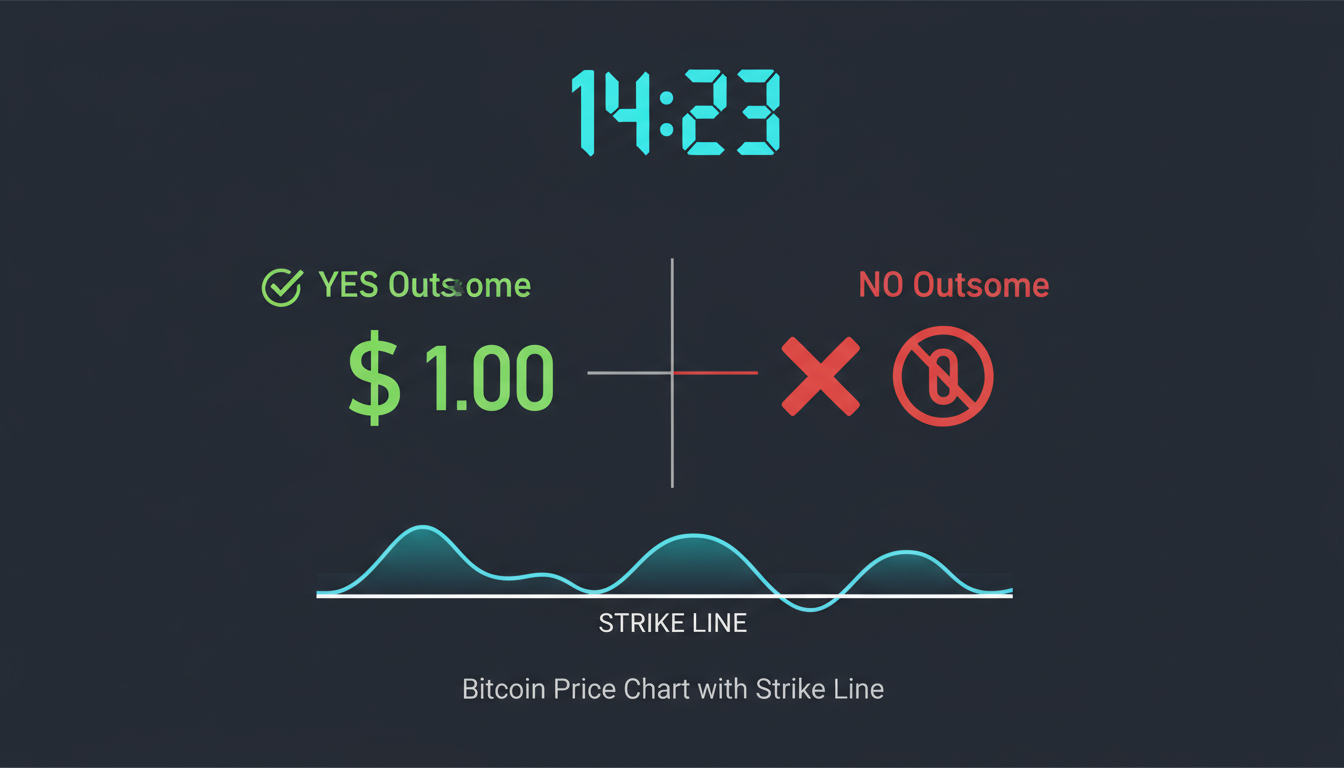
These are pure event contracts. "Will BTC close above $X in 15 minutes?" YES or NO. Settlement happens at the contract's expiration — your position pays $1.00 if correct, $0 if wrong. Maximum loss is your entry price.
Perpetual Futures
No expiration. You hold the position as long as you want, paying or receiving funding rate payments based on the gap between the perpetual price and the spot price. Familiar territory if you've traded on Binance or Bybit, but new to a US-regulated venue.
CCN reported funding fee caps of approximately 11% APR with settlement windows ranging from 5 minutes to 8 hours (CCN, Apr 2026). Specific leverage limits weren't publicly disclosed before launch.
Key insight: The interesting product isn't the perpetual futures — it's the 15-minute binaries. Perpetuals are a commodity offering. Every offshore exchange has them. The 15-minute binary contracts are uniquely Kalshi's territory: short enough that traditional finance can't replicate them, regulated enough that crypto-native traders can't dismiss them. The bot opportunity is overwhelmingly on the binary side.
For a deeper look at Kalshi's broader product strategy, see our breakdown of Kalshi's macro contracts and why automation dominates prediction markets.
Why Are 15-Minute Crypto Contracts Bot-Native?
Combined crypto perpetual futures volume grew 75% in two years — from $4.14 trillion monthly in January 2024 to $7.24 trillion in January 2026 (CoinGecko Research / Coinglass, Jan 2026). Peak single-day volume hit approximately $750 billion. None of that is human traders making thoughtful decisions every 15 minutes. It's bots.
A 15-minute binary contract requires you to:
- Read the current orderbook and infer implied volatility
- Compare against your model's probability estimate
- Account for the funding rate or settlement risk
- Size the position appropriately
- Submit an order before the price moves
- Repeat in 15 minutes
A human can do this maybe twice an hour with quality. A bot does it every 15 minutes for as many contracts as exist, simultaneously. The math is unforgiving.
Polymarket added per-trade fees up to 1.56% on crypto markets specifically to curb bot activity (crypto.news / FT, Jan 2026). Volume kept growing post-fee. The fees didn't stop the bots — they just made the bots more efficient.
What Bot Strategies Actually Work Here?
Latency arbitrage. Kalshi prices update in real-time. Coinbase and other spot exchanges have brief lags. A bot that watches both can identify when Kalshi is mispriced relative to spot and capture the gap.
Cross-platform arb. Polymarket BTC contracts and Kalshi BTC contracts diverge frequently. A 5% spread on a 15-minute binary creates structural arbitrage just like the patterns we covered in our arbitrage bots deep dive.
Volatility forecasting. Bots that run statistical models on order flow, funding rates, and on-chain data can forecast 15-minute realized vol better than the implied vol baked into contract prices. The edge is small per trade. Cumulative over 96 daily contracts, it compounds.
Funding rate plays. When Kalshi's perpetual price diverges from spot beyond a threshold, the funding rate payment becomes attractive. Bots that arb the funding rate against spot can collect risk-controlled returns.
From our experience: The Turbine Studio users running 15-minute crypto strategies share a pattern: they don't try to predict price direction. They predict implied volatility relative to realized volatility. When IV is overpriced, they sell. When IV is underpriced, they buy. Direction-agnostic. The traders who try to call BTC up or down every 15 minutes lose money. The ones who model volatility win.
How Does Kalshi Crypto Compare to Binance, CME, and Polymarket?
Binance commands roughly 29.3% of crypto perpetual futures market share with $25 trillion in 2025 volume; OKX and Bybit each hold around 21% (iTrusty / CoinGlass, 2025-2026). CME Bitcoin futures open interest hit a record $45 billion in April 2026, with each contract representing 5 BTC notional (CoinReporter / CME Group, Apr 2026).
Kalshi and Polymarket are the small players by volume. But they're playing a different game.
The Core Differences
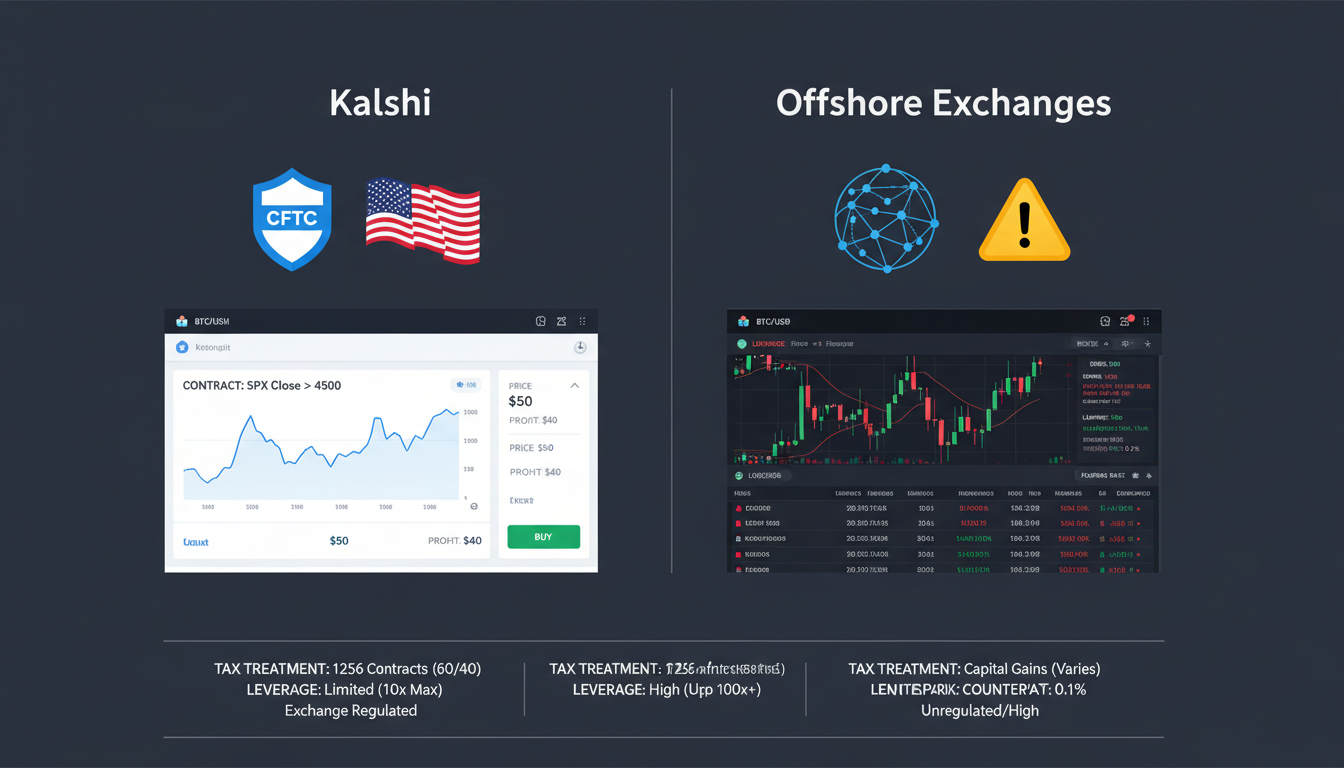
Regulatory status. Kalshi is a CFTC-designated contract market (DCM). Polymarket operates offshore but recently signed an MoU with the CFTC for an integrity framework. Binance, Bybit, OKX, and most major crypto exchanges are not US-regulated and require offshore accounts.
Tax treatment. Kalshi event contracts may qualify for Section 1256 60/40 treatment depending on classification. Crypto exchange perpetual futures are taxed as ordinary income, with each trade potentially triggering taxable events. The tax math alone can make Kalshi cheaper for active US traders.
Leverage. Binance offers up to 100-125x on BTC perps. Polymarket caps at 10x. Kalshi's launch leverage limits weren't publicly disclosed before April 27, but expected to be conservative for a CFTC-regulated venue. Lower leverage means lower blow-up risk but capped upside.
Fee structure. Kalshi uses its existing event contract fee formula: 7% × p × (1−p) for takers (Kalshi Fee Schedule). Crypto exchanges typically charge 0.04-0.10% per trade. For a 15-minute binary at 50¢ pricing, Kalshi's fee tops out at about $0.0175 per contract — competitive at small size, expensive at scale.
Settlement and counterparty risk. Kalshi clears through US-regulated infrastructure. Funds sit in segregated accounts at regulated banks. Offshore crypto exchanges have a documented track record of solvency issues, withdrawal freezes, and outright collapses (FTX, Celsius, etc.).
For more on the regulatory landscape, see our prediction market regulation guide.
How Do You Actually Place Your First Trade?
Kalshi processes over $1 billion weekly notional volume — $1.87 billion as of March 2026 (FinancialContent / Sacra, Mar 2026). Liquidity isn't the problem. Knowing what to actually do is. Here's the path.
Step 1: Account Setup
Create a Kalshi account. Verify identity (required — CFTC regulated). Deposit funds via bank transfer or debit card. Minimum deposit: zero.
Step 2: Pick Your Product
- Manual learning? Start with 15-minute BTC binary contracts. Smallest unit, fastest feedback loop.
- Hedging existing crypto exposure? Kalshi perpetuals let you short BTC without leaving the regulated banking system.
- Automated trading? Skip directly to perpetuals or 15-min binaries. The API supports both.
Step 3: Read the Orderbook
Pull up a 15-minute BTC contract. The market price is the implied probability of the YES outcome. A contract at $0.62 implies the market thinks there's a 62% chance BTC closes above the strike. Your job is to decide if 62% is too high or too low.
Step 4: Position Size
Use fractional Kelly sizing. For a 15-minute binary at price m with your estimated probability p, optimal Kelly size is f* = (p − m) / (1 − m) of bankroll. In practice, use 25% of full Kelly to survive losing streaks. For a $10K bankroll with a 5% perceived edge, that's $625 max per contract.
Step 5: Set Exit Rules Before Entering
With binaries, the exit rule is automatic — settlement at expiration. With perpetuals, you decide. Most successful Kalshi crypto traders set hard stop-losses at -25% per position and take-profits at +50%.
Our finding: Across Turbine Studio users running automated 15-minute crypto strategies, the most consistent winners share three patterns: (1) they trade volatility, not direction, (2) they cap individual contract exposure at 2% of bankroll, (3) they don't trade outside US market hours when liquidity is thinner. The traders trying to scalp 15-minute trends with directional bets get crushed by the bots that have been doing this for months on offshore venues.
Should You Build a Kalshi Crypto Trading Bot?
Trader Max Wojcik told the FT he claimed to "double his capital in two months" using AI chatbots like Claude, Gemini, and ChatGPT for 5-minute BTC bets (crypto.news / FT summary, 2026). Anecdotal. But the broader pattern — automation winning over humans on short-duration crypto contracts — is well documented.
Two paths to building one. The hard way: integrate the Kalshi API, manage authentication, build order management, design risk controls, host on a VPS, handle reconnects and edge cases. Plan on 4-6 weeks before your first paper trade. The easy way: describe your strategy on Turbine Studio, let it generate the bot code, deploy in minutes.
For a deeper comparison, see our hard way vs. easy way breakdown and strategies you can automate today.
Build your first Kalshi crypto bot on Turbine Studio
What Are the Risks Most Coverage Glosses Over?
Owen Lau of Clear Street told reporters that Kalshi's launch isn't an immediate threat to Coinbase or Binance: "I don't see this as an immediate threat... It'd be hard to ask people from Coinbase or Binance or Robinhood to abandon their existing platform." Mizuho's Dan Dolev called it "a defensive move more than it is an offensive move" — Kalshi guarding against Robinhood eventually offering perpetuals itself (Bloomberg, Apr 2026).
The launch is real. The trader migration may not be.
Realistic risks for traders evaluating this product:
Liquidity in early days. Kalshi's combined short-duration crypto volume is $35M-$40M daily — meaningful for retail but tiny next to Binance. Slippage on large orders could be brutal in the first weeks.
Bot competition. The same bots dominating Polymarket and offshore exchanges are already integrating Kalshi APIs. Retail traders entering 15-minute markets are competing against systems that have run for months.
Funding rate uncertainty. Kalshi perpetual funding rates aren't fully battle-tested. The 11% APR cap reported by CCN is a directional figure, not a guarantee. Funding rate dynamics in volatile markets can produce unexpected costs.
Regulatory risk. While Kalshi is CFTC-regulated, the boundaries between event contracts and securities/futures remain disputed. State-level legal challenges continue. Future regulatory shifts could change product economics.
For a deeper look at how data signals beat intuition in these markets, see our post on why your edge isn't intuition.
Frequently Asked Questions
Are Kalshi crypto perpetual futures legal in all 50 states?
Yes for most users. Kalshi operates as a CFTC-designated contract market under federal regulation, with preemption arguments holding in federal courts. Some state-level legal challenges remain unresolved, but Kalshi's $11 billion valuation and $1.87 billion weekly volume suggest the regulatory framework is durable (Kalshi News, Dec 2025).
How are Kalshi crypto contracts taxed compared to Binance perpetuals?
Kalshi event contracts may qualify for Section 1256 60/40 tax treatment, while crypto exchange perpetuals are typically taxed as ordinary income with each trade potentially triggering a taxable event. Consult a tax professional — the OBBBA legislation passed in late 2025 also introduced gambling-loss caps that may affect classification.
Can I really make money on 15-minute Bitcoin contracts as a manual trader?
Probably not consistently. Combined daily volume on 5-15 minute crypto contracts hit $70 million, with bots dominating execution (Benzinga, Mar 2026). Manual traders can win occasionally on conviction trades, but systematic profit requires automation.
What's the minimum capital to start trading Kalshi crypto contracts?
Kalshi has no minimum deposit. Individual contracts trade at fractional dollar amounts ($0.01-$0.99). With $500 you can take meaningful positions across multiple 15-minute BTC contracts and learn the mechanics. Scale up only after validating an edge with real-money trades over 50+ positions.
How does Kalshi's crypto product differ from Polymarket's?
Polymarket launched perpetuals April 21 with up to 10x leverage on BTC, gold, and NVDA (CNBC, Apr 21, 2026). Kalshi launched April 27 with crypto perpetuals and existing 15-minute binary contracts. Kalshi is CFTC-regulated; Polymarket operates offshore. For US traders, Kalshi offers cleaner tax and regulatory treatment. For higher leverage and broader asset coverage, Polymarket may be preferable.
The Crypto Window Just Opened — Bots Are Already Inside
Kalshi's April 27 launch is a regulatory milestone, not just a product launch. For the first time, US traders can access crypto perpetual futures and short-duration binaries on a CFTC-regulated venue with proper banking infrastructure and tax treatment. That's a meaningful shift from the Binance/Bybit offshore default.
But the trading edge — especially on 15-minute binary contracts — is overwhelmingly on the bot side. Combined $70M daily volume on these contracts didn't come from humans clicking buy. It came from systems that monitor every contract, every 15 minutes, all day.
- 15-minute crypto binaries are bot-native by design — humans can't process the decision speed
- Combined daily volume of $70M+ across Kalshi and Polymarket short-duration contracts
- Crypto perpetual futures grew from $4.14T to $7.24T monthly volume in 2 years
- Kalshi's CFTC regulation and Section 1256 tax potential differentiate it from offshore exchanges
- Real edge is direction-agnostic volatility forecasting, not BTC up/down predictions
If you're going to trade these contracts seriously, build a bot. If you're going to build a bot, start somewhere with the infrastructure already handled.
Start building your Kalshi crypto trading bot on Turbine Studio
This post is for informational purposes only and does not constitute financial, legal, or tax advice. Crypto perpetual futures trading involves significant risk of loss, including total loss of invested capital. Past performance does not indicate future results. Consult a financial advisor for advice specific to your situation.