Prediction Markets vs Options vs Sports Betting: A Trader's Comparison (2026)
 Ryan Bajollari
Prediction markets, options, and sportsbooks all bet on outcomes — but sportsbooks keep ~9% while Kalshi takes ~1.2%. A trader's 2026 instrument comparison.
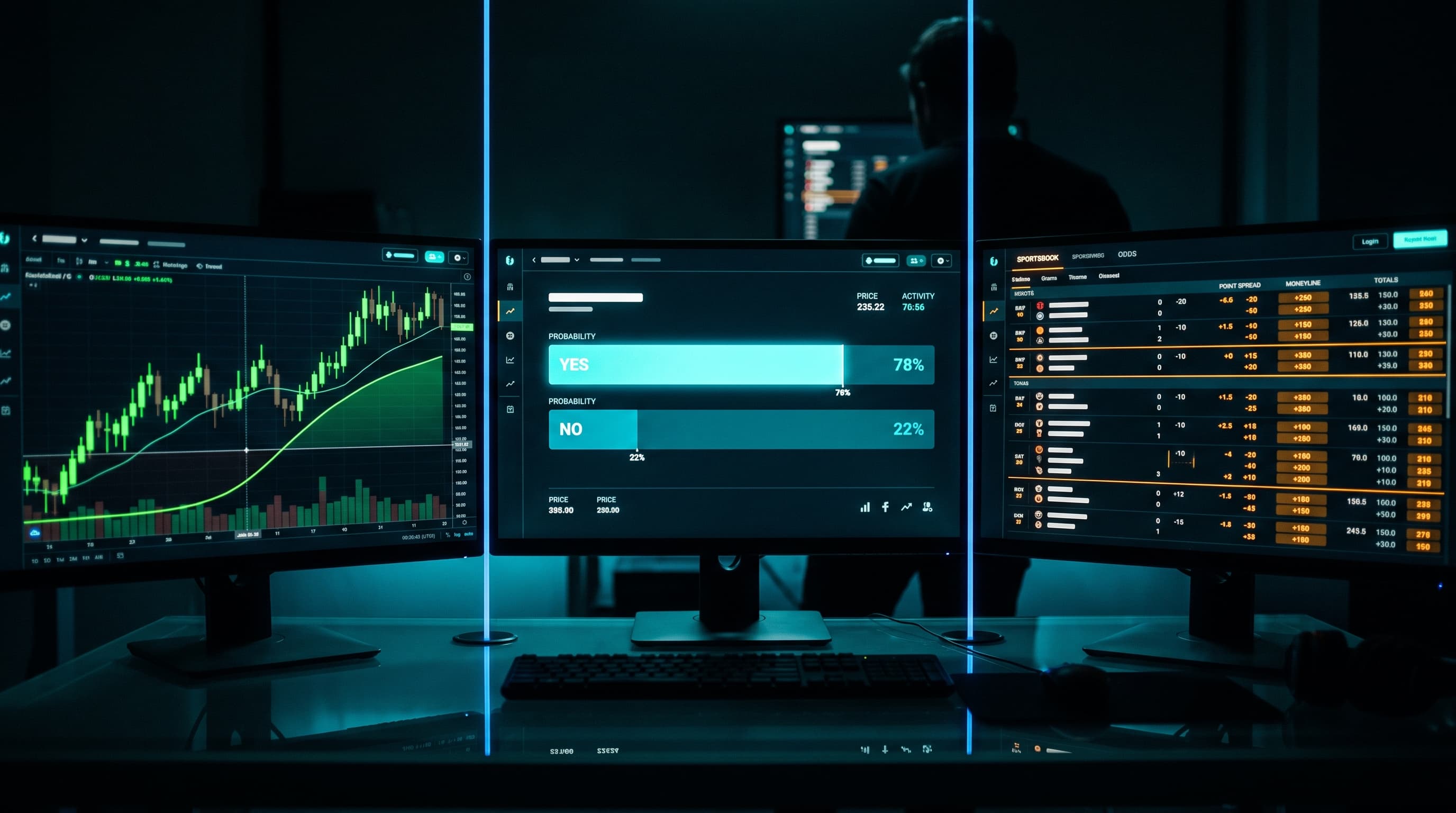
Options traders, sports bettors, and prediction market traders are all doing the same thing: putting money on an outcome. The difference is what it costs them. A US sportsbook kept 9.3% of every dollar that stayed in play in 2024 (ESPN / AGA, 2025). Kalshi's effective take was roughly 1.2% (Yahoo Finance, 2026). Listed options charge no commission at most major brokers. Same instinct, three very different bills.
That gap matters more than most comparison articles admit. US listed options hit 15.2 billion contracts in 2025 — a sixth straight record (Cboe, 2026). Legal sportsbooks took $147.9 billion in handle in 2024 (ESPN / AGA, 2025). And prediction markets grew about 4x to $63.5 billion in 2025 (Yahoo Finance / CertiK, 2026). Three booming markets, three different rulebooks. Here's how a trader should think about each.
Key Takeaways
- All three let you bet on an outcome, but the house take ranges from near-zero (options commission) to ~1.2% (Kalshi's effective fee) to ~9.3% (2024 sportsbook hold) (ESPN / AGA, 2025)
- Prediction markets offer binary, defined-risk payoffs with no Greeks; options add leverage and flexibility but bring time decay and, for short positions, undefined risk
- Prediction markets and options are true two-sided exchanges — you can sell to close before expiry. Sportsbooks set a line and mostly lock you in
- Tax treatment splits sharply: index options get Section 1256 60/40, sports winnings are ordinary income, and prediction markets sit in a contested gray zone with no 1099-B
- No instrument wins outright — the right pick depends on your edge, your risk geometry, and whether you plan to automate
The Same Bet, Three Different Instruments
Strip away the branding and each instrument is a claim on a future event. But the structure underneath changes everything about how you trade it.
A prediction market contract on Kalshi is a binary. You buy YES or NO at a price between $0.01 and $0.99, and it settles at $1.00 or $0.00. Buy YES at $0.40, and you risk 40 cents to make 60. The price is the market's probability. Clean, capped, and easy to reason about.
An options contract is a right, not a binary. A call or put gives you exposure to how far an underlying moves, not just whether an event happens. That brings leverage and flexibility — and the Greeks (delta, gamma, theta, vega) that govern how your position behaves as price, time, and volatility shift.
A sportsbook wager is a bet against the house at a fixed line. You're not trading a contract with another participant. The book sets the odds, bakes in its margin, and holds your stake until the game ends.
Key insight: The cleanest way to compare these three isn't "which pays more." It's three axes a trader already knows — cost to trade, risk geometry, and exit liquidity. On every one of those axes, the binary event contract sits between the simplicity of a sportsbook bet and the flexibility of an options position. That middle ground is exactly why prediction markets are pulling in both crowds.
If you're new to the category, our beginner's guide to prediction markets covers the mechanics before you compare instruments.
What Does It Actually Cost to Trade Each One?
This is the comparison most articles get lazy about — and the one that matters most. Let's use real 2025–2026 numbers instead of the tired "Kalshi has zero fees" line, which isn't true.
Kalshi charges a formula-based trading fee — it's not free. The fee scales with a contract's price and tops out near 1.75 cents per contract around a 50-cent price (Kalshi Help Center, 2026). Across 2025, that worked out to about $263.5 million in fees on $22.88 billion of volume — an effective take rate just under 1.2% (Yahoo Finance, 2026).
Options sit at the cheap end. Major US brokers charge no commission on equity and index options; your real cost is the bid-ask spread, which varies by contract liquidity (Cboe, 2026). Sportsbooks sit at the expensive end. The theoretical hold on a standard −110/−110 line is about 4.5% (GamedayMath, 2026), but books actually held 9.3% nationally in 2024 once parlays and live betting fold in (ESPN / AGA, 2025).
Our finding: Put the three side by side and the sportsbook is the worst deal for anyone trading on edge. A bettor pays roughly 8x the cost of a Kalshi trade and gives up far more than an options trader paying only the spread. For high-frequency or systematic strategies, that cost gap compounds fast — it's the difference between an edge that survives and one that the vig eats. This is the single comparison most "prediction markets vs sports betting" articles skip.
Defined Risk, No Greeks: The Options Comparison
Here's where prediction markets win over options for a lot of traders — and where they don't.
A binary contract has dead-simple risk. Your maximum loss is what you paid, your maximum gain is the rest of the dollar, and there are no Greeks to manage. No theta bleeding your position while you wait. No volatility crush after the event. The contract is worth its probability, and at settlement it's worth $1 or $0. For a trader who wants a clean directional view on an event, that simplicity is the whole appeal.
Options give you something binaries can't: leverage and shape. A long call costs a fraction of the underlying and pays off proportionally to the move — the further it runs, the more you make, with no cap. You can build spreads, hedge equity exposure, and express views on volatility itself. That flexibility is why retail now drives about 43% of daily US options volume, and why 0DTE contracts have grown to 59% of SPX volume (Traders Magazine, 2026).
The catch is risk geometry. A long option caps your loss at the premium, but a short option can lose far more than you collect. Binaries never do that — your downside is always the stake. The chart below shows the difference.
So the trade-off is real. Want defined risk and a payoff you can explain in one sentence? Binaries. Want leverage, hedging, and volatility plays — and you're willing to manage the Greeks? Options. Many traders run both, using prediction markets for clean event views and options for everything price-and-volatility shaped.
True Two-Sided Markets vs Betting Against the House
The sportsbook comparison comes down to one structural fact: a prediction market is an exchange, and a sportsbook is a counterparty.
On Kalshi or in the options market, every trade has another participant on the other side. You can buy, and you can sell to close before expiry. Bought a contract at $0.40 and it's trading at $0.65 at halftime? Sell it and book the gain. That sell-side liquidity means you can take profit, cut losses, or flip your view mid-event — the same way you'd manage any position.
A sportsbook doesn't work that way. The book sets the line, takes your bet, and holds it to settlement. Some offer a "cash out," but the price is the book's, not a market's — and it's shaded in the house's favor. You also can't freely sell the "other side" of your bet to a willing buyer. There's no order book; there's just the house. That's the heart of the difference our sports prediction markets guide digs into for the sports vertical specifically.
This is why systematic traders gravitate to exchanges. Two-sided liquidity is what makes market-making, arbitrage, and continuous risk management possible. You can read how that plays out in practice in our breakdown of how to make money on prediction markets.
From our experience: The traders who switch from sportsbooks to prediction markets rarely come back — not because the contracts are more exciting, but because they can finally exit a position. Being able to sell at $0.65 instead of praying for $1.00 changes how you size, how you manage risk, and how often you trade. It turns a one-shot bet into an actual position you can work.
How Each Is Taxed (And Why It's Not Settled)
Taxes quietly decide who keeps their winnings — and this is the second place competitor articles get it wrong.
Sports betting is the simplest and the harshest. Winnings are ordinary income, taxed up to 37%, and starting in 2026 a new rule caps deductible gambling losses at 90% of winnings — meaning you can owe tax even at break-even (Kiplinger, 2026; IRS, 2026). Casual bettors also have to itemize to deduct anything at all.
Options split by type. Broad-based index options (SPX, NDX, RUT) get Section 1256 treatment — 60% long-term, 40% short-term, for a blended rate near 26.8% regardless of holding period. Equity options (think SPY or single stocks) are taxed as ordinary capital gains, up to 37% if short-term (TurboTax, 2026).
Prediction markets are the gray zone. Many articles claim they automatically get the same 60/40 treatment as futures. The honest answer is that it's contested — the CFTC classifies event contracts as swaps, which may trip the Section 1256 exclusion, the IRS hasn't issued guidance, and platforms don't send a 1099-B, so you self-report (Camuso CPA, 2025). Treat any "60/40" assumption as an aggressive position, not a settled fact, and talk to a tax professional.
| Tax dimension | Prediction markets | Index options (SPX) | Sports betting |
|---|---|---|---|
| Classification | Section 1256 — contested | Section 1256 (60/40) | Ordinary income |
| Top blended rate | ~37% if treated as ordinary | ~26.8% | Up to 37% |
| Loss treatment | Self-report, no 1099-B | Full netting | Itemize only; 90% cap (2026) |
Regulation tracks the tax picture. Options and index products are SEC/CFTC-regulated and decades-established. Kalshi is a CFTC-designated contract market, though state-level challenges continue — our 2026 regulation guide covers the live court fights. Sports betting is a state-by-state patchwork, now legal in 38–39 states plus DC (CBS Sports, 2026).
Which Instrument Wins? Honest Answer: It Depends
No instrument is best for everyone. Match the tool to your edge.

Options win when you want leverage, want to hedge a stock portfolio, or have a view on volatility rather than a single event. The liquidity is enormous, the tax treatment on index options is favorable and settled, and the flexibility is unmatched. The price is complexity — you're managing the Greeks whether you want to or not.
Sportsbooks win in narrow cases: a specific prop a prediction market doesn't list, a sign-up promotion with real expected value, or pure convenience. For a profit-seeking trader, though, the ~9% hold and ordinary-income tax are hard to overcome. You're paying a premium for a one-shot bet you can't exit.
Prediction markets win when you want a clean, defined-risk view on a real-world event — elections, economic data, crypto levels, sports — at a fraction of the sportsbook's cost, on a two-sided market you can exit anytime. They're also the most automation-friendly of the three, with open APIs that let you run systematic strategies. The trade-offs are thinner liquidity than options on some contracts and that unsettled tax status.
Key insight: The instrument you should trade is the one that matches your edge, not the one with the biggest market. If your edge is reading events, the binary's low cost and clean payoff beat both alternatives. If your edge is volatility or you need leverage, options. Sportsbooks rarely win on the math — they win on habit. The fastest upgrade for most sports bettors is simply moving the same opinions onto an exchange.
That automation angle is where prediction markets pull ahead for serious traders. You can describe a strategy in plain English on Turbine Studio and have it trading Kalshi contracts in minutes — no managing Greeks, no sportsbook locking your bet, no code. Browse strategies you can automate today to see what that looks like in practice.
Build and backtest your first prediction market strategy on Turbine Studio
Frequently Asked Questions
Are prediction markets cheaper than sportsbooks?
Yes, by a wide margin. Kalshi's effective fee was about 1.2% of volume in 2025, while US sportsbooks held 9.3% in 2024 (Yahoo Finance, 2026; ESPN / AGA, 2025). Prediction markets aren't free — the "zero fees" claim is wrong — but they're far cheaper than the vig on a sportsbook line.
How are prediction markets different from options?
Prediction market contracts are binaries that settle at $0 or $1, with capped risk and no Greeks. Options give leveraged, uncapped exposure to how far an underlying moves, plus tools to hedge and trade volatility — at the cost of managing delta, gamma, theta, and vega. Binaries are simpler; options are more flexible.
Do prediction markets get the same 60/40 tax treatment as futures?
It's contested, not guaranteed. Some treat event contracts as Section 1256 (60/40), but the CFTC classifies them as swaps, which may exclude them, and the IRS hasn't issued guidance (Camuso CPA, 2025). Platforms don't issue a 1099-B, so you self-report. Treat 60/40 as an aggressive position and consult a tax professional.
Can I automate trading across these instruments?
Prediction markets are the most automation-friendly. Kalshi offers free API access (REST, WebSocket, FIX), and tools like Turbine Studio let you build bots without code. Options can be automated through broker APIs but require managing the Greeks. Sportsbooks actively block automated and sharp betting, so systematic strategies are hard to run there.
Which is best for a beginner?
Prediction markets, for most people. The binary payoff is easy to understand, risk is capped at your stake, and costs are low. Options demand you learn the Greeks before risking capital, and sportsbooks charge the highest effective price. Start with small, defined-risk event contracts, then expand once you understand how the market prices probability.
The Bottom Line
Three instruments, three rulebooks. The right choice isn't about which market is biggest — it's about which one fits how you trade.
- Cost: Options (spread only) and prediction markets (
1.2%) are far cheaper than sportsbooks (9.3% hold) - Risk geometry: Binaries are capped both ways; long options cap losses but leverage upside; short options carry undefined risk
- Liquidity: Prediction markets and options are two-sided exchanges you can exit; sportsbooks lock you in
- Tax: Index options get clean 60/40, sports winnings are ordinary income with a new 90% loss cap, and prediction markets sit in a contested gray zone
- Automation: Prediction markets are the most bot-friendly, with open APIs and no-code tools
If your edge is reading events, the binary contract is usually the best-priced way to express it — and the easiest to automate.
Start building automated prediction market strategies on Turbine Studio
This post is for informational purposes only and does not constitute financial, tax, or legal advice. Trading prediction markets, options, and sports betting all involve risk of loss, including total loss of capital. Tax treatment is general and unsettled in places — consult a qualified tax professional for your situation. Past performance does not indicate future results.