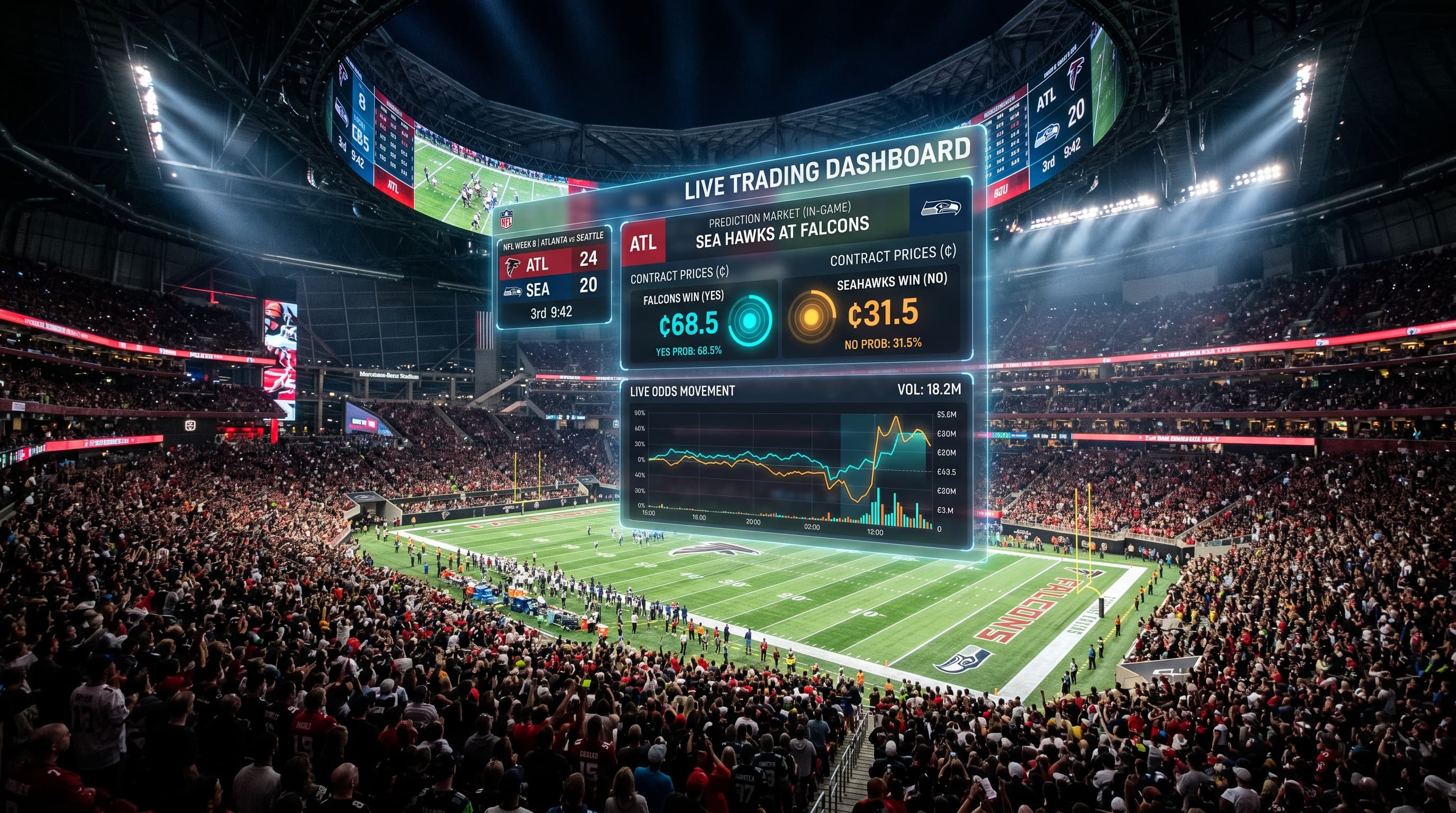
How to Market-Make on Kalshi and Polymarket: Earn the Spread Instead of Paying It (2026)
 Ryan Bajollari
On Kalshi, ~95% of liquidity comes from 2,000+ small market makers — some just individuals. Here's how to quote two-sided liquidity and earn the spread in 2026.
Every time you take a price on Kalshi, you pay the spread. Someone else earns it. And that someone is usually not a giant: roughly 95% of bid matches on Kalshi come from more than 2,000 smaller market makers, "some of which are just individuals," co-founder Luana Lopes Lara said in 2026 (eFinancialCareers, 2026). Only about 5% comes from institutions like Susquehanna.
That number reframes everything. The maker side of the book isn't walled off behind a Citadel badge. Retail can post quotes too. This post is the structural flip side of our piece on why your trades keep getting picked off — that one is about being the victim of the spread. This one is about earning it. It's also advanced, and a good way to lose money fast if you skip the risk sections. So we won't skip them.
Key Takeaways
- About 95% of Kalshi's bid matches come from 2,000+ small market makers — the maker side is open to retail (eFinancialCareers, 2026)
- Kalshi makers pay a fraction of the taker fee (reported at roughly a quarter), charged only when an order fills; canceling is free (Kalshi, 2026)
- Polymarket makers pay 0% and get 20–25% of taker fees rebated daily, plus a share of liquidity-rewards pools with per-market caps up to $52,000 (Polymarket, 2026)
- The catch: makers win on miscalibrated retail flow and bleed on informed flow — Kalshi's own in-house market maker is "not profitable" (Bloomberg via Yahoo, 2026)
The Spread Is a Cost to Takers and Income to Makers
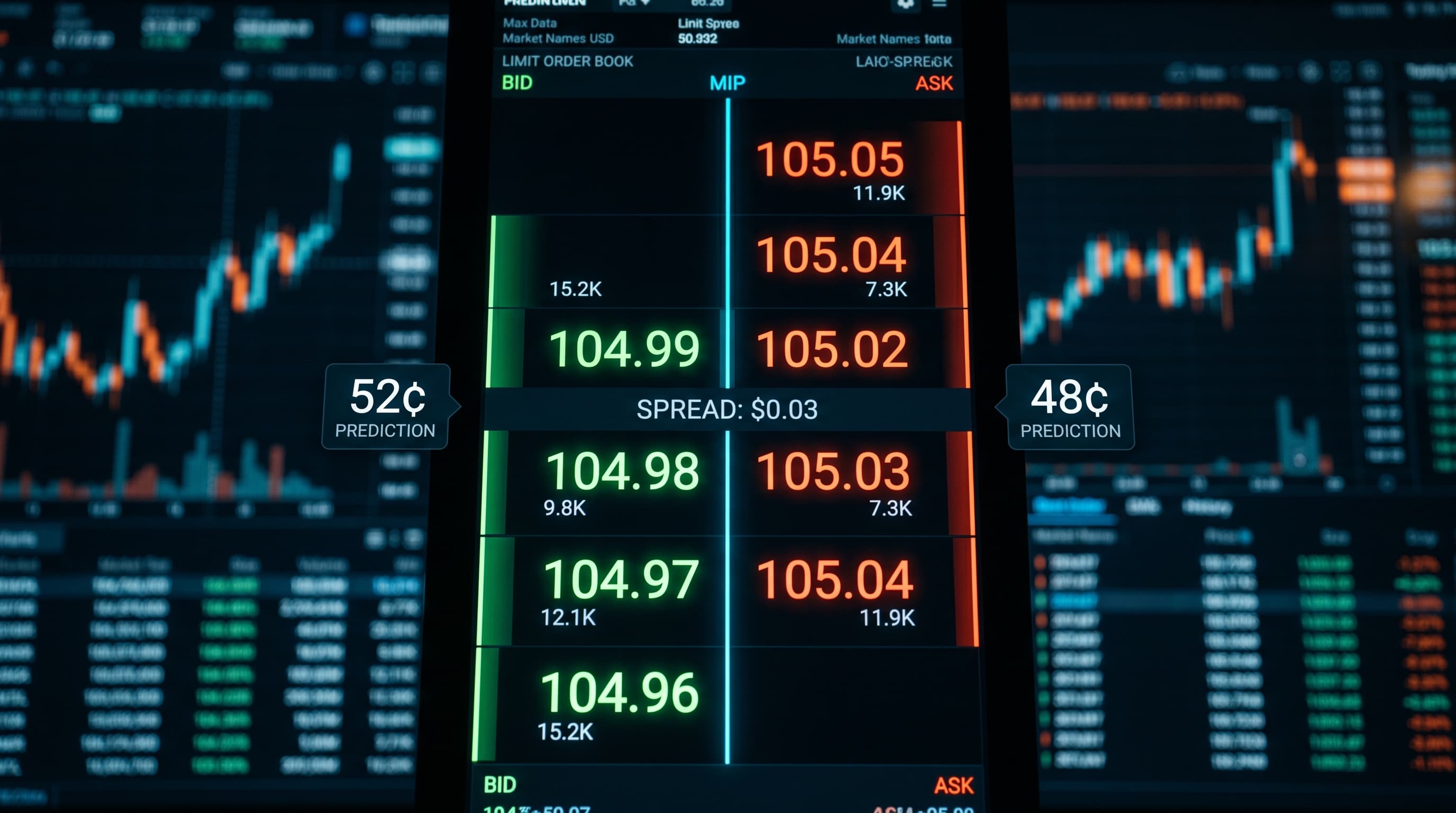
Start with the mechanic our pick-off post laid out. A market maker posts a bid and an ask. The gap between them — the spread — is what takers pay to trade immediately. If a contract is bid 47¢ / ask 52¢, a buyer pays 52¢ and a seller gets 47¢. The maker who quoted both sides pockets the 5¢ difference when both fill.
Do that across thousands of round trips and the spread becomes a yield. That's the whole business. You're not predicting outcomes better than anyone. You're getting paid to be the counterparty who's always there.
The reason this pays at all is adverse selection. The classic Glosten-Milgrom model (1985) showed that spreads exist precisely because some traders know more than the maker (Glosten & Milgrom, JFE, 1985). The maker loses to those informed traders and recovers it from everyone else. So the maker's profit-and-loss reduces to one honest identity.
The market maker's P&L, in plain English: Maker P&L ≈ the spread you capture on uninformed round trips, minus what you lose to informed traders who pick off your stale quotes, minus the directional damage your inventory takes when the market moves against it. Win the first term, survive the other two, and you earn the spread. Lose control of either, and you've just become the slow side of someone else's trade (Glosten & Milgrom, 1985).
Everything below is about making that first term big and the other two small.
What the Maker Side Costs (and Pays) on Kalshi
Kalshi's taker fee is small but real: fee = round_up(0.07 × C × P × (1−P)) per contract, where C is contracts and P is price in dollars. It peaks at 1.75¢ per contract at a 50¢ price and shrinks toward the penny tails (Kalshi, 2026). On S&P 500 and Nasdaq-100 range markets, the coefficient is half that (0.035), so those are cheaper to trade.
Makers get a better deal. Kalshi charges makers a fraction of the taker fee — reported at roughly a quarter — and on some markets nothing. Critically, a resting order is only charged when it actually fills, and canceling costs nothing (Kalshi, 2026). That cancel-for-free rule is what makes high-frequency re-quoting viable: you can pull and replace stale quotes all day without bleeding fees.
Above the basic fee tier sits Kalshi's market maker program. Designated market makers get reduced fees and adjusted position limits in exchange for two-sided quoting obligations and a steep uptime requirement — 98% availability in each one-hour increment across listed products. Kalshi calls the program "highly selective" (Kalshi, 2026). Susquehanna International Group became Kalshi's first dedicated institutional market maker in 2024, reportedly adding around 30x the prior liquidity in select markets (Business Wire, 2024).
Here's where the brief most retail traders carry is wrong. Kalshi does run a Liquidity Provider Program, but it's not a flat rebate you opt into. It's gated behind a signed Market Maker Agreement, and rewards are distributed by an auction among designated providers who meet incentive-period requirements (Kalshi, 2026). For an individual quoting from a laptop, the real Kalshi edge isn't a rebate check. It's the lower maker fee and the free cancels.
What the Maker Side Pays on Polymarket
Polymarket is the more generous venue for makers, and it's where the "get paid to provide liquidity" pitch is literally true. Note one thing first: Polymarket is no longer fee-free. Starting with a March 30, 2026 overhaul, Polymarket began rolling out category-based taker fees — sports takers pay up to about 0.75% at the 50/50 price point, crypto carries the steepest fees, and geopolitics markets stay free (Polymarket, 2026). Don't repeat the old "Polymarket has no fees" line. Takers pay now.
But makers still pay 0%. And they collect on the other side three different ways.
First, the maker rebate: Polymarket hands makers back 20% of taker fees on crypto and 25% on every other eligible category, paid daily in pUSD (Polymarket's dollar balance), proportional to the fees your filled liquidity generated (Polymarket, 2026). Second, a separate liquidity rewards program pays you for resting orders close to the midpoint. It scores every order each minute and pays out daily at midnight UTC, weighting two-sided quotes more than one-sided ones (Polymarket, 2026). The pools are real money: documented reward caps reach $52,000 on a single market — the 2026 World Cup final — with smaller per-game caps across the tournament.
For US traders, Polymarket's CFTC-regulated venue uses a simpler flat schedule — a small fixed maker rebate across categories (Laika Labs, 2026). Either way, the structure rewards the same behavior: post tight, two-sided, and stay near the middle.
If you're new to either venue's API surface, our build guides cover the wiring: building a Kalshi bot and building a Polymarket bot.
Inventory Risk: The Way This Actually Hurts
Free money it is not. The second term in that P&L identity — inventory — is where most retail makers blow up.
When your bid fills, you're long. When your ask fills, you're short. If the market trends, you accumulate inventory on the losing side faster than the spread can pay for it. The standard answer is the Avellaneda-Stoikov model (2008), which skews your quotes around a reservation price that shifts away from your inventory: get too long, and you lower both quotes to encourage selling and discourage buying (Avellaneda & Stoikov, Quantitative Finance, 2008). Quote skewing is how a maker stays roughly flat instead of accidentally becoming a directional bettor.
Prediction markets add risks equities don't have, because the contract is binary and bounded between 0 and 1.
Binary-specific risks every maker must price in: Resolution risk — the contract settles to exactly 0 or 1, so any inventory you hold through resolution on the wrong side is a total loss, not a markdown. Pin risk — when price sits near a decisive level at expiry, you can't cleanly hedge or exit. Gap risk — a news headline can move a contract 40–50 points in seconds, jumping straight over your quotes before you cancel. The bounded payoff means the tails are thin exactly when you most need to get out.

This is why market-making and position discipline are the same skill. Sizing your quotes, capping inventory per market, and killing the strategy before resolution all belong in the same risk budget — see our position sizing and risk management guide for the framework.
When Retail Market-Making Works — and When You Just Get Picked Off
Now the honest part. Making markets pays when you're absorbing miscalibrated retail noise. It bleeds when you're standing in front of informed flow. The same market can contain both.
The best evidence comes from Stanford Law's Bartlett & O'Hara study of 41.6 million Kalshi trades. They found makers earn roughly twice as much per contract in single-name markets as in broad-based ones — because traders systematically overbet "YES" in markets that mostly settle "NO," handing makers a behavioral surplus. But the same study found that one-sided, toxic order flow predicts maker losses in exactly those single-name markets (Stanford Law, 2026). You get paid for the noise and punished for the signal, and they arrive at the same address.
How real is the downside? Kalshi's own in-house market maker — a desk with full data and professional tooling — is "not profitable," Lopes Lara disclosed in 2026, running less than 6% of the platform's sports making volume (Bloomberg via Yahoo, 2026). If the house desk can't reliably print on sports, a part-time bot quoting single-name contracts should be humble.
There's a hopeful counterpoint, though. A 2026 analysis of who wins and loses on Polymarket found that winning accounts tend to provide liquidity with resting limit orders, while losing accounts tend to take it with market orders — even as 68.8% of users lost money overall and the top 1% captured most of the profits (Akey et al. via CNBC, 2026). Being the maker is correlated with being a winner. It just isn't sufficient on its own.
The practical read: quote liquid, broad-based markets where informed flow is thin. Be very careful in single-name markets. Treat short-term crypto as automation-only territory — it's the same latency battlefield we covered in the speed and latency post.
The Bot Mechanics: Quoting and Re-Quoting
You cannot do this by hand. A two-sided quote goes stale the instant the fair value moves, and a stale quote is a free option for faster traders. As a rule of thumb, practitioners treat anything slower than a few hundred milliseconds as dangerous — if your cancel-and-replace loop lags the market, fast takers grab your old price before the new one lands. Manual clicking isn't within three orders of magnitude of fast enough.
A minimal market-making loop runs a tight cycle:
- Estimate fair value. Compute a midpoint from the order book (and any external signal — for crypto contracts, the spot price).
- Quote two-sided. Post a bid below and an ask above, sized to your inventory limits. Platforms let you batch orders to cut latency.
- Skew by inventory. If you're long, shade both quotes down (Avellaneda-Stoikov). This pushes you back toward flat.
- Cancel and replace on drift. When the mid moves past a threshold, pull and re-post. Free cancels on Kalshi make this cheap.
- Widen or pull on toxicity. When flow turns one-directional or news is imminent, widen the spread or pull quotes entirely. Time-bounded orders that auto-expire before scheduled events are the clean primitive here.
- Flatten before resolution. Don't hold inventory into settlement.
That loop is fiddly to build and unforgiving to run. We built Turbine Studio so you can describe a quoting strategy in plain English — your spread, your inventory caps, your widen-on-news rules — and have it compiled into inspectable logic, backtested against historical Kalshi data with fees modeled in, and deployed with hard risk limits. The deploy gate stops new quotes when a market behaves outside the strategy's assumptions, which is exactly when stale-quote losses compound. You still own the strategy. You just don't hand-feed edge to faster traders while you sleep. For the broader menu of automatable patterns, see the five strategy archetypes.
Frequently Asked Questions
Is market-making on Kalshi or Polymarket profitable for retail?
Sometimes. Winning Polymarket accounts skew toward providing liquidity rather than taking it (Akey et al. via CNBC, 2026). But 68.8% of users still lose money, and even Kalshi's in-house desk is "not profitable" on sports. Profitability depends on quoting low-toxicity markets and managing inventory ruthlessly.
How much can I earn from the spread?
The spread itself is your gross yield — a 4¢ two-sided quote earns 4¢ per matched round trip before costs. On Polymarket, makers add 20–25% taker-fee rebates plus liquidity-pool payouts on top (Polymarket, 2026). Net profit is gross spread minus adverse selection and inventory losses, which can easily exceed the spread.
Do I need to be a "designated market maker" to earn maker fees?
No. Kalshi's lower maker fee applies to ordinary resting limit orders — you don't need a Market Maker Agreement for that (Kalshi, 2026). The designated programs add rebates and higher limits but are highly selective and carry uptime obligations. Polymarket's maker rebates and liquidity rewards are open to anyone posting qualifying orders.
What's the single biggest risk?
Inventory through resolution. Because contracts settle to exactly 0 or 1, holding the wrong side at settlement is a total loss, not a drawdown. Combined with gap risk on news — 40–50 point moves in seconds — an unmanaged maker can lose far more than weeks of accumulated spread in one event.
Why do I need a bot instead of trading manually?
Stale-quote risk. Quotes must be cancelled and replaced faster than fast takers can pick them off — a window practitioners measure in hundreds of milliseconds. No human clicks that fast, and two-sided quoting across multiple markets simultaneously is only feasible with automation.
The Bottom Line
Earning the spread is the structural inverse of paying it. The opportunity is real, the door is open to retail, and the risk is just as real:
- The maker side isn't gatekept — ~95% of Kalshi liquidity comes from 2,000+ small makers (eFinancialCareers, 2026)
- Makers pay less and get paid more — lower Kalshi fees; 0% plus 20–25% rebates on Polymarket (Polymarket, 2026)
- But adverse selection is undefeated — Kalshi's own desk is "not profitable" (Bloomberg via Yahoo, 2026)
- Quote the calm markets, automate the loop, flatten before resolution — that's the whole edge
If getting picked off was the problem, becoming the maker is one answer — but only if you can quote, skew, and re-quote faster than the field. Start with Turbine Studio and backtest the strategy with fees modeled before you risk a cent. And read the counterpart first: why prediction market trades get picked off.
This article is for educational purposes only. Market-making is an advanced strategy involving substantial risk of loss, including total loss of inventory at contract resolution. Fee schedules and incentive programs change frequently — always check current platform rules before trading. Past performance does not guarantee future results.