Position Sizing and Risk Management for Prediction Market Trading (2026)
 Ryan Bajollari
Full Kelly has a 50% chance of halving your bankroll. Here's the sizing and risk math that keeps prediction-market traders solvent — with Kalshi numbers.
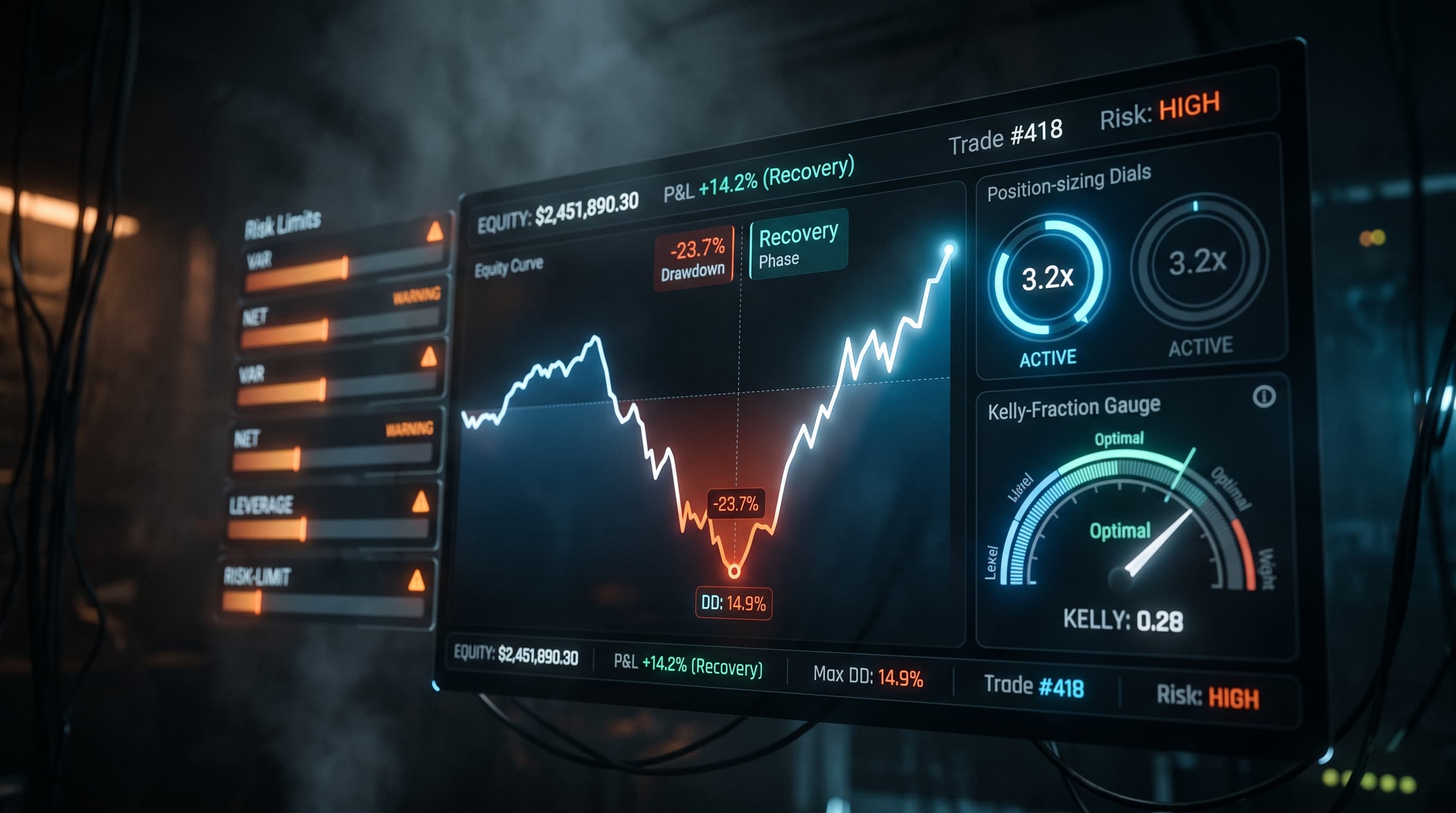
Betting full Kelly gives you a 50% chance of seeing your bankroll cut in half at some point — even when your edge is real (Thorp, "The Kelly Criterion in Blackjack, Sports Betting, and the Stock Market", 2008). That's not a tail risk. It's the base case for sizing correctly and still getting wrecked. Meanwhile a Wall Street Journal investigation of 1.6 million accounts found just 0.1% of Polymarket accounts captured 67% of all profits, and over 70% of users lost money (WSJ via Benzinga, May 2026).
Most of those losses aren't bad picks. They're bad sizing. Our quant playbook treats position sizing as one of five steps. This post is that step, expanded into its full treatment — the Kelly math for binary contracts, why your noisy edge forces you to bet smaller, the drawdown odds nobody shows you, per-market caps, daily circuit breakers, correlation across related markets, and the bankroll survival math underneath all of it.
Key Takeaways
- Full Kelly carries a 50% chance of halving your bankroll; half Kelly drops that to 12.5% while keeping
75% of the growth rate ([Thorp](https://www.stat.berkeley.edu/aldous/157/Papers/Good_Bad_Kelly.pdf); MacLean, Ziemba & Blazenko).- Real edges decay 26% out-of-sample and 58% after publication — so discount your edge before you size it (McLean & Pontiff).
- On Kalshi, informed flow hits single-name markets hardest — makers earn ~2× per contract there — so cap and discount those bets (Bartlett & O'Hara).
- Treat five correlated BTC strikes as one position. Cap any single market at 10–15% of bankroll.
How Much Should You Bet? Start With Kelly
The canonical answer to "how much per trade" is the Kelly criterion, derived by J.L. Kelly Jr. at Bell Labs in 1956 (Bell System Technical Journal, 1956). It tells you the bet fraction that maximizes long-run compound growth. For a binary prediction-market contract, the formula is clean:
f* = (b · p − q) / b
Where f* is the fraction of your bankroll to stake, p is your estimated probability of winning, q = 1 − p, and b is the payoff odds. For a contract priced at c dollars, b = (1 − c) / c.
Here's a worked Kalshi example. A contract trades at 40¢, so b = 0.60 / 0.40 = 1.5. You estimate the true probability is 50%, not the 40% the market implies. Plug it in:
f* = (1.5 × 0.50 − 0.50) / 1.5 = 0.25 / 1.5 = 16.7%
Full Kelly says stake 16.7% of your bankroll on this one contract. On a $5,000 account, that's $835. Feels aggressive — and it is. Full Kelly is the most you'd ever rationally bet. Everything in this post is about why you should bet a fraction of it.
The second thing Kelly tells you: if you have no edge, you bet nothing. Set your estimate p equal to the market price (p = 0.40 on that contract) and f* collapses to 0%. No edge, no bet. That sounds obvious, but most blown accounts come from sizing positions where the real edge was zero and the trader only thought it was there.
Your Edge Estimate Is Noisier Than You Think
Here's the problem the textbook Kelly formula hides: it assumes you know p exactly. You don't. You have an estimate from a backtest or a model, and that estimate is wrong more often than you'd like.
The evidence is brutal and consistent. McLean and Pontiff studied 97 published market predictors and found returns drop 26% out-of-sample and 58% after publication (Journal of Finance, 2016). QuantPedia's review of published strategies found returns degrade by roughly a quarter to a half once you leave the sample you fit on (QuantPedia, 2024). Your live edge is smaller than your backtest edge. Always.
Why noise forces you to bet smaller — not just hedge more. Kelly is asymmetric around its peak. Underbet and you give up a little growth. Overbet and you destroy growth and multiply ruin risk. So when your edge estimate is uncertain, the cost of accidentally overbetting dwarfs the cost of underbetting. Fractional Kelly isn't caution for its own sake. It's the mathematically correct response to not knowing your true
p.
The example makes it concrete. Say you think p = 0.55 on that 40¢ contract, so you compute full Kelly at 25%. But the true probability is only 0.50, where real Kelly is 16.7%. You're now betting 1.5× the correct amount — deep in overbet territory — and you don't even know it. The fix isn't a better model. It's a haircut applied before you size.
Half Kelly keeps about 75% of the growth rate at 50% of the volatility (MacLean, Ziemba & Blazenko, Management Science, 1992). Quarter Kelly keeps ~44% of the growth at a quarter of the volatility. You give up some compounding to buy a much smoother ride. Given that your edge is noisy and decaying, that's a trade worth making every time. We dug into where backtested edges go to die in the overfitting post.
The Drawdown Math: Full Kelly's 50% Trap
This is the number that should change how you size. In the continuous Kelly model, the probability your bankroll ever falls to a fraction x of its starting value is approximately x^(2/f − 1), where f is the fraction of full Kelly you bet (Thorp, 2008).
At full Kelly (f = 1), the exponent is 1, so the probability of ever reaching fraction x is just x. Read that again: at full Kelly, the chance of your bankroll ever dropping to half is 50%. The chance of it ever dropping to a quarter is 25%. Those aren't crash scenarios. They're the expected path of correct full-Kelly sizing.
Now watch what fractional sizing does to that curve. The exponent grows as you bet smaller, and the drawdown odds collapse:
A 30% drawdown — bankroll falling to 70% — happens with 70% probability at full Kelly but only 34% at half Kelly. Halving your bet size more than halves your odds of a deep drawdown. That's the trade fractional Kelly buys you, and it's why every serious systematic shop bets a fraction. This is the survival math: you can't compound an account you've blown up, so the first job of sizing is staying in the game.
Practical rule: start at Quarter Kelly. Move to Half Kelly only after 30+ live resolutions confirm your edge survives contact with the market. Full Kelly is for people who've never lived through a regime change.
Per-Market Position Caps
Kelly sizes a single bet in isolation. Real risk management adds a hard ceiling on top: no single market should exceed 10–15% of your bankroll, regardless of what the formula says. When Kelly tells you to bet 17% on one contract, the cap wins.
The reason is adverse selection, and it's measurable. A 2026 study by Bartlett (Stanford Law) and O'Hara (Cornell) analyzed 41.6 million Kalshi trades and found single-name markets carry significantly more informed price impact than broad-based ones — market makers earn roughly 2× per contract on them precisely because the flow is more toxic (Stanford Law / SSRN, April 2026). They also found traders systematically overbet YES in markets that settle NO. When you take a big single-name position, you're often the uninformed side.
The cap math is simple. On a $5,000 bankroll with a 12% per-market cap, no contract gets more than $600 — even if your Kelly fraction came out higher. If your model says bet 17% ($850), you clip it to $600 and move on. You're trading a sliver of theoretical growth for protection against the one market where your edge estimate was most wrong. Single-name and long-shot contracts deserve the tightest caps, because that's where informed flow hits hardest.
This connects to the structural disadvantage we covered in why retail trades get picked off. Caps don't fix bad edge. They limit the blast radius when your edge isn't there.
Daily Drawdown Circuit Breakers
Position sizing controls per-trade risk. A circuit breaker controls per-day risk — and it's the single most important rule for surviving a bad signal day. Set a hard daily loss limit of 5–10% of bankroll. Hit it, and you stop trading until tomorrow. No exceptions, no "just one more to make it back."

The failure mode it prevents is tilt. The discretionary retail reflex after a loss is to double down, and that's exactly how a bad day becomes a strategy-ending one. The data shows where this leads: Kalshi posts 2.9 unprofitable users for every profitable one (WSJ via Benzinga, 2026). Much of that gap is behavioral — chasing, oversizing, refusing to stop.
The institutional version of skipping this rule is famous. Knight Capital lost $440 million in 45 minutes in 2012 when untested code ran without a kill switch (SEC 8-K, 2012). Long-Term Capital Management lost $4.6 billion in under four months in 1998 when its risk assumptions broke (Federal Reserve History). Both had brilliant models. Neither had a working circuit breaker at the moment it mattered.
The fix is to put the limit in code, not willpower. A bot that hits its daily stop simply stops placing orders. It doesn't get frustrated, and it doesn't negotiate with itself. That's the whole advantage — it's covered more broadly in our piece on why bots survive volatility that breaks manual traders.
Correlation: Five BTC Strikes Are One Bet
This is where most retail risk management quietly fails. You hold five Kalshi contracts on Bitcoin — different strikes, same underlying, same expiry. You think you have five 12% positions. You actually have one 60% position, because they all resolve off the same BTC print.
Correlated positions don't diversify. They concentrate. If BTC dumps, every strike below the price goes to zero together. The same logic extends across assets: BTC and ETH have historically traded above 0.8 correlation (crypto-economy.com, 2025), so a "diversified" book of BTC and ETH strikes is barely diversified at all.
The correlation haircut. Before sizing, group every position by what actually drives its outcome. Treat each group as a single synthetic position for both your Kelly fraction and your per-market cap. Five BTC strikes share one 12% cap between them, not five. If you want exposure to three uncorrelated themes — crypto, weather, an election — size each theme to its cap independently. Diversification only counts when the drivers are genuinely different.
This is the gap generic bankroll-management guides miss entirely. They size bet-by-bet as if every wager were independent. In prediction markets, where dozens of contracts can hang off one number, independent sizing is how you wake up to a 60% drawdown you didn't know you were exposed to. For the broader strategy context, see the five strategy archetypes.
Fees Quietly Shrink the Edge You're Sizing
Every fraction above is computed on your net edge — gross edge minus fees. Skip the subtraction and you'll oversize every trade, because the fee comes out of the exact edge Kelly is sizing against.
Kalshi's trading fee is round up(0.07 × C × p × (1 − p)) per contract (Kalshi fee schedule, effective Feb 2026). That p × (1 − p) term peaks at exactly p = 0.50, the coin-flip midpoint where most thin edges live. Polymarket charges a category-tiered taker fee on the same p × (1 − p) shape — for example 0.03 on sports — and 0% on geopolitics, while makers pay no taker fee at all (Polymarket, 2026).
This matters for sizing. You buy a 50¢ contract you think is worth 53¢ — a 3¢ gross edge. The Kalshi fee at 50¢ is 1.75¢. Your net edge is 1.25¢, not 3¢. Feed the gross number into Kelly and you'll bet more than twice the correct size. The thinner your edge and the closer to 50¢, the more the fee dominates — which is exactly why disciplined traders post limit orders (the maker side) and lean toward markets away from the midpoint. Makers sidestep the taker fee and absorb less adverse selection, since informed flow tends to hit the taker (Bartlett & O'Hara, 2026). More on stretching small accounts in our affordable bots breakdown.
Putting It Together: A Survival-First Sizing Stack
Layer the rules in order, top to bottom. Each one can only shrink the bet, never grow it:
- Estimate net edge — gross edge minus fees, on a probability you'd defend out loud.
- Compute full Kelly —
f* = (b · p − q) / bon that net edge. - Apply the fractional haircut — multiply by 0.25–0.50 for edge-estimate noise.
- Apply the correlation haircut — group by underlying driver; size the group, not each contract.
- Clip to the per-market cap — 10–15% of bankroll, tighter on single-name markets.
- Check the daily circuit breaker — if today's losses hit 5–10%, the bet size is zero.
Notice that every layer is subtractive. The number that survives all six is your position size. That ordering is the whole discipline — it's the same gauntlet systematic funds run, just written down for binary contracts. It pairs with the validation work in the quant playbook, because sizing a strategy that never passed walk-forward testing is sizing noise.
What This Looks Like in Turbine Studio
[PERSONAL EXPERIENCE] We built Turbine Studio so this stack runs by default instead of living in a spreadsheet. Sizing is Half Kelly out of the box, computed on net-of-fee edge, with Quarter and custom fractions a click away. Per-market caps and daily drawdown limits are deploy-gate settings — the bot physically can't place an order that breaches them. Correlated contracts on the same underlying share a cap. The circuit breaker halts entries automatically when the daily limit trips.
You don't need Turbine to run this math — every formula here is public, and you can build it in Python. We just packaged the survival-first sizing stack so retail traders get the same guardrails systematic funds have, without wiring them up by hand. See Turbine Studio plans.
Frequently Asked Questions
How much should I bet per trade on Kalshi or Polymarket?
Start with Quarter Kelly on your net-of-fee edge, then cap any single market at 10–15% of bankroll. Full Kelly maximizes growth but carries a 50% chance of halving your account (Thorp, 2008). Most blown accounts come from oversizing a real edge, not from picking wrong.
What is the Kelly criterion for a binary prediction-market contract?
It's f* = (b · p − q) / b, where p is your win probability, q = 1 − p, and b = (1 − c) / c for a contract priced at c. A 40¢ contract you think is worth 50¢ gives a full-Kelly bet of 16.7% of bankroll. Bet a fraction of that.
Why shouldn't I just bet full Kelly?
Two reasons. Full Kelly assumes you know your edge exactly, but edges decay 26% out-of-sample and 58% after publication (McLean & Pontiff, 2016). And full Kelly carries a 50% chance of a 50% drawdown. Half Kelly keeps ~75% of the growth and cuts that drawdown risk to 12.5%.
How do I handle multiple correlated markets like BTC strikes?
Treat them as one position. Five Kalshi BTC strikes at the same expiry all resolve off one price, so they share a single cap and a single Kelly fraction — not five. BTC and ETH have historically run above 0.8 correlated (crypto-economy.com), so even cross-asset crypto books barely diversify.
What daily loss limit should a prediction-market bot use?
A hard stop at 5–10% of bankroll, enforced in code. When the day's losses hit the limit, the bot stops entering — which removes the tilt-driven doubling-down that turns a bad day into a blown account. The discipline gap is real: Kalshi posts 2.9 losing users for every winner (WSJ via Benzinga, 2026).
The Bottom Line
The traders in the WSJ's losing 70% mostly didn't pick wrong — they sized wrong, then chased. Surviving prediction markets is a sequence of subtractive rules:
- Size on net edge — subtract fees before Kelly, because fees peak right where coin-flip edges live.
- Bet a fraction of Kelly — Quarter to start, Half once your edge proves out live.
- Cap every market at 10–15% — tighter on single-name contracts, where adverse selection bites.
- Group correlated positions — five BTC strikes are one bet, so they share one cap.
- Run a daily circuit breaker — a hard 5–10% stop in code, not willpower.
None of this requires a better signal. It requires betting small enough that a noisy edge and a bad streak can't end your run. Start with Turbine if you want the sizing stack enforced automatically, or build it yourself — but don't size a single contract until all six layers are in place.
This article is for educational purposes only. Trading prediction markets involves substantial risk of loss. Position sizing and risk limits reduce the odds of ruin but do not eliminate them. Past performance does not guarantee future results. Validate every strategy and every sizing rule in paper trading before risking live capital.