How to Run Prediction Market Bots Without Constant Monitoring (Set-and-Forget Automation)
 Ryan Bajollari
Only 3% of alerts need immediate action. Here's how to wire prediction market bots with kill switches, anomaly alerts, and auto-reconnect to run unattended.
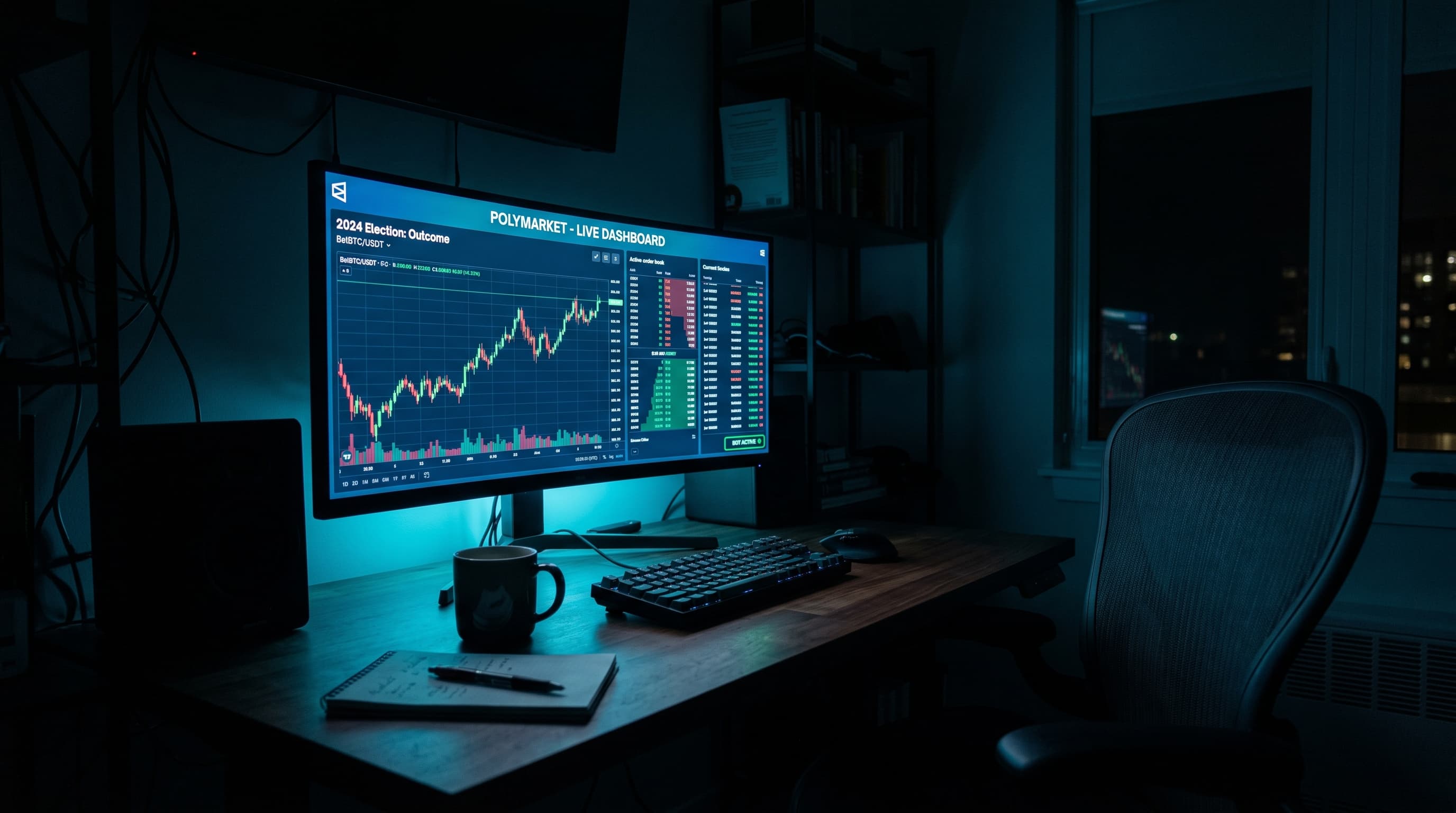
Prediction markets are having a moment. Combined monthly volume on Kalshi and Polymarket jumped from under $5 billion in September 2025 to roughly $24 billion by April 2026, already more than Americans wager through legal sportsbooks (Pew Research Center, 2026). Most of that volume is automated. A review of Polymarket's public leaderboard found that 14 of the 20 most profitable wallets are bots (Finance Magnates, 2026).
Here's the part nobody tells you: those bots only win if they don't quietly die while you're at your day job. A bot that disconnects at 2 a.m. and keeps "trading" against a stale order book isn't set-and-forget. It's a slow-motion loss you'll discover on Saturday.
This guide is about the boring half of automation: the part that keeps a bot alive and bounded for weeks without babysitting. If you've already built a bot (or read our guide to building a Kalshi trading bot), this is how you operate one on 30 minutes a week.
Key Takeaways
- Combined Kalshi + Polymarket volume hit roughly $24B/month by April 2026 (Pew, 2026), and bots now hold 14 of the 20 most profitable Polymarket wallets (Finance Magnates, 2026)
- Only about 3% of alerts need immediate action. Ping every trade and you'll mute the one that matters (incident.io, 2025)
- Knight Capital lost $440M in 45 minutes with no kill switch; a drawdown circuit breaker is the highest-leverage thing you can add (Wikipedia, 2012)
- A 50% drawdown needs a 100% gain just to break even, so bound losses before they compound (TradeZella, 2025)
- Silent WebSocket disconnects, not bad strategies, are the number-one killer of unattended bots, so always reconcile state via REST after reconnecting
The Real Reason Unattended Bots Fail (It's the Plumbing, Not the Strategy)
When a set-and-forget bot blows up, the strategy is rarely the culprit. The plumbing is.
Even the largest venues drop offline. An October 2025 AWS outage degraded Coinbase for 3 hours and 17 minutes (Coinbase, 2025). Ten days earlier, the October 10 crypto crash forcibly closed more than $19 billion in leveraged positions while Binance reported "systems under heavy load" with API failures (CoinGecko, 2025). And even Kraken's WebSocket feed has acknowledged "unexpected disconnections from market data feeds" (Kraken, 2026).
Your bot's job isn't just to be right. It's to notice when it's flying blind and stop.
The set-and-forget reliability stack: A bot you can leave alone for weeks isn't one good script. It's five layers stacked on top of the strategy: (1) anomaly alerts so you hear about problems, (2) automated kill switches so losses stop without you, (3) rebalancing so the bot doesn't drift, (4) health monitoring and auto-reconnect so it stays alive and in sync, and (5) a 30-minute weekly review, the only step that needs a human.
Skip any layer and "unattended" just means "unsupervised while it breaks." The rest of this guide builds the stack from the top down.
Alert on Anomalies, Not Every Trade
Alert on exceptions, not on every trade. The instinct when you deploy your first bot is to pipe every fill to your phone, but that's exactly backwards.
The teams that monitor systems for a living are already drowning. incident.io estimates that organizations field over 2,000 alerts a week, only 3% of which need immediate action, and 85% are false positives (incident.io, 2025). The result of that noise is predictable: 73% of organizations have had an outage tied to an alert someone ignored or suppressed (Splunk State of Observability 2025, via Runframe, 2025).
The same trap snaps shut on traders. A Telegram ping on every fill trains you to mute the channel. Then the one alert that mattered (a drawdown breach, a feed gone silent) arrives in a channel you stopped reading three weeks ago.
The fix is a hard line between logging and alerting. Log everything for your weekly review. Alert only on exceptions a human needs to act on.
In practice, that means alerting on a short list of exceptions and routing everything else to a log file. A free Telegram bot or Discord webhook is all the delivery you need.
# Don't do this — a ping on every fill trains you to ignore the channel
notify(f"Filled {qty} @ {price}")

# Do this — alert only on exceptions a human must act on
if drawdown_pct >= MAX_DRAWDOWN:
    alert(f"🔴 Drawdown {drawdown_pct:.0%} — new entries halted")
if seconds_since_heartbeat > 90:
    alert(f"🔴 Feed silent {seconds_since_heartbeat}s — check connection")
if daily_pnl <= DAILY_LOSS_LIMIT:
    alert(f"🟠 Daily loss limit hit ({daily_pnl}) — flat for the day")
# every routine fill just goes to the log, not your phone

def alert(msg):
    requests.post(DISCORD_WEBHOOK_URL, json={"content": msg})
    # or Telegram: api.telegram.org/bot{TOKEN}/sendMessage
If your phone buzzes, something is wrong. That's the entire point. An alert you trust is one you'll still read in month two.
Build Automated Kill Switches (Circuit Breakers and Regime Detection)
Alerts tell you something broke. Kill switches stop the bleeding while you're asleep.
The canonical lesson is Knight Capital. On August 1, 2012, a runaway algorithm fired millions of unintended orders and lost the firm $440 million in about 45 minutes, and the company effectively ceased to exist days later (Wikipedia, 2012). The takeaway traders drew from it is blunt: nothing automatically halted the misbehaving system in time. The 2010 Flash Crash made the same point at market scale, erasing roughly $1 trillion in value in about 36 minutes and prompting exchanges to install circuit breakers in the first place (Wikipedia, 2010).
You're not trading 397 million shares. But the math of a hole is the same at every size, and it's brutally asymmetric.
A circuit breaker is two tiers of automatic response. A soft tier stops opening new positions but keeps managing what's live. A hard tier flattens everything and halts until you intervene. Wire both to a handful of triggers.
class CircuitBreaker:
    def check(self, state):
        # Tier 1 — soft: stop opening, keep managing existing positions
        if state.drawdown >= 0.10 or state.consecutive_losses >= 5:
            state.allow_new_entries = False
        # Tier 2 — hard: flatten everything and halt
        if state.drawdown >= 0.20 or state.daily_pnl <= DAILY_LOSS_CAP:
            flatten_all_positions()
            state.halted = True
            alert("🔴 Hard stop — positions flattened, bot halted")
The second job of a kill switch is catching a regime shift, the market quietly becoming something different from what you backtested. Strategies decay; a momentum edge that worked in spring can be noise by autumn. You don't need a forecast, just a tripwire that pauses trading when live conditions diverge from the backtest.
# Pause new entries if the live regime stops matching the backtest
if realized_vol > 2 * backtest_vol or rolling_win_rate < 0.5 * backtest_win_rate:
    state.allow_new_entries = False
    alert("🟠 Regime shift — live stats diverging from backtest, pausing")
This is where most "profitable" backtests go to die. For why a clean backtest so often falls apart live, see our breakdown of why backtests lie about prediction market strategies. A regime detector is the runtime insurance policy against an overfit strategy you didn't catch.
Automate Rebalancing and Position Hygiene
Four mechanical rules keep an unattended account clean: re-size by bankroll, cap concentration, clear stale orders, and flatten into resolution. Each one exists because a bot that runs for weeks accumulates mess. Position sizes drift as your bankroll moves, exposure quietly concentrates in one correlated cluster, and orphaned orders pile up at the edge of the book. None of it trips an alert, and all of it bleeds you slowly.
What each rule does in practice:
- Size off current bankroll, not the starting one. Recompute position size from your live balance on every entry. Fixed fractional sizing keeps risk constant as the account grows or shrinks, instead of betting last month's bankroll.
- Cap concentration. Set a ceiling on exposure to any single market or correlated group. If three contracts all key off the same Fed decision, they're one bet, not three.
- Cancel stale orders on a timer. A resting limit order that hasn't filled in an hour is usually a mispriced order in a market that moved. Cancel and re-evaluate rather than leaving it to get picked off.
- Flatten into resolution. Decide in advance whether a position should ride into settlement. If not, close it automatically in the final window. Don't let a forgotten contract resolve against you overnight.
Why hygiene beats heroics: None of these rules is clever. That's the feature. A bot that mechanically re-sizes, caps concentration, and clears stale orders every cycle removes the exact failure modes a distracted human creates. The goal of set-and-forget isn't a smarter bot. It's a bot that can't quietly drift into a position you'd never have taken on purpose.
For the strategy patterns that automate cleanly in the first place, our guide to the five strategy archetypes pairs well with this section.
Keep the Bot Alive: Health Monitoring and WebSocket Recovery
This is the layer nobody writes about and everybody needs. The number-one killer of unattended bots isn't a crash — it's a silent WebSocket disconnect. Long-lived connections drop without raising an error, and your bot keeps acting on a frozen order book it thinks is live.
It's not a bug you can fix once. Random disconnects are normal behavior for persistent connections, which is why even Kraken documents "unexpected disconnections" as a standing operational reality (Kraken, 2026). And the damage is asymmetric: a feed that's dark for ninety seconds can leave a position exposed for hours. You're not a bank with a redundant trading floor. You're one VPS and one socket away from flying blind.
The defense is a reconnect loop that does four things in order, and one of them is the part people forget.
async def run_feed():
    backoff = 1
    while True:
        try:
            ws = await connect(WS_URL)
            await resubscribe(ws)
            reconcile_state_via_rest()   # <-- re-sync positions/orders after any gap
            backoff = 1
            async for msg in heartbeat(ws, timeout=30):
                handle(msg)
        except (Disconnect, Timeout):
            await sleep(backoff)
            backoff = min(backoff * 2, 30)   # 1 → 2 → 4 → 8 → … → 30s cap
Two more pieces finish the layer. Run the bot under a process supervisor (systemd, Docker's restart policy, or a watchdog) so a hard crash restarts it automatically. Then add a dead-man's switch: have the bot ping an external uptime monitor every minute, and if that monitor stops hearing from it for a few minutes, the monitor pages you. That's the only way to catch the failure a dead bot can't report itself.
Your 30-Minute Weekly Check-In
Once the four automated layers are in place, your job shrinks to a weekly review. Not five anxious minutes a day, just one focused half hour. I run it in this order.
- Equity curve vs backtest (2 min). Is live PnL tracking the modeled path, or drifting below it? Divergence is the earliest warning of regime change.
- Drawdown ledger (5 min). Current peak-to-trough, and did any circuit breaker trip this week? A trip isn't a failure; it's the system working. A trip you didn't expect is the thing to investigate.
- Health and reconnect log (5 min). How many disconnects happened, and did each one reconcile cleanly? Repeated drops without clean recovery is a plumbing problem to fix now.
- Fill quality (8 min). Compare slippage to expectations. Flag any fill that immediately went against you, the signature of getting picked off by faster traders.
- Open positions and stale orders (5 min). Anything riding into resolution it shouldn't? Any resting order that's been ignored for days?
- Regime sanity (5 min). Has the market itself changed in volatility, volume, or who's dominant on the book?
What you deliberately ignore matters as much as what you check. Individual winning and losing trades are noise at this altitude. Day-to-day PnL wiggle is noise. If you find yourself opening the dashboard daily, the real problem is usually that your alerting isn't trustworthy yet. Fix the alerts, and the urge to check disappears.
What This Looks Like in Turbine Studio
We built Turbine Studio around exactly this operational layer, because the strategy was never the hard part. Keeping a bot alive, bounded, and honest for weeks is.
The pattern maps onto the product directly. The backtest is a deploy gate: Studio won't push a strategy live until it's run against 30 days of real Kalshi order-book data, so you see win rate, Sharpe, and max drawdown before a dollar is at risk. The kill switches are risk limits you set in plain English, like "add a max daily loss of $100," and the deploy gate stops new entries when a market moves in ways the strategy didn't expect. The health layer is handled for you: bots run 24/7 on an isolated runner managed through Locus, with reconnection and state reconciliation built in rather than hand-rolled.
You don't out-engineer an AWS outage with Turbine. You just stop being the single point of failure: the human who has to be awake, online, and paying attention for the bot to stay safe. You describe the strategy, set the limits, and the operational layer runs underneath it. See Turbine Studio plans.
Frequently Asked Questions
Can I really leave a prediction market bot running for weeks unattended?
Yes, if it has the operational layer this guide describes. The bot placing trades is the easy part. Staying alive, bounded, and in sync with the exchange is what lets you step away. Without kill switches and reconnect logic, "unattended" just means unsupervised while it breaks.
What's the single most important safety feature to add first?
A drawdown circuit breaker. Knight Capital lost $440 million in about 45 minutes in 2012 when no kill switch stopped a misbehaving system (Wikipedia, 2012). One rule prevents the catastrophic outcomes: stop trading at a set drawdown. Everything else is refinement on top of that.
How do I get alerted if my bot silently disconnects?
Use a dead-man's switch. Your bot pings an external uptime monitor every minute; if the monitor stops hearing from it for a few minutes, it pages you. Because a silently disconnected bot believes it's fine, this external check is the only reliable way to catch the failure.
How often should I actually check it?
About 30 minutes a week is enough once the automation is in place. You're reviewing the equity curve, drawdown, reconnect log, and fill quality, not individual trades. If you feel the need to check daily, that's usually a sign your alerting isn't trustworthy yet, not that the bot needs you.
Do I have to code all of this myself?
No. You can build it from scratch (see our Kalshi bot guide) or use a platform that ships it. Tools like Turbine Studio include the backtest gate, plain-English risk limits, and a managed 24/7 runner, so the operational layer is handled rather than hand-built.
The Bottom Line
Set-and-forget automation isn't about a smarter strategy. It's about the boring infrastructure that keeps an ordinary strategy alive and bounded while you're not looking:
- The plumbing fails before the strategy does. Silent disconnects and missing kill switches kill more bots than bad signals.
- Alert on anomalies, not trades. Only about 3% of alerts ever need immediate action (incident.io, 2025), so a per-trade ping channel is one you'll mute.
- A drawdown circuit breaker is the highest-leverage line of code you'll write. A 50% hole needs a 100% climb to fill (TradeZella, 2025).
- Reconcile via REST after every reconnect, or your bot trades on a frozen order book it thinks is live.
- Thirty minutes a week beats five anxious minutes a day. Once the four automated layers run, the human job is just review.
The bots already winning prediction markets aren't being watched around the clock. They're built so they don't need to be. Start with Turbine or wire the layers yourself. Just stop being the reason your bot is only as reliable as your attention span.
This article is for educational purposes only. Prediction market trading involves substantial risk of loss. Past performance does not guarantee future results. Always check current platform rules and applicable regulations in your jurisdiction before trading.