How to Hedge Real-World Risk With Prediction Markets (2026)
 Ryan Bajollari
Businesses already transfer $192B in crop risk and $61B via catastrophe bonds. Here's how to hedge elections, Fed decisions, and weather on prediction markets.

The federal regulator that oversees Kalshi doesn't call event contracts a bet. It calls them a hedge. The CFTC's own explainer says a citrus farmer "might buy a weather event contract to hedge against losses" from a sudden freeze (CFTC, 2026). That's not gambling language. That's risk-transfer language — the same idea behind the $192 billion of crops US farmers insure each year (USDA ERS, 2024) and the $61.3 billion of catastrophe bonds outstanding (Artemis, 2025).
Almost every article about Kalshi and Polymarket — including most of ours — treats them as a place to make money. This one doesn't. It's about using them to lose less when a discrete event goes against your portfolio or your business. Elections, Fed decisions, weather, a regulatory ruling: risks that options and futures price badly or don't price at all. Here's how the hedge actually works, how to size it, and where it breaks.
Key Takeaways
- A hedge isn't a bet — it's insurance. You pay a premium so a position pays off when something bad hits your real exposure, exactly how the CFTC frames event contracts.
- Event contracts beat options for binary outcomes: fixed $0/$1 payoff, max loss known up front, no margin calls — and they exist for risks no listed option references (elections, rate decisions, rulings).
- Size to your loss: buy
L ÷ (1 − p)contracts to recover$Lon the event. Your premium at risk isL · p ÷ (1 − p).- Basis risk is the catch. Settlement, threshold, timing, and payoff-shape mismatches mean the hedge rarely offsets your loss one-for-one.
- Liquidity caps how much you can hedge. Deep election books absorb five-figure orders; niche and weather contracts stay thin.
A Hedge Is Insurance, Not a Bet
Start with the mindset, because it's the opposite of every other post on this blog. A speculator wants positive expected value — they only put on a trade they think pays in the long run. A hedger accepts negative expected value on the hedge itself, on purpose. Why? Because the hedge cancels a risk sitting somewhere else. You're not trying to win. You're trying to make the bad outcome survivable.
That's insurance. And the scale of event-risk transfer that already exists is enormous. US farmers protect $192 billion in crop value through federally subsidized insurance (USDA ERS, 2024). The catastrophe-bond market — Wall Street's tool for transferring hurricane and earthquake risk — hit a record $61.3 billion outstanding at the end of 2025 (Artemis, 2025). Weather derivatives cover billions more (CME Group, 2024).
What prediction markets add is access. A catastrophe bond needs a structuring desk. Crop insurance needs an underwriter. A Kalshi or Polymarket contract needs $1 and a few minutes. The same risk-transfer logic, minus the institutional gatekeeping. If you're new to how these contracts settle, our beginner's guide to prediction markets covers the mechanics; this post assumes you know a YES contract pays $1 if the event happens and $0 if it doesn't.
Why Event Contracts Beat Options for Binary Outcomes
Options are built for continuous risk. A put on the S&P pays more the further the index falls — smooth, sloped, priced off a distribution. That's perfect when your risk is "the market drops." It's clumsy when your risk is a yes-or-no event: did the Fed cut, did the bill pass, did the candidate win. Those outcomes are discrete, and options handle discrete badly.
To get a fixed digital payoff from options, you have to build it — a tight call-or-put spread that approximates a step. The narrower you want the step, the more contracts you need, and the wider the combined bid-ask gets; volatility skew makes the replicating spread cost more than the theoretical digital, too (Quant Next, 2024). You're paying a tax to fake a payoff the event contract gives you natively.
The deciding point: for most real-world events, there's no option at all. No US-listed option references a presidential winner, an FOMC decision, a government shutdown, or an SEC ruling. The underlying isn't a price — it's an outcome. Event contracts exist precisely in the gap where the options market is silent. That's not a marginal advantage. For election, policy, and regulatory risk, it's the only clean instrument that exists.
The structural wins compound. An event contract has a payoff you know cold: max loss is the premium, max gain is the rest of the dollar, both fixed the moment you buy. No Greeks. No delta to re-hedge as conditions move. No margin call, because you pre-fund the whole position. For a treasurer or a portfolio manager who wants protection without a derivatives desk babysitting it, that defined-risk profile is the entire pitch. The trade-off — the binary shape leaves basis risk — comes later in this post.
Sizing a Hedge: How Many Contracts to Buy
The sizing rule is short. If a bad event would cost you $L, and the market prices that event at p dollars per contract, buy:
N = L ÷ (1 − p)
Each YES contract costs p now and pays $1 on the event, so it nets (1 − p) per contract when the event hits. Buy N of them and the payoff is N · (1 − p) = L — exactly your loss. The capital you put up front, and the most you can lose on the hedge, is N · p = L · p ÷ (1 − p).
Make it concrete. A pending regulation would cost your business $100,000 if it passes. The market prices passage at 30¢ — a 30% implied chance. Each contract nets 70¢ on passage, so you buy 100,000 ÷ 0.70 ≈ 142,900 contracts for about $42,900 up front. If the rule passes, the contracts pay $142,900 — a $100,000 gain over cost that offsets the hit. If it doesn't, you forfeit the $42,900. That's the premium for protection you turned out not to need.
Here's the part that makes a prediction-market hedge cheaper than an insurance policy. At a fair market price, the hedge is close to break-even in expectation — your real cost is the trading fee plus the bid-ask spread, not an insurer's 30-to-40% expense load. You're buying protection at roughly fair value from another trader, not at a marked-up premium from a carrier whose margin is baked in. Kalshi's fee runs round up(0.07 × C × p × (1 − p)) per contract (Kalshi, 2026); on our example that's roughly $2,100, about 5% of the premium.
That fee curve has a useful shape for hedgers. It peaks at the 50¢ midpoint and shrinks toward the tails, so cheap, far-from-even protection — buying a 10¢ contract against an unlikely-but-ruinous event — costs the least in fees. It's the prediction-market version of cheap out-of-the-money insurance. We break the full fee math down in the position sizing guide; for hedging, the takeaway is that tail protection is the fee-efficient corner of the board.
The Catch: Basis Risk
A hedge is only as good as how tightly it tracks your actual loss. The gap between the two is basis risk, and a binary contract has more of it than a continuous instrument. Four mismatches cause it.
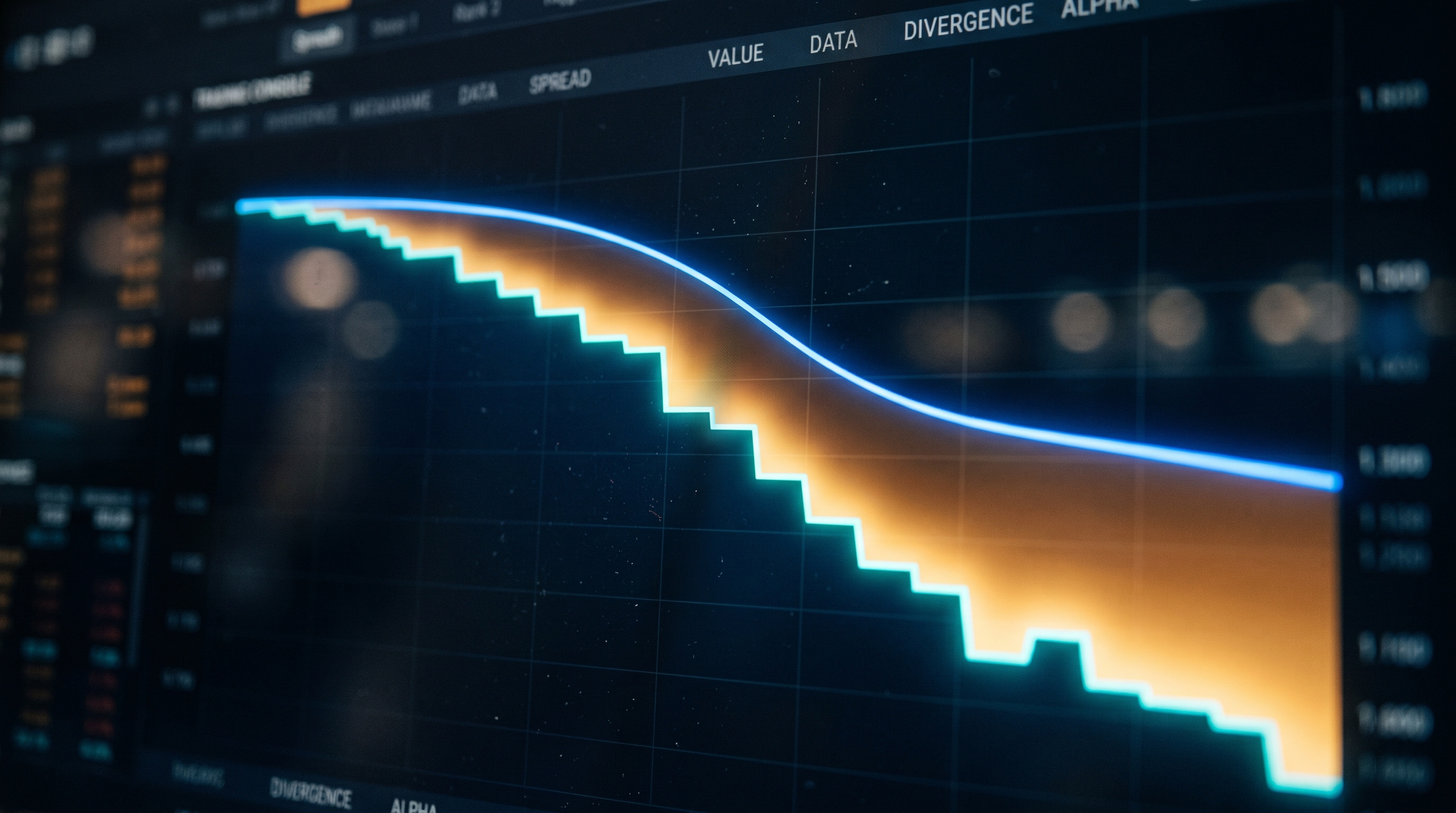
Payoff shape. Your loss may scale with severity; the contract pays a flat amount. If higher rates cost you more the higher they go, a single "Fed holds" contract still pays the same whether they hold once or hike three times. Threshold. A contract that resolves on "a cut of 25 basis points or more" ignores the difference between 25 and 75. Settlement definition. Kalshi's temperature markets settle on a specific National Weather Service station (Kalshi, 2026) — great if your exposure is in that city, leaky if it's 80 miles away. Timing. The contract resolves on a fixed date that may not line up with when you actually book the loss.
How to shrink basis risk. Pick the contract whose resolution criteria most tightly match your loss trigger — same metric, same region, same window. When one threshold can't capture a sloped loss, ladder several: buy contracts at "cut ≥25bps," "≥50bps," and "≥75bps" in proportion to how much each step costs you, and the staircase starts to approximate your actual payoff curve. You'll never zero it out. You're aiming to convert an unhedgeable exposure into a small, known residual.
Four Real-World Hedges You Can Actually Build
Theory is cheap. Here are four exposures traditional markets handle poorly, and the contract that covers each. The pattern is the same every time: identify the event that costs you money, buy the outcome that pays when it happens, size to the loss.
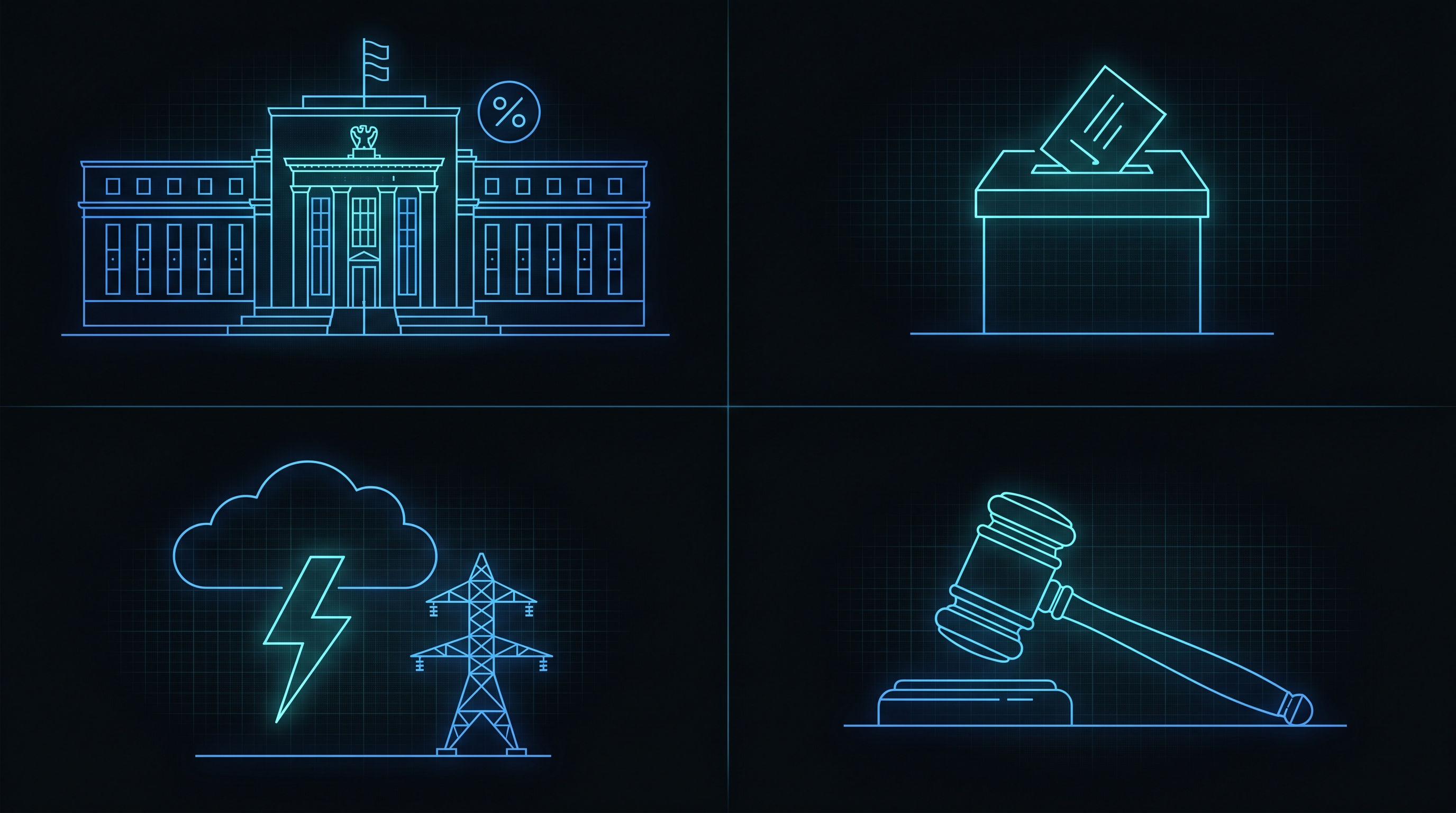
Fed rate decisions. The traditional tool is CME's 30-Day Fed Funds futures — the same contracts behind the FedWatch tool. They work, but one contract carries about $5 million in face value and moves roughly $41.67 per basis point (CME Group, 2025). That's an institutional instrument. Kalshi lists the same question — will the Fed cut at the next meeting — for $1. Ahead of the December 2025 decision, Kalshi's market priced a quarter-point cut at 96%, with about $393 million staked across Kalshi and Polymarket, while FedWatch sat at 87.6% (Stocktwits, 2025). A small business with a floating-rate loan that hurts if the Fed holds can buy "no cut" contracts sized to the extra interest. More on these in our Kalshi economic-events guide.
Election and policy outcomes. This is the purest case, because the alternative is nothing. There's no listed instrument for "Candidate X wins," so businesses proxy it with sector ETFs — a hedge full of market beta and noise. Polymarket's 2024 presidential market traded about $3.69 billion in volume (Polymarket, 2024), deep enough to move real size. A firm whose costs jump under one administration's policy can buy that outcome directly and offset the hit, with none of the ETF's contamination.
Weather and commodity risk. Roughly a third of US GDP — about $3 trillion — is sensitive to weather (NOAA / Dept. of Commerce, 2017), yet the derivatives market that covers it stays mostly OTC and institutional, with the overall weather-risk market estimated as large as $25 billion (CME Group, 2024). Kalshi lists daily-high-temperature, rainfall, and hurricane contracts (Kalshi, 2026). An events company facing a washout or an energy retailer exposed to a warm winter can hedge the specific weather outcome — watching the station-settlement basis risk we covered above. We tested the trading side of these in a New York temperature backtest.
Regulatory and legal events. Again, no traditional instrument exists. When the SEC was deciding on spot Bitcoin ETFs, a Polymarket contract on approval traded near 89% before the agency approved them days later (CoinDesk, 2024). A crypto firm whose revenue depended on the opposite outcome could have bought "not approved" as insurance. The same works for government-shutdown markets, bill passage, and merger approvals — discrete legal events with real P&L attached and no other hedge.
A Word on Capacity and Legality
Two guardrails before you size anything. First, liquidity sets a ceiling. Kalshi's flagship macro and election markets trade at sub-2¢ spreads and absorb five-figure orders with little slippage, but niche and weather contracts carry only four-figure depth (Kalshi, 2026). A very large hedge can move the very price you're trying to lock — a big enough order swings a thin market by tens of percent. Check the book before you assume capacity.
Second, the legal ground is firmer than the headlines suggest. Kalshi is a CFTC-regulated Designated Contract Market, and a 2024 D.C. Circuit ruling let it list US election contracts (Dentons, 2024). Trading volume across Kalshi and Polymarket climbed from under $5 billion a month in September 2025 to about $24 billion by April 2026 (Pew Research, 2026) — the depth a hedger needs is finally there. For the full regulatory picture, see our 2026 regulation rundown.
What This Looks Like in Turbine Studio
[PERSONAL EXPERIENCE] You don't need Turbine to put on a hedge — any Kalshi or Polymarket account does that in a few clicks. Where automation earns its keep is maintaining one. A hedge is rarely set-and-forget: you roll it every FOMC cycle, resize it as your underlying exposure changes, and execute legs across both venues when the best price is split between them. Done by hand, that's a recurring chore that's easy to forget at exactly the wrong time.
We built Turbine Studio as the execution layer for that. The same engine that runs trading bots can hold a standing position, re-enter it on a schedule, and enforce hard caps so a hedge never drifts past the size you set. You can also backtest how a given hedge would have behaved across past events before you commit capital. It's the boring, repeatable maintenance — not the one-time trade — that's worth automating.
Frequently Asked Questions
Can you really hedge risk with prediction markets, or is it just gambling?
You can, and the regulator agrees. The CFTC describes event contracts as a hedging tool, using the example of a farmer buying weather protection against a freeze (CFTC, 2026). A hedge offsets a real exposure you already hold — that's risk transfer, the same function as insurance, not speculation.
How do I size a prediction-market hedge?
Buy N = L ÷ (1 − p) contracts, where L is your potential loss and p is the contract price. Each contract nets (1 − p) on the event, so N of them pay back exactly L. Your premium at risk — the most the hedge can cost — is L · p ÷ (1 − p).
Are event contracts better than options for hedging?
For binary outcomes, usually yes. They have a fixed payoff, a known max loss, and no margin calls. More importantly, no US-listed option references an election, a Fed decision, or a court ruling (Quant Next, 2024) — so for those risks the event contract is the only clean instrument.
What is basis risk in a prediction-market hedge?
It's the gap between the contract's payoff and your actual loss. A binary pays a fixed amount, so if your loss scales with severity, or the contract settles on a different region, threshold, or date than your exposure, the hedge won't offset you one-for-one. Match the resolution criteria closely to shrink it.
How much can I hedge before I move the market?
It depends on the contract. Kalshi's deep macro and election markets absorb five-figure orders at sub-2¢ spreads, but niche and weather contracts hold only four-figure depth (Kalshi, 2026). Large hedges in thin markets move the price against you — check the order book before sizing.
The Bottom Line
The CFTC put it plainly: event contracts let you move real-world risk off your books. For the discrete events that options and futures price badly — or don't price at all — that makes prediction markets the cleanest hedge available to a non-institution.
- Treat it as insurance. Accept negative expected value on the hedge because it cancels a bigger risk elsewhere.
- Size to your loss. Buy
L ÷ (1 − p)contracts; your premium at risk isL · p ÷ (1 − p). - Respect basis risk. Match the contract's metric, region, threshold, and timing to your exposure, and ladder thresholds when the loss is sloped.
- Check capacity. Deep markets absorb size; thin ones move against you.
- Pick binary where binary fits. Defined risk, no margin calls, and an instrument that exists where options don't.
Putting on the hedge is the easy part. Maintaining it — rolling, resizing, executing across venues — is where it slips. Start with Turbine Studio if you want that maintenance automated, or run it by hand. Either way, the next election, rate decision, or storm is already on the calendar. The time to price the hedge is before it is.
This article is for educational purposes only and is not financial, investment, or legal advice. Prediction markets involve substantial risk of loss, and a hedge reduces but does not eliminate that risk. Basis risk means a hedge may not offset your actual exposure. Product availability and legality vary by jurisdiction. Confirm current rules and consult a qualified professional before transferring real risk with these instruments.