How Many Hours Does Automation Actually Save a Kalshi Trader? (A Time-Motion Study)
 Ryan Bajollari
A manual Kalshi routine burns roughly 21.5 hours a week. Automating the same workflow cuts it to about 4. Here's the full task-by-task breakdown, netted.
Kalshi is open 166 of the 168 hours in a week. It closes only for maintenance, 3:00–5:00 AM ET on Thursdays (Kalshi Help Center). You are awake for maybe 112 of those hours, and paying attention for far fewer.
That gap is the entire story.
Most automation content sells you performance. This post sells you time back, and it puts a number on it. Below is a task-by-task accounting of a realistic manual Kalshi week against the same workflow automated. Nobody has published one, so we built it. It's a stated-assumption model rather than a stopwatch observation, and every line is spelled out so you can substitute your own minutes.
Key Takeaways
- A serious part-time manual Kalshi routine costs roughly 21.5 hours a week, and monitoring alone eats 9 of them
- Automating it drops the week to about 4 hours, but only because that 4 hours is the maintenance overhead. Maintenance never hits zero, and any pitch claiming otherwise is selling you something
- Kalshi trades 166 of 168 hours a week (Kalshi). 24/7 isn't a stretch goal; it's where a bot starts
- Bots average 89 trades per active day vs 2.2 for humans, and Bloomberg's analysis found they win by entering earlier at better prices, not by forecasting better (Bloomberg, Apr 2026)
- More screen time doesn't reliably mean more money: households with less market access earned about $400/year more than near-identical neighbors with more (Stanford GSB, 2024)
The Manual Kalshi Week: Where 21.5 Hours Actually Go
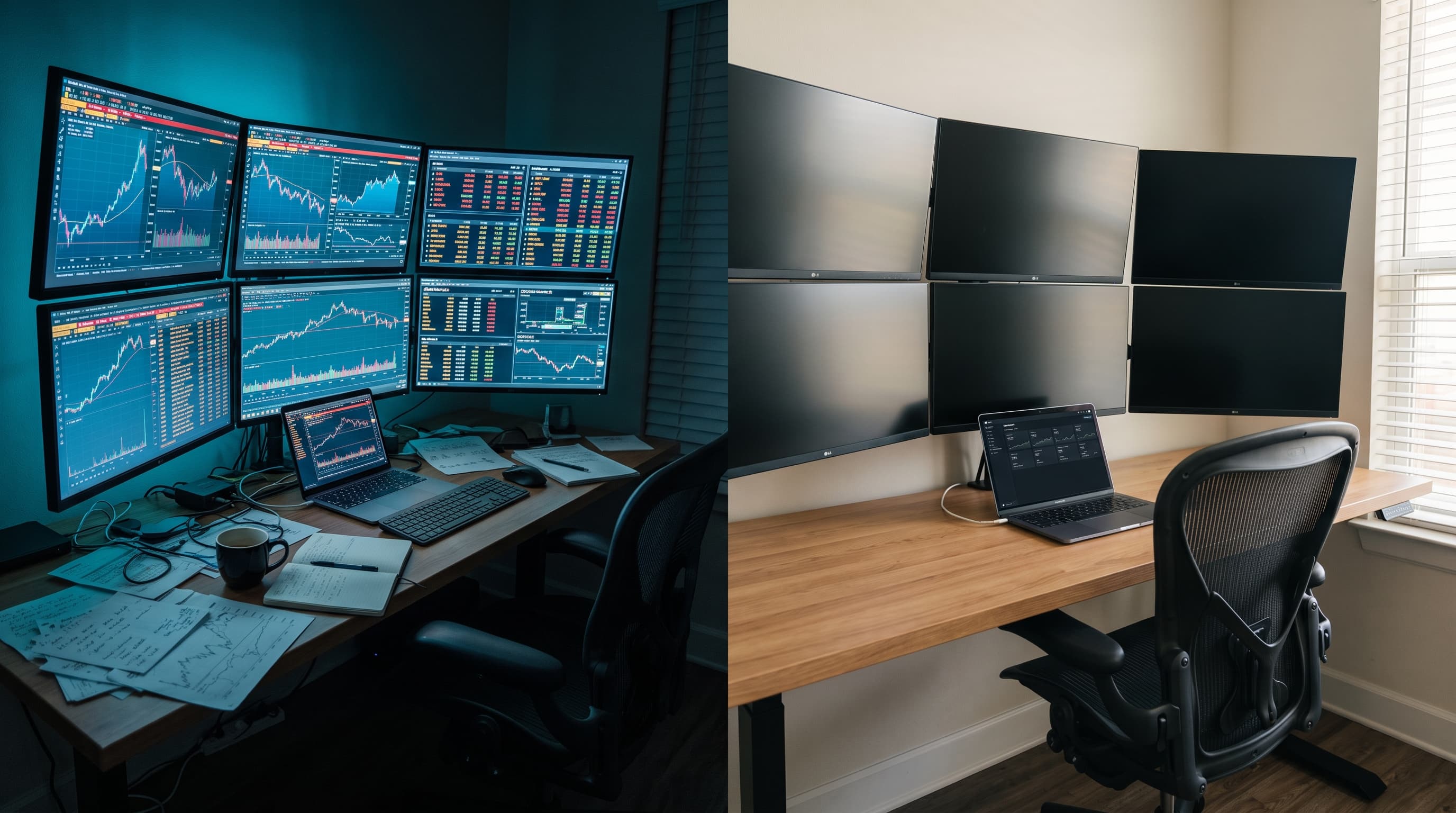
The model describes someone trading Kalshi seriously but part-time: six active days, a handful of concurrent positions, no team.
| Task | Per day | Days | Hours/week |
|---|---|---|---|
| Morning scan, candidate shortlist | 40 min | 6 | 4.0 |
| Live position monitoring | 90 min | 6 | 9.0 |
| Order entry, adjustments, exits | 25 min | 6 | 2.5 |
| News and data checks around events | 20 min | 6 | 2.0 |
| End-of-day reconciliation and journal | 20 min | 6 | 2.0 |
| Weekly review and strategy tinkering | — | — | 2.0 |
| Total | 21.5 |
Notice what dominates. Monitoring is 9 hours, roughly 42% of the week, and it produces nothing on its own. It's the cost of being available in case something happens. Execution, the part that actually moves money, is 2.5 hours. So you're spending three and a half hours watching for every hour you spend acting, which is the ratio automation attacks first.
There's a second cost the table can't hold: ambient attention. The phone checks between meetings, the tab you leave open at dinner. It doesn't show up as hours, but it's the part people actually burn out on.
Price your own time at $50 an hour, and 21.5 hours a week is roughly $56,000 a year. That rate is a placeholder, not a claim. Use yours.
Why Does Kalshi's 166-Hour Week Break a Manual Routine?
Kalshi doesn't sleep, and neither do crypto and hourly contracts that open and resolve overnight. A trader working a generous 10-hour day covers 70 hours a week. That's 42% of the tradable window.
For context on what typical activity looks like: the median Polymarket user made 46 trades over six weeks and was active on just 10 of 42 days (Pew Research Center, Jul 2026). Most people aren't covering 70 hours. They're covering a fraction of that.
The naive fix is to trade more hours. The evidence says don't bother. A natural experiment across 208 US counties on time-zone borders found middle-income households with less convenient market access realized about 3 percentage points more in capital gains — roughly $400 a year more than near-identical neighbors one zone east (Stanford GSB, 2024). The effect didn't show up for wealthier investors.
Grinding more hours isn't the answer. Covering hours you aren't personally present for is.
Decision Fatigue Is Real. The Famous Number Is Wrong.
You'll see the parole-judge study everywhere in automation marketing. Israeli judges granted parole about 65% of the time right after a break, falling to near zero before the next one (Danziger et al., PNAS, 2011). It's a great story. It's also probably overstated.
A later simulation showed a perfectly rational, unbiased judge would produce a drop of comparable magnitude with no depletion at all. Favorable rulings take longer to write, so judges avoid starting them late in a session. Between 15% and 45% of the effect traces to that scheduling artifact, and the original effect size, an odds ratio of 35, is more than twice the conventional threshold for "large" (Glöckner, Judgment and Decision Making, 2016). A PNAS letter added that case ordering wasn't random to begin with (Weinshall-Margel & Shapard, 2011).
So drop the 65%-to-zero line. The direction still holds, and it holds on better evidence.
Sustained-monitoring research finds accuracy declines sharply through roughly the first 30 minutes of a vigilance task, then plateaus (Attention, Perception & Psychophysics, 2026). Ninety minutes of staring at an order book is exactly that task.
The trading-specific evidence is tighter still. In a global experimental asset market, circadian-mismatched traders held the riskier asset in later rounds and mispriced shares more severely (Experimental Economics, 2020). Insufficient sleep measurably degrades intraday financial decisions (Management Science, 2024).
Your 9 monitoring hours aren't 9 equal hours. Hour one and hour nine make different decisions.
The Automated Kalshi Week: About 4 Hours
Same workflow, with rules running the execution layer. The tasks don't vanish. They change shape.
| Task | Manual hrs/wk | Automated hrs/wk | Reclaimed |
|---|---|---|---|
| Scanning and candidate selection | 4.0 | 0 | 4.0 |
| Position monitoring | 9.0 | 0.5 | 8.5 |
| Order entry, adjustments, exits | 2.5 | 0 | 2.5 |
| News and data checks | 2.0 | 0 | 2.0 |
| Reconciliation and journaling | 2.0 | 0 | 2.0 |
| Review, backtesting, iteration | 2.0 | 2.0 | 0 |
| Alert triage | 0 | 0.5 | −0.5 |
| Ops: deploys, key rotation, breakage | 0 | 1.0 | −1.0 |
| Total | 21.5 | 4.0 | 17.5 |
Seventeen and a half hours back. Two full workdays, or roughly $45,000 a year at that same placeholder rate, minus whatever your tooling costs — which for any hosted platform is a rounding error against the hours.
Three lines are worth staring at. Monitoring drops from 9 hours to 0.5, because you're reviewing outcomes instead of watching for events. Execution goes to zero, since rules fire whether or not you're at the desk. And two new lines appear, triage and ops, which is the honest part most automation pitches leave out.
Backtesting is the line that holds steady at 2 hours, and that's deliberate. It's the one task manual traders systematically underinvest in, and the one automation makes worth doing.
One reconciliation, since it looks like a contradiction: our set-and-forget guide puts the ongoing job at a 30-minute weekly check-in. That's the 0.5-hour review line here. The other 3.5 hours are backtesting, triage, and ops, which that post treats as build-time rather than upkeep. Same workflow, different accounting boundary.
Does Automation Really Give the Time Back?
Almost every automation pitch quotes gross savings. Net is what you live with, and net looks worse.
A survey of 6,000 digital workers found 11 hours a week saved through AI tooling, against 6.5 hours a week spent managing it. More than a third of AI sessions failed outright (Glean Work AI Index via CIO Dive, Jun 2026). That's a 59% clawback. Worth noting the source: Glean sells AI tooling, so if anything the number is generous to automation. The measured economy-wide figure is more sober still, with generative AI users saving 5.4% of their work hours, about 2.2 hours in a 40-hour week (Federal Reserve Bank of St. Louis, Feb 2025).
So why does the trading model above show a 19% clawback instead of 59%? Same arithmetic, different inputs: 4 hours of management against 21.5 hours of work handed off.
Because monitoring an order book is far more mechanizable than open-ended knowledge work. The rules are explicit, the inputs are structured, and "did the price cross 62 cents" needs no judgment. Nothing has to be checked for tone or hallucination.
That advantage evaporates if you hand-roll everything. Build your own bot and you own reconnect logic, state reconciliation, key rotation, and deploys. Expect the overhead line to land much closer to Glean's ratio.
The numbers that follow are our own build estimates, not survey data, so treat them as order-of-magnitude. Hand-rolled, budget 8 to 10 hours a week of upkeep before things stabilize. Setup on a platform that ships the operational layer runs 10 to 20 hours and pays back in about a week; hand-built, it's more like 60 to 80 hours and a month, assuming nothing breaks.
Something will break.
Bots Don't Win Because They're Smarter. They Win Because They're Early.
This is the finding most coverage skips. Since the start of 2025, the typical bot averaged 89 trades per active day against 2.2 for non-bots. High-volume bot accounts netted $131 million, concentrated in 823 users clearing $100k or more. And the mechanism was entering earlier at better prices, not forecasting more accurately (Bloomberg, Apr 2026).
Read that as a scheduling problem, not an intelligence problem. Bots aren't beating you at analysis. They're beating you at being there — which is precisely the thing a manual routine can't scale.
The outcome data supports the reframing. A WSJ review of 1.6 million accounts found 0.1% of Polymarket accounts captured 67% of all profits, with over 70% of users losing money. In the same reporting, a Kalshi spokesperson put the platform's own ratio at 2.9 unprofitable users for every profitable one (WSJ via Benzinga, May 2026).
Effort alone doesn't fix that. Pew found 11% of Polymarket accounts placed 1,000+ trades in six weeks — and that hyperactive cohort typically lost about $140 (Pew Research Center, Jul 2026).
One caveat worth stating, since automation content loves to overreach: the old "nearly all equity returns are earned overnight" claim is out of date. The 2:00–3:00 AM ET hour once drove over 60% of the S&P E-mini's return, but has averaged roughly zero since 2021 (NY Fed Liberty Street Economics, Jul 2026). The case for overnight coverage on Kalshi is structural — 166 tradable hours, contracts that open and resolve while you sleep — not borrowed from equities.
What This Looks Like in Turbine Studio
We built Turbine Studio around the 4-hour column, not the 21.5-hour one.
Look at which rows of that table it attacks. Scanning, execution, and reconciliation go to zero, because you describe a strategy in plain English and it compiles into rules that fire without you. Risk limits are written the same way. "Stop trading at a $100 daily loss" holds at 3 a.m. whether or not you're awake.
The ops row is the one that matters most. That's the hour that eats hand-rolled builds alive, and it stays an hour instead of eight, because the runner is managed rather than yours to babysit.
Backtesting stays yours. It's the row where your judgment earns something, and it's the whole trade this post is arguing for: less watching, more testing.
If you'd rather build it yourself, our Kalshi bot guide walks the whole path. Just budget the hours honestly.
Frequently Asked Questions
How many hours a week does automating Kalshi trading actually save?
In the task model above, about 17.5 hours: a 21.5-hour manual week drops to roughly 4. The savings come almost entirely from monitoring, which falls from 9 hours to 0.5. Execution goes to zero. Backtesting time holds steady.
Does automation eliminate the work or just move it?
It moves a lot of it. Workers report saving 11 hours a week to AI tooling while spending 6.5 managing it (CIO Dive, 2026). Trading automates more cleanly than open-ended work, but the maintenance line never hits zero.
Is 24/7 coverage really worth it on Kalshi?
Structurally, yes. Kalshi trades 166 of 168 hours a week (Kalshi), and crypto and hourly contracts open and resolve overnight. Bloomberg found bots win by entering earlier at better prices, which is an availability edge rather than an analytical one.
Won't I just make worse decisions if I'm not watching?
Probably the opposite. Vigilance research shows monitoring accuracy degrades within about 30 minutes (Attention, Perception & Psychophysics, 2026), and middle-income households with less market access earned about $400/year more than closer-matched neighbors (Stanford GSB, 2024).
How long before automation pays back the setup time?
On a platform that ships the ops layer, setup runs 10 to 20 hours and pays back in roughly a week at 17.5 hours saved. Hand-built, budget 60 to 80 hours and about a month. Test in paper trading before either clock starts.
The Bottom Line
Automation's honest pitch isn't a better forecast. It's a smaller week:
- Monitoring is the whole cost. Nine of the 21.5 hours produce nothing directly, and that's the line automation actually deletes. Scanning and execution follow it to zero. Everything else in the table is rounding.
- 166 hours beat 70. No manual schedule covers Kalshi's window, and bots win by being early, not smarter (Bloomberg, 2026).
- Budget net, not gross. Four hours a week on a managed platform; eight to ten hand-rolled.
- More screen time isn't more money. Hyperactive traders with 1,000+ trades typically lost about $140 (Pew, 2026).
- Skip the parole-judge stat. The direction holds. The famous magnitude doesn't (Glöckner, 2016).
Run your own minutes through the table. If your total lands anywhere near 21.5, the question isn't whether automation improves your edge. It's what you'd do with two workdays back. Start with Turbine Studio.
This post is for informational purposes only and is not investment advice. Prediction market trading involves risk of loss. The time models presented here are stated assumptions built from a representative task list, not measured survey data — substitute your own figures. Past performance and backtested results don't guarantee future outcomes.