What Is an Automated Prediction Market Trading Bot? How They Work (2026)
 Ryan Bajollari
5% of bot-like wallets drive 75% of Polymarket volume. Learn what an automated prediction market trading bot is, its five parts, four types, and limits.
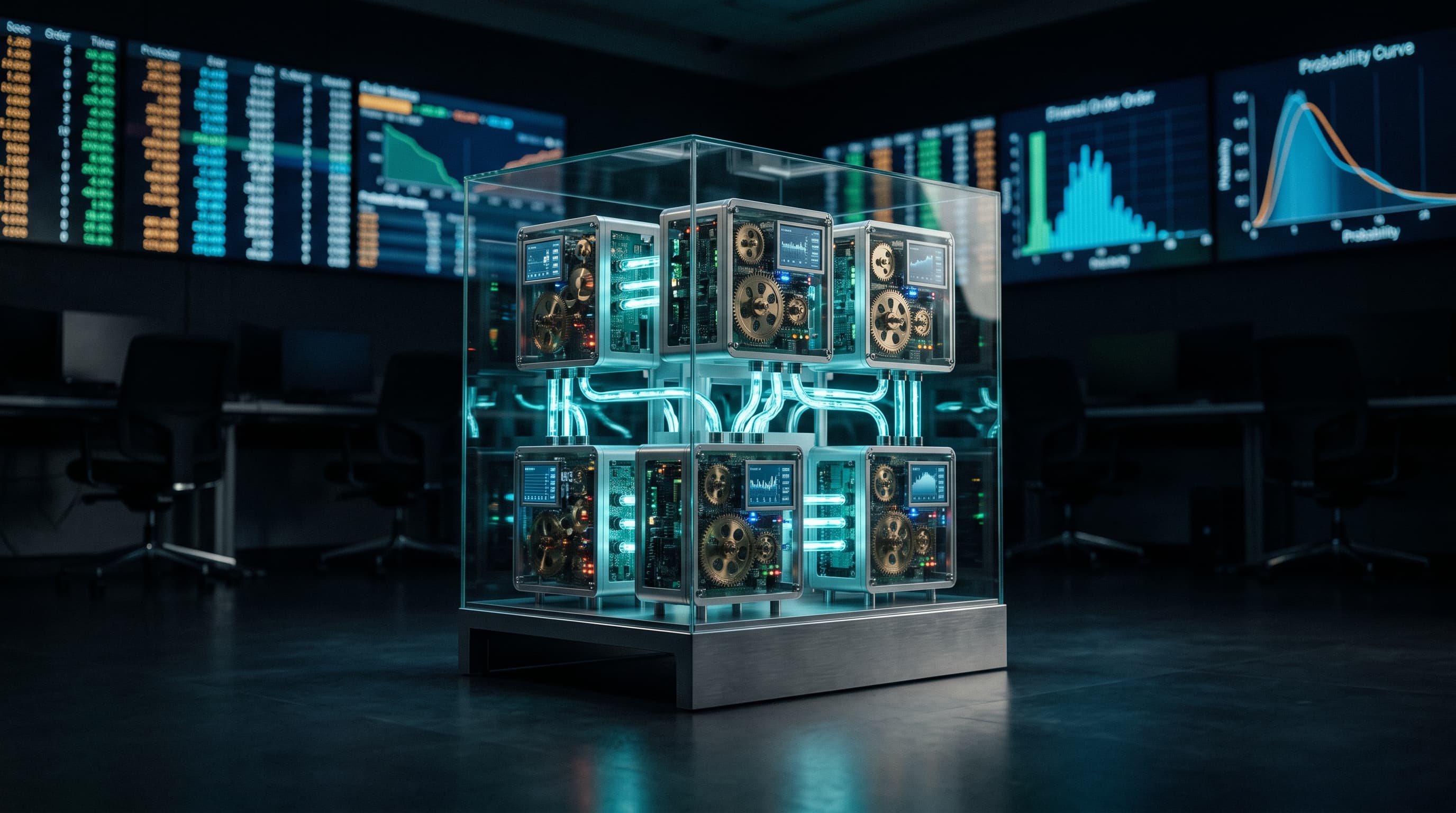
An automated prediction market trading bot is a program that trades event contracts on exchanges like Kalshi and Polymarket without a person placing each order. It pulls live market data, decides when a price looks wrong, and sizes the trade inside preset risk limits. Then it sends orders through the exchange's API and manages the position until it exits or settles.
That's the whole definition. What makes it matter in 2026 is who's already on the other side of your trades. A Bloomberg analysis found that roughly 5% of bot-like wallets generated 75% of Polymarket's trading volume (BeInCrypto, citing Bloomberg, 2026).
Kalshi accounts are private, so we sampled a week of its public trade feed instead. About 75% of the trades happened outside weekday business hours. A trader who's only active at their desk sees about a quarter of the trades.
Key Takeaways
- A bot is a five-step loop: data, signal, sizing, execution, monitoring
- Four types dominate: arbitrage, market-making, model/LLM-based, and copy trading
- Bots beat people on coverage, speed, and consistency, not judgment
- 75% of the Kalshi trades we sampled landed outside weekday 9-to-5 hours
What a Prediction Market Trading Bot Actually Does
Kalshi recorded $37.17 billion in trading volume in August 2026, and Kalshi plus Polymarket together cleared $45.33 billion (The Block, 2026). In September 2025, combined monthly volume was under $5 billion (Pew Research Center, 2026). Markets that size run on software.
A bot does what a manual trader does. It watches prices, forms a view, places orders, and tracks what it owns. The difference is that every one of those steps is written down as code and runs on a server, whether or not you're awake.
If prediction markets themselves are new to you, start with what prediction markets are and how contracts pay out. The short version: each contract trades between 1¢ and 99¢ and settles at $1 or $0. The price reads as the market's probability that the event happens.
How it differs from a crypto trading bot
Most "trading bot" content online is about crypto price bots. Prediction market bots look similar from the outside, but they're solving a different problem.
| Crypto price bot | Prediction market bot | |
|---|---|---|
| What it trades | An asset's price direction | The probability an event happens |
| Price range | Unbounded | 1¢ to 99¢, settling at $0 or $1 |
| Typical inputs | Charts, momentum, order flow | Data about the event: forecasts, polls, spot prices, scores |
| Deadline | None; positions can run forever | Every contract expires and settles |
| Hidden risk | Volatility and liquidation | Resolution rules and thin order books |
The deadline changes the design more than anything else. Every position has a known end, so exits and settlement are part of the bot from day one. And because prices are capped, edge is measured in cents of probability, not in percent moves.
The practical upshot: a crypto bot asks "where is the price going?" A prediction market bot asks "is this price the right probability?" The second question has an answer that arrives on a known date. That makes these bots unusually easy to grade, and unusually hard to fool yourself with.
How a Prediction Market Bot Works: Five Parts in a Loop
On Kalshi's Basic API tier, a bot gets 200 read tokens and 100 write tokens per second, and most requests cost 10 tokens. The top Prestige tier allows 10,000 read tokens a second (Kalshi Docs, 2026). At Basic, that's about 20 reads a second. The budget shapes the whole architecture, starting with how the bot gets its data.
Every bot, from a 50-line script to a fund's trading system, runs the same loop. It repeats until the market closes or you switch it off.

1. Market data: REST for snapshots, WebSocket for changes
A bot needs two kinds of data. There's exchange data: prices, order books, trades, and its own fills. Then there's outside data about the event itself, like a weather model, a Bitcoin spot feed, or a live score.
Exchange data arrives two ways. REST calls fetch a snapshot on request, such as the market list, contract terms, or your balance. WebSocket streams push changes as they happen. Kalshi's WebSocket offers channels including orderbook_delta, ticker, trade, fill, market_positions, and user_orders (Kalshi Docs, 2026). Polymarket splits its stream into a market channel for book updates (Polymarket Docs, 2026) and a user channel for your own orders (Polymarket Docs, 2026).
In practice, a bot makes a handful of REST calls at startup and then lives on the stream. Polling twenty order books a second over REST would spend Kalshi's entire Basic read budget. Larger traders can go further. Kalshi gives FIX protocol access by default to members on its Premier tier and above (Kalshi Docs, 2026).
The outside data is usually where the edge lives. We've argued before that your edge is the data you wire in, not a clever formula.
2. Signal: is this price wrong?
The signal is the bot's opinion. It compares a fair probability, from a model, a rule, or another market, against the price on screen. Say your model puts a weather contract at 62% and the YES ask is 55¢. That's seven points of gross edge.
Gross edge isn't profit. The signal has to clear the spread and the fee. Kalshi's taker fee is 0.07 × P × (1−P) per contract, which peaks at 1.75¢ at a 50¢ price before rounding up to the cent (Bürgi, Deng & Whelan, 2026). Polymarket uses the same shape, C × feeRate × p × (1−p), with a rate set by category (Polymarket Docs, 2026).
What goes into the signal is a strategy question, not a bot question. Five strategy archetypes covers the assumption families behind signals, from mean reversion to news reaction, and how each one breaks.
3. Sizing and risk limits: how much, and when to stop
Sizing turns "this is mispriced" into "buy 40 contracts." Risk limits decide when the bot isn't allowed to trade at all. A bot without hard limits isn't automated trading. It's an unattended liability.
| Limit | What it prevents |
|---|---|
| Max size per order | One bad signal becoming one huge loss |
| Max position per market | Piling into a single event as the price moves against you |
| Max total exposure | Many small positions adding up to an oversized bet |
| Daily loss limit | A broken model trading all day before anyone notices |
| Kill switch | Everything else; a single flag that halts all new orders |
Many bots size with a fraction of the Kelly criterion, a formula that scales bet size to edge and odds, because edge estimates are noisy. Our guide to position sizing and risk management walks through the math and the failure modes.
4. Order execution: turning a decision into a fill
Execution picks the order type and sends it. Polymarket supports good-til-cancelled (GTC), good-til-date (GTD), fill-or-kill (FOK), and fill-and-kill (FAK) orders. It also offers a post-only option and batches of up to 15 orders (Polymarket Docs, 2026). Its order endpoint allows bursts of 5,000 requests per 10 seconds (Polymarket Docs, 2026).
Kalshi works along the same lines. In the Kalshi order templates Turbine runs, the time-in-force values we actually use are good-till-canceled and immediate-or-cancel, plus a post-only flag for resting quotes.
The big choice is maker or taker. A taker order crosses the spread and fills now, paying the fee. A maker order rests on the book at your price and waits. Automated traders lean hard toward the second. CFTC staff studying 30 futures markets found automated orders "are almost always limit orders" (CFTC, 2019).
5. Monitoring and exits: until the contract settles
Once orders are out, the bot has to know what it actually owns. A sent order might rest, fill in pieces, or get canceled at close. So good bots count positions from fill messages and regularly compare them with the exchange's own position feed.
Then comes the exit. There are four common ones: a take-profit price, a stop-loss, a time-based exit before resolution, or holding to settlement. Kalshi's fee schedule lists no settlement fee, so holding a winner to expiry costs nothing extra (Kalshi Fee Schedule, as filed with the CFTC, 2022). When an early exit makes sense is its own topic, covered in timing trades around Kalshi resolution windows.
Each of the five parts is well documented on its own. Most live failures happen in the handoffs between them, which we map in the Kalshi automation stack.
The Four Types of Prediction Market Bots
Arbitrage bots extracted an estimated $40 million in profit on Polymarket between April 2024 and April 2025, according to researchers at IMDEA Networks (Saguillo et al., arXiv, 2025). That's one bot type. Most bots in the wild fall into four families, sorted by where their edge comes from.
| Bot type | Where the edge comes from | Speed needed | Main risk |
|---|---|---|---|
| Arbitrage | Prices that don't add up | Very high | One leg fills, the other doesn't |
| Market-making | Spread plus exchange incentives | High | Getting filled by better-informed traders |
| Model / LLM-based | A better probability estimate | Low to medium | The model is wrong, or already priced in |
| Copy trading | Someone else's edge | Medium | Entering late, without their context |
Arbitrage bots
Arbitrage bots hunt prices that can't all be right at once. Inside one venue, that means a YES and a NO that together cost less than $1, or a multi-outcome event whose prices sum below $1. Across venues, it means the same event priced differently on Kalshi and Polymarket.
The IMDEA figure is Polymarket-only. It counts single markets that don't add up, plus related markets on the same venue that contradict each other. Two things limit arbitrage in practice. Windows close fast, because the competition is other bots. And "the same event" isn't always the same contract, since resolution wording can differ between venues. Read how prediction markets resolve before trusting a cross-venue spread, then how to automate cross-platform arbitrage.
Market-making bots
Market makers post a bid and an ask at the same time and earn the spread when both sides fill. Both big venues pay them to do it. Kalshi's Liquidity Incentive Program pays $1 to $1,000 per market, per day for qualifying resting orders, sampled once per second, whether or not they fill (Kalshi Help Center, 2026). The program runs through January 1, 2027.
Polymarket instead hands makers a share of taker fees: 20% in crypto markets, 25% in most categories, and 15% in sports, paid daily (Polymarket Docs, 2026).
The catch is adverse selection. Your quote fills most often right when someone knows more than you do. That's the subject of why prediction market trades get picked off. For the mechanics, see how to market-make on Kalshi and Polymarket.
Model and LLM-based bots
Model bots estimate their own probability and trade the gap. The model can be a weather ensemble, a statistical model on crypto spot prices, or a large language model reading news and resolution rules. This is the type most people picture when they hear "AI trading bot."
The evidence on LLMs is moving quickly. In January 2026, the best model on ForecastBench posted a Brier score of 0.102 against 0.085 for human superforecasters (Forecasting Research Institute, 2026). A July 2026 update found several models "statistically indistinguishable from superforecaster-level accuracy" (Forecasting Research Institute, 2026).
The more useful number comes from trading, not forecasting. Prophet Arena scored models on 1,367 Kalshi events. The best one, GPT-5R, scored 0.184 against the market's own 0.187, a gap inside the paper's error bars. In other words, it matched the market. But the best average return any model posted was 0.943 per dollar, a loss (Prophet Arena, arXiv, 2025).
Being slightly more accurate than the price is not an edge. A model that matches the market's accuracy, or edges it by 0.003 Brier points, can still lose money, as every model in Prophet Arena did. The trades that pay are the ones where the model disagrees with the price by a lot, and is right. A good model bot trades rarely and passes on most markets.
We made the broader case for AI traders in why AI agents are the best prediction market traders. The benchmark data says the same thing with a caveat: the model is the easy half.
Copy-trading bots
Copy-trading bots mirror another trader's positions. This works on Polymarket because its trades settle on a public blockchain, so every wallet's history is visible.
Kalshi is different. When we pulled its public trade feed, each trade carried a ticker, price, size, and taker side, but no account identifier. There's no wallet to follow, so copy trading is mostly a Polymarket strategy.
The case for copying is how concentrated the winners are. On Polymarket politics markets, 0.55% of profitable maker wallets captured half of all gains, and 0.26% of winning taker wallets took nearly the same share (CoinDesk, citing Solidus Labs, 2026).
Concentration has a flip side, though. Your copy fills after theirs, at a worse price. Many top wallets are market makers, so their positions are inventory, not opinions. And you can't see what they've hedged elsewhere. We compare the tradeoffs in copy trading vs. custom strategy bots.
What Bots Do Better Than People
In a study of 1,469 adults, the mean simple reaction time to a visual signal was 231 milliseconds, or 213 ms after correcting for hardware delay (Woods et al., via PubMed Central, 2015). That's just noticing a light. Reading a headline, deciding, and clicking take far longer. Bots don't win on judgment. They win on three structural things.
24/7 coverage
Prediction markets don't close at 5 p.m. To see how much that matters, we sampled Kalshi's public trade feed across every hour of August 31 to September 6, 2026, a week with no US holidays. For each hour, we pulled three windows of 1,000 trades and measured how many seconds each window spanned. That gives a trades-per-hour estimate for all 168 hours of the week.
Only 25% of the week's trades happened on weekdays between 9 a.m. and 5 p.m. ET. More than one in five came between midnight and 8 a.m. ET. Weekends carried 32% of trades, more than their 29% share of the clock. Hour for hour, evenings were busiest of all.
We ran the same sample on the following week, September 7–13, which included Labor Day. Business hours came out at 24% of trades, nearly identical. The pattern isn't a one-week fluke.
We also counted one hour in full: Sunday night football, 11 p.m. to midnight ET on September 13, when Kalshi's feed printed 583,159 trades. At the other extreme, the quietest hour of the clean week, 5 to 6 a.m. ET on Monday, August 31, still ran an estimated 133,000. Our sampling runs low, so the true number is likely higher.
The telling part: weekday business hours are 40 of the week's 168 hours, or 24% of the clock. They carried 25% of the trades. Kalshi trades roughly as if office hours don't exist. A bot is the only kind of trader that doesn't keep them either.
A note on method: these are sampled estimates, so treat them as shares, not totals, and we assume the sampling error is similar from hour to hour. In the one hour we also counted in full, the estimate came in about 25% low on raw count. The absolute numbers are rough; the shape of the week held across both weeks we sampled.
Reaction speed
A bot's decision runs in code on a server. Its bottleneck is the network round trip to the exchange, not a thumb on a trackpad. When a score changes or a Bitcoin price crosses a strike, the bot has usually acted before a person has finished reading.
Speed matters a lot for some bots and barely at all for others. Arbitrage and market-making live and die on it. A model bot trading tomorrow's high temperature can take a full minute and lose nothing. That's why arbitrage is a latency race and weather trading usually isn't.
Discipline
People are bad at longshots. A University College Dublin study of Kalshi found that buyers of contracts under 10¢ lose over 60% of their money, and the average contract returns about −20% before fees (Bürgi, Deng & Whelan, 2026). The longshot bias was stronger among takers, the traders who cross the spread to get in now.
A bot buys a 6¢ contract only if its rule says to. It doesn't revenge-trade after a loss. It doesn't skip the stop because it "has a feeling." It checks at 3 a.m. exactly the way it checks at noon.
Discipline cuts both ways. A bot executes a bad rule just as faithfully as a good one, thousands of times, without doubting it. That's why testing comes before deploying. Why backtests lie covers the traps that make a bad rule look good on paper.
What Bots Can't Do: Limits and Risks
Bots aren't a shortcut to profit. More than 100,000 Polymarket accounts have recorded losses of at least $1,000 since January 2025, per the same Bloomberg analysis (BeInCrypto, citing Bloomberg, 2026).
The competition is already automated. A CNBC analysis found that bots made up more than 80% of volume in Polymarket markets under $10,000 (BeInCrypto, citing CNBC, 2026). The same analysis found more than 45,000 markets, close to 5% of the total, with no reported volume at all.
A bot can't fix any of these for you:
- A strategy without edge. Automation scales whatever the rule does, including losing money.
- Thin markets. A signal on a market nobody's quoting can't be filled at any sensible price.
- Resolution surprises. The contract settles on its written rules, not on what the headline implied.
- Silent technical failure. Position drift, stale data, and expired API keys don't announce themselves.
- Key security. A bot holds credentials that can trade your account. Read how to keep your bot and funds secure.
- Regulatory change. The CFTC issued a prediction-markets advisory in March 2026 (CFTC, 2026), and venue rules keep moving.
How to Get Started With a Prediction Market Bot
There are three ways to run one. You can code it yourself against the Kalshi or Polymarket API. You can subscribe to a copy-trading tool. Or you can use a platform that handles the plumbing while you define the strategy. The hard way vs. the easy way compares the first and last honestly.
Whichever path you pick, the promotion order is the same:
- Backtest on historical order-book data, with fees and realistic fills. How to backtest prediction market strategies shows how.
- Paper trade against live prices to test the plumbing. Here's what paper trading can and can't prove.
- Go live small, with every risk limit from the table above switched on.
If you want to write the code, start with how to build a Kalshi trading bot or how to build a Polymarket trading bot.
Build Your First Bot in Turbine Studio
Most of a working bot is plumbing: data streams, order management, fill reconciliation, risk limits, and exits. That plumbing is the same for everyone. The signal is the part that's actually yours.
Turbine Studio lets you describe a strategy in plain English, backtest it on historical Kalshi and Polymarket order-book data, and deploy it with risk limits built in. You spend your time on the signal, not the WebSocket reconnect logic.
Frequently Asked Questions
What is an automated prediction market trading bot?
It's software that trades event contracts on venues like Kalshi or Polymarket by rule, without manual clicks. It reads market data, finds prices it thinks are wrong, sizes trades within risk limits, places orders via API, and manages positions to exit or settlement. About 5% of bot-like wallets drive roughly 75% of Polymarket volume.
Are prediction market trading bots legal?
Automated trading is generally allowed on major venues. Kalshi, a CFTC-regulated exchange, publishes API rate-limit tiers up to 10,000 read tokens per second and offers FIX access to Premier members. Polymarket documents its order API openly. Always check each venue's current terms and your local rules. This isn't legal advice.
Does a prediction market bot hold my funds or API keys?
It depends on the setup. A self-hosted bot keeps your API key on your own server, so its security is yours to manage. Hosted platforms store your credentials to trade for you. Funds stay in your exchange account either way. Treat any key that can trade as a password, and limit its permissions.
Do prediction market bots actually make money?
Some do, most don't. Profits are concentrated: 0.55% of profitable maker wallets took half of gains in Polymarket politics markets. In the Prophet Arena benchmark, the best AI model matched the market on accuracy but still averaged 0.943 per dollar staked. Edge, not automation, decides the result.
How fast does a prediction market bot need to be?
That depends on the type. Arbitrage and market-making bots compete on speed, because other bots close the same windows. Model bots trading slower markets, like daily weather or monthly CPI, can take seconds or minutes. Human visual reaction time alone averages about 231 milliseconds, before any decision.
The Takeaways
- A bot is a loop, not a script. Data, signal, sizing, execution, and monitoring run until settlement. The handoffs between them fail silently.
- Know which of the four types you're building. Arbitrage and market-making need speed. Model bots need genuine edge. Copy bots need the right fraction of 1% of wallets.
- Accuracy isn't profit. The best AI model in Prophet Arena matched the Kalshi market's accuracy and still lost money.
- Markets don't keep office hours. 75% of the Kalshi trades we sampled happened outside weekday 9-to-5, and more than one in five came between midnight and 8 a.m. ET.
- Test before you trust. A bot executes a bad rule perfectly. Backtest, paper trade, then go live small.
When you're ready to run one, start with our overview of automated trading bots for prediction markets.
This article is for informational and educational purposes only. It is not investment, legal, or tax advice, and nothing here recommends trading any specific contract. Prediction market trading involves risk of loss, and automated trading can lose money faster than manual trading. Kalshi trade data was sampled from its public API for August 31–September 6, 2026, cross-checked against September 7–13, and reflects those weeks only. Rate limits, fees, incentive programs, and exchange rules change; verify current terms with each venue before trading.